
Limp Bizkit
The heartbeat that arrived eleven days late
By Rebobinados · Published on September 17, 2026
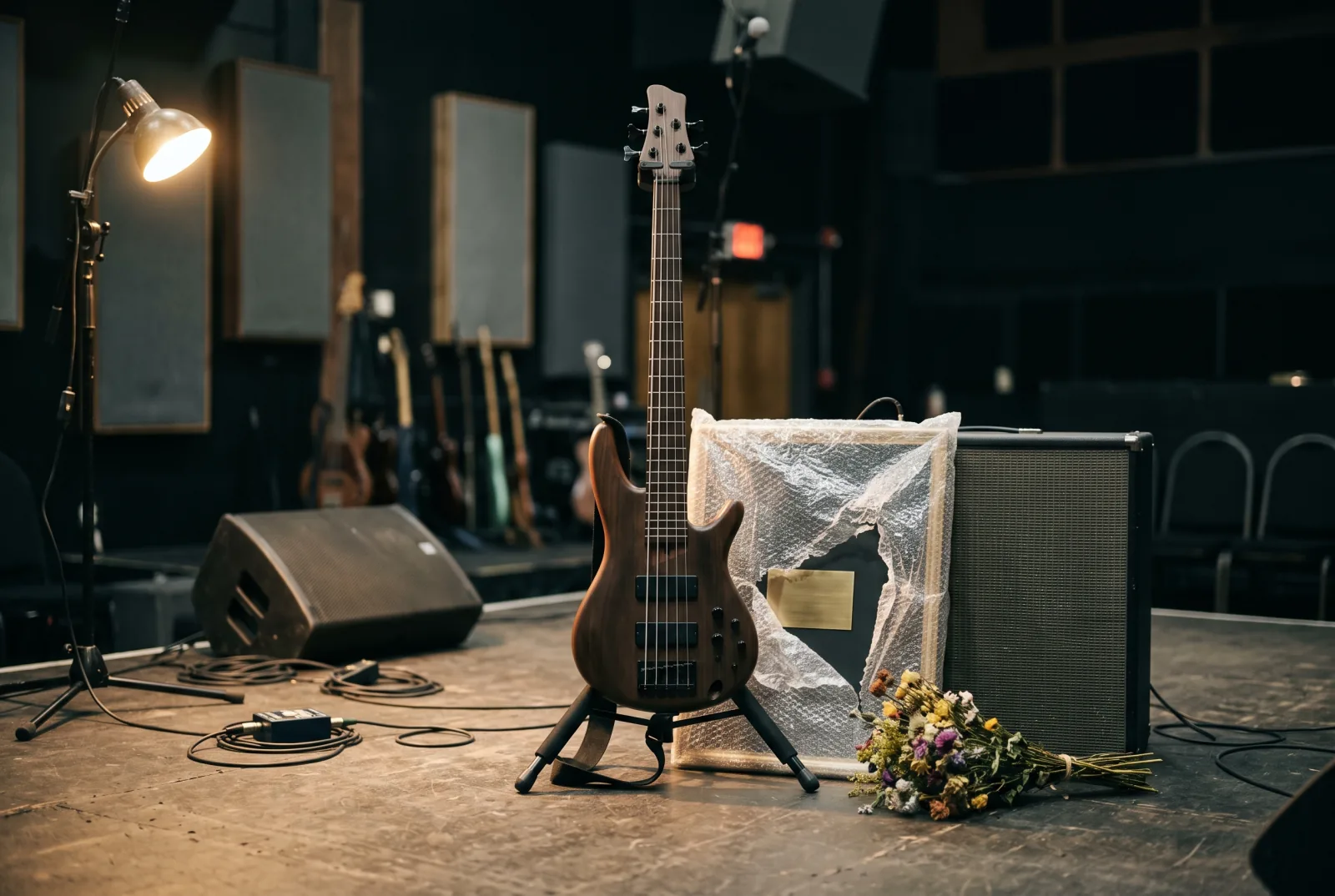
Ilustración: Rebobinados
There are bands the critics adored and the public forgot, and there are bands where it went exactly the other way. Limp Bizkit is the second kind, and proudly so. The awards never wanted them, the singles charts never quite let them in, and they filled stadiums anyway, sold a million records in a week and gave a whole generation's anger a soundtrack. They did not need anyone to anoint them. They had something better: a crowd that knew every shout by heart, and a bass that was the heart of the whole thing.
That bass was played by Sam Rivers. And he has to come first.
Sam Rivers, the heartbeat
Sam Rivers founded Limp Bizkit in 1994, in Jacksonville, with Fred Durst and John Otto, a friend from high school. He played bass on every one of the band's records, without exception. He was not the one standing at the front or appearing in magazines, and for that very reason he was the one holding the whole thing up from underneath.
Wes Borland, the guitarist, put it better than anyone once he was gone: that losing him was like losing a piece of his own DNA, that Sam was not a replaceable person, that he was the heartbeat. In a band that made its name on noise and fury, the guitarist reached for a word from the body to name the bassist. Heartbeat. The thing that keeps everything else alive.
Rivers died on 18 October 2025, at his home in Florida, aged forty-eight. His last time on a stage had been eight weeks earlier, at a British festival. He went out playing.
The fight he had already won
Years before he had fought another one, and he told it himself without dressing it up. In 2015 he left the band with a liver disease caused by drinking too much. He had a transplant, recovered, and in 2018 picked the bass back up. Three years away, fighting to stay alive, and back to the heartbeat.
Something is worth saying about that return: not everyone who steps down for a reason like that steps back up. Sam did, and played for another seven years. The last note he left recorded is from a month before he died.
What the fans knew and the industry did not
Here is what makes his story more than an obituary. "Break Stuff" came out in 2000 and at the time did not even enter the main American singles chart. It was, and still is, the band's most shouted anthem: the song you reach for when the day was rubbish and something has to break. Millions of people used it for exactly that for twenty-five years.
Twenty-five. That is the number that matters. In October 2025 the song finally reached number one on the country's hard rock chart. It passed a billion streams. In the United Kingdom it was certified double platinum.
And it arrived eleven days after the death of the man who played bass on it.
This was not the industry discovering them late. It was people, all at once, going back to "Break Stuff" to see Sam off the only way a crowd knows how: by carrying it to the top. The heartbeat stopped and millions of people put the song on so it would keep sounding. No academy signed that number one. The audience signed it, in mourning.
What they were never given, and why it did not matter
The context is worth adding, because it enlarges the above rather than shrinking it. Limp Bizkit sold more than a million copies of "Chocolate Starfish and the Hot Dog Flavored Water" in its first week, in 2000: the biggest rock album debut in the United States since these things have been measured by scanner. With a phenomenon like that behind them, they never once had a top forty single. Three Grammy nominations, none won. And the only single the American industry ever certified them for is "Behind Blue Eyes", a cover of The Who written by Pete Townshend. Neither "Break Stuff" nor "Rollin'", their two anthems, carries the stamp.
Read that twice. The band that moved millions has no certification for either of its anthems, but does have one for a cover of someone else's song. It is almost comic, and it says everything about the distance between what the industry rewards and what people sing. Limp Bizkit always lived on the people's side. Over there they never went short.
They carry on
The band carries on. Since late 2025, the live bass has been covered by a musician from the support act, with no official appointment, like someone who does not quite dare fill that seat all the way. And Sam managed to leave one last thing: he is credited as co-writer of the group's latest single, released a month before he died, the one that gave them their first number one on a Billboard chart since 1999. He left a number one on the table on his way out.
Borland, in 2026, said the band feels as big as when they started, or bigger. Coming from someone who had just lost his heartbeat, that is not a marketing line. It is what you say when the one who left kept the heart running.
What to remember
Limp Bizkit never mattered much to the industry, and the industry never mattered much to Limp Bizkit. It makes no difference. They sold a million records in seven days, gathered a billion listens on their anthem and handed half a generation the exact song for bad days. And when Sam Rivers died, the quiet bassist Borland called the heartbeat, people did the only thing they could: they played "Break Stuff" until it went, twenty-five years late, to number one.
Remember it this way: the prizes always reached Limp Bizkit late, and the highest crown arrived eleven days late. But no academy sent it. It was sent by the ones who had been shouting the song from the start, seeing off the man who held it up from underneath.
This text mentions an illness arising from alcohol use. If you or someone you know is struggling with alcohol or drug use, in Chile SENDA's Drugs and Alcohol helpline answers free of charge 24 hours a day on 1412.
Sources
Limp Bizkit, an American band formed in Jacksonville, Florida, in 1994 by Fred Durst (vocals), Sam Rivers (bass) and John Otto (drums), joined by Wes Borland (guitar) and DJ Lethal (turntables) in 1996. Samuel Robert Rivers, born 2 September 1977, died on 18 October 2025 in St. Johns County, Florida, aged forty-eight; the cause was not made public, although the police report of the incident describes a cardiac arrest. Rivers had left the band in 2015 with a liver disease associated with alcohol use, received a liver transplant and rejoined in 2018; his last performance was on 24 August 2025 at the Leeds Festival. "Break Stuff" (2000) did not enter the Billboard Hot 100 and reached number one on Billboard's Hot Hard Rock Songs chart in the week of 29 October 2025, eleven days after Rivers's death; that month it passed a billion streams on Spotify and in August 2026 it was certified double platinum by the British BPI. "Chocolate Starfish and the Hot Dog Flavored Water" sold 1,054,511 copies in its first week in October 2000, the biggest rock album debut in the United States since Nielsen SoundScan measurement began in 1991. The band has never reached the top 40 of the Billboard Hot 100; its best position is number 65 for "Rollin' (Air Raid Vehicle)", a number one in the United Kingdom. It has three Grammy nominations and no wins; its only RIAA single certification is for "Behind Blue Eyes", a cover of The Who written by Pete Townshend, certified gold on 26 January 2005. At the February 2026 Grammy ceremony Rivers did not appear in the televised in memoriam segment — in which Brent Hinds, of Mastodon, was also absent — although he does appear on the award's official page; the coverage that pointed this out noted that the broadcast used wide shots, and the Recording Academy did not comment. Since 29 November 2025 the live bass has been played by Richie Buxton, of Ecca Vandal, with no official membership announced. Rivers is credited as co-writer of the single "Making Love to Morgan Wallen", released on 12 September 2025, which gave the group its first number one on a Billboard songs chart since 1999. The Who have their own profile in this series, and Limp Bizkit have another. A Rebobinados rewrite of previously verified research; interpretations of the meaning of their work are offered as the author's reading. No song lyrics are reproduced, for copyright reasons. Information drawn from Wikipedia, Billboard, RIAA, BPI, Rolling Stone, Variety, CNN, NPR, Consequence, Loudwire and other coverage.
Keep rewinding
10s
metal
Bring Me the Horizon
Twenty years to get back to the scream
Bring Me the Horizon started in 2006 with a deathcore record and their turn did not happen in 2013: the leap to metalcore was in September 2008 and the synthesisers and clean vocals arrived in October 2010. Jordan Fish, eleven years in the band, was the one who put in the electronics. On 10 July 2026 they re-recorded that first record for its twentieth anniversary, with Oli Sykes back on the guttural scream.
00s
metal
Staind
The sleeve that nearly cost them everything
In October 1997, Fred Durst tried to pull Staind off the bill at the Webster Theatre in Hartford over the sleeve of their home-made record; then he listened to them and signed them. In 2001, Break the Cycle debuted at number one on the Billboard 200 and "It's Been Awhile" spent sixteen weeks at number one on the Modern Rock. Jon Wysocki, founding drummer, died on 18 May 2024.
90s
metal
Marilyn Manson
The lawsuit he withdrew while paying
The triad of Antichrist Superstar, Mechanical Animals and Holy Wood, and a file that is still open: two out-of-court settlements, one sworn retraction, the prosecutor's office that ruled out charges in January 2025 on statute-of-limitations grounds, the defamation suit he withdrew while paying 327,000 dollars and a jury trial set for November 2027.
Rewind with us
Comments · 0
No one has commented yet. Open the conversation.