
Los Bravos
Sounding like they weren't Spanish
By Rebobinados · Published on September 6, 2026
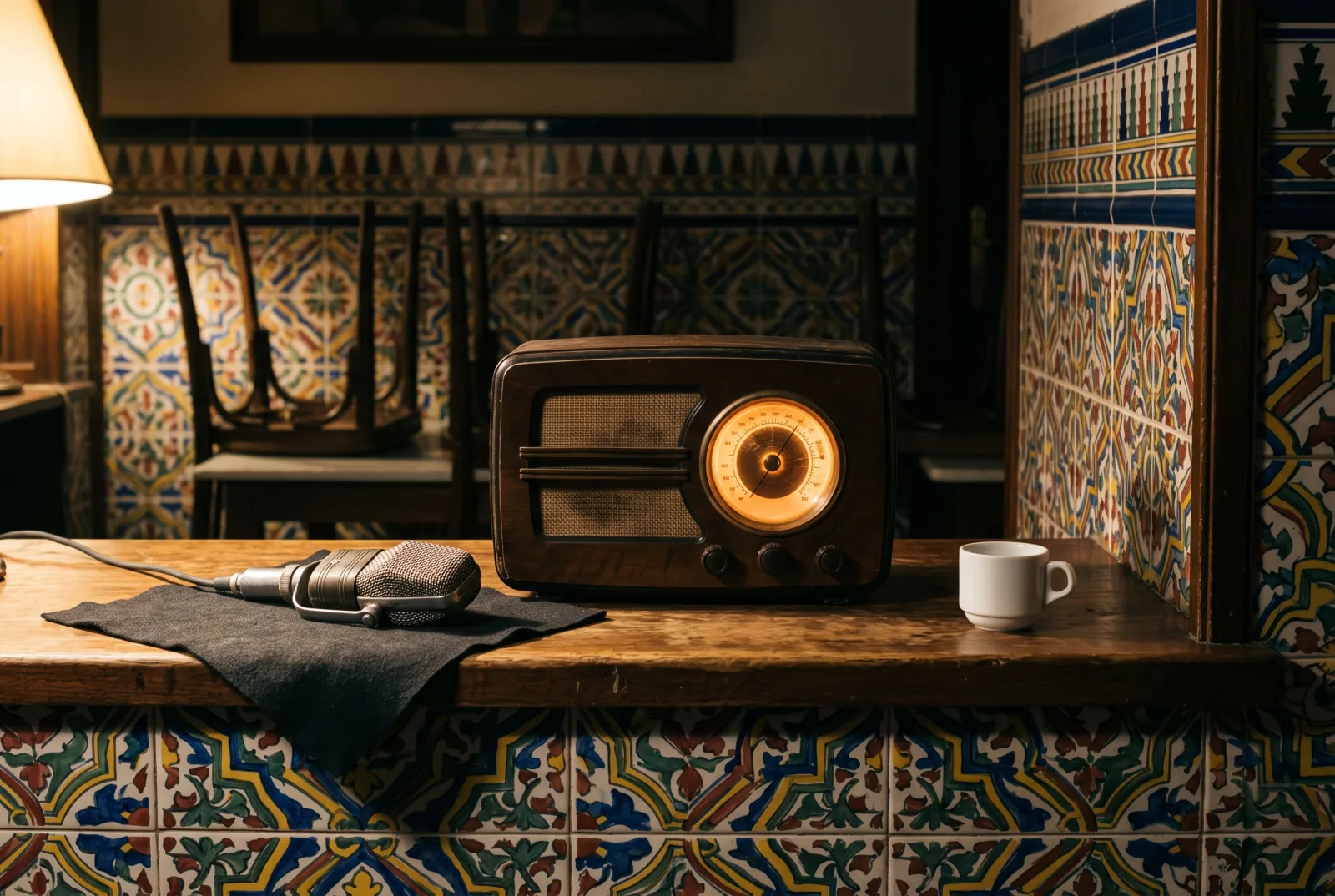
Ilustración: Rebobinados
In 1966, a band formed in Madrid broke into the American top ten.
It had never happened before. It would not happen again for a long time.
The song was called "Black Is Black", and the story usually told about it is the story of a Spanish triumph. The real story is a good deal stranger, and a good deal more interesting.
A Spanish band, a German singer, an English song
Los Bravos came together in Madrid in 1965, out of the merger of two groups: Los Sonor, from Madrid, and Mike & the Runaways, from Mallorca.
The singer came from the second one. He called himself Mike Kennedy, but his name was Michael Volker Kogel and he had been born in Berlin.
They did not write "Black Is Black". It was signed by three Britons — Tony Hayes, Steve Wadey and Michelle Grainger — and recorded in London with the English producer Ivor Raymonde.
And there is the detail that almost never gets told: for union rules and for speed, Raymonde used British session musicians. Of Los Bravos, on the record that made them famous, there is Kogel's voice and little else.
A Spanish band, with a German singer, singing in English a song by English writers, played by English musicians.
What had to be erased to get in
Put like that, it sounds like a swindle. It is not. It is something else, and sadder.
In the sixties, a song that sounded Spanish did not get onto the radio in London or in New York. It was not even up for discussion: it did not get in. Pop was a club with the door shut, and Spain was outside by definition.
Los Bravos did the only thing that worked: sound as though they were not from Spain. Sing in English, record in London, copy the air of the British bands of the moment until nobody could tell the difference.
It worked. "Black Is Black" reached number two in the United Kingdom and number four on the American Billboard chart, sold more than a million copies, and in Canada it went to number one — the first Spanish band ever to manage it.
It is worth being precise, because the story tends to grow in the telling: they were not number one in London or in New York. Second and fourth. Which was already, for a band out of Franco's Spain, a feat without precedent.
The price of the passport
What is left is an uncomfortable question, and this piece is not going to settle it.
If getting let in means singing in another language, with someone else's songs and someone else's musicians, how much of the triumph is yours?
The honest answer is: the part that mattered at the time. Los Bravos proved it could be done. That a band based in Madrid could be on the charts of half the world, that the ceiling was not made of concrete but of habit.
They were not a one-hit band: "I Don't Care" reached sixteen in Britain, and "Bring a Little Lovin'" put them back on the American charts in 1968.
But the one that counts is the first, because it opened the door that those who came after would walk through, by then singing in Spanish.
What to remember
Los Bravos are the clearest example of what it cost to get out of Spain making popular music.
Put on "Black Is Black" and you will hear a terrific song, with a low, urgent voice that sounded like nothing else being made here at the time. And you will hear, too, a perfect disguise.
The feat was not conquering the world. It was getting into a place where people from your country were not let in, even if getting there meant looking as though you came from somewhere else.
Remember them like this: not as the Spaniards who made it in English, but as the ones who proved the ceiling was there, and broke it at the only point where it could be broken.
Sources
Los Bravos, a band formed in Madrid in 1965 from the merger of Los Sonor (Madrid) and Mike & the Runaways (Mallorca). Their singer, Mike Kennedy, real name Michael Volker Kogel, was born in Berlin on 25 April 1944 and is still alive. "Black Is Black" (1966) was written by the Britons Tony Hayes, Steve Wadey and Michelle Grainger, and recorded in London with the producer Ivor Raymonde; for union and production reasons British session musicians were used, so that the band's contribution was mainly Kogel's voice. The single reached number two on the UK Singles Chart (July 1966), number four on the Billboard Hot 100 (October 1966) and number one in Canada, where they were the first Spanish band to top the chart; it sold more than a million copies. Other singles with international impact: "I Don't Care" (number sixteen in the United Kingdom) and "Bring a Little Lovin'" (number fifty-one in the United States, 1968). It should be made clear, since the opposite is often repeated, that the band did not reach number one in the United Kingdom or in the United States. Externally authored text, edited and verified for Rebobinados. Interpretations of the meaning of their work are offered as the author's reading. No song lyrics are reproduced, for copyright reasons. Information drawn from Wikipedia, the Official Charts Company, Billboard and other coverage.
Keep rewinding

10s
pop
Bruno Mars
Eleven names in the credits
"Uptown Funk" came out on 10 November 2014 with six writers and today it has eleven. In February 2015 The Gap Band's publisher filed a claim over "Oops Up Side Your Head" in YouTube's copyright system —there was never a lawsuit— and on 28 April five names were added, with 17 % of the publishing. It happened weeks after the "Blurred Lines" verdict, and the song had been fourteen weeks at number one.

00s
pop
André Rieu
It was not from the jazz suite
The waltz with which André Rieu reached half the world is not from Shostakovich's Suite for Jazz Orchestra No. 2: it is from the Suite for Variety Orchestra, which the composer did not assemble, and it was born in 1956 as music for a Soviet film about settlers in Kazakhstan. The error comes from a misprint in volume 10 of the complete works (Muzyka, Moscow, 1984), corrected only in 2001. And the title "The Second Waltz" was invented by his wife, because the real one did not sell.

90s
pop
Daniela Mercury
She took the neighbourhood out of the song
"O Canto da Cidade" was written by Tote Gira, a composer from Nordeste de Amaralina who recorded the demo on a borrowed cassette, marking the beat on the door of a refrigerator; Mercury's team almost threw the tape away. She shares the credit because she deleted the references to the Pelourinho so that the song would serve all of Brazil. The album, from 20 September 1992, sold more than 2 million copies and nationalised axé. But she did not invent it: the name was a journalist's insult in 1987.
Rewind with us
Comments · 0
No one has commented yet. Open the conversation.