
Decade 80s · Rhythm progresivo
Los Jaivas: The Progressive Rock That Spoke to the Land
By Rebobinados · Published on July 29, 2026
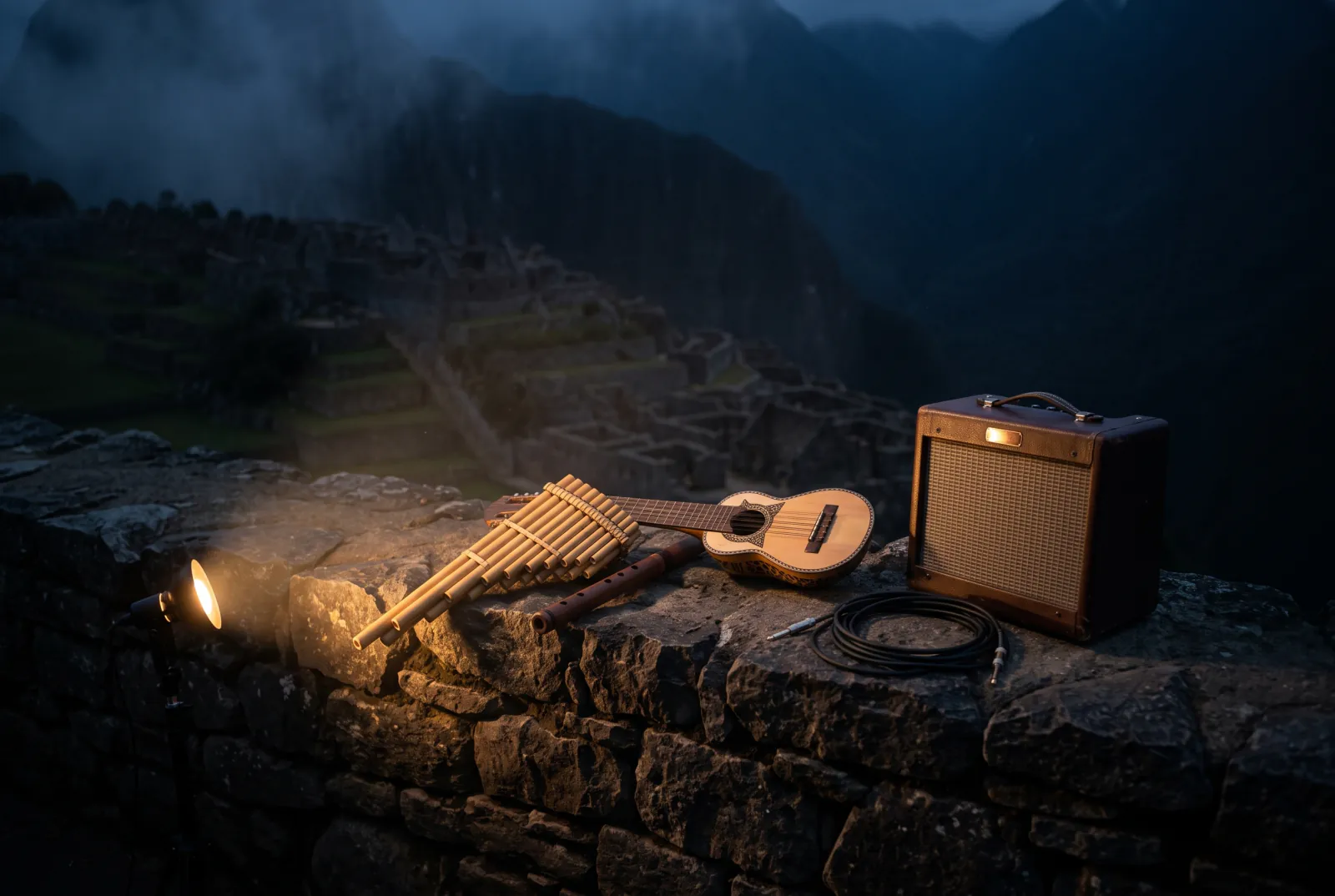
Ilustración: Rebobinados
When the world talks about progressive rock, it always looks at the same map. England, with King Crimson, Yes and Genesis. At most, as exotic colour, Italian prog or German Krautrock. Latin America does not appear. It is as if the ambition to turn rock into high art had been a privilege of the northern hemisphere, something that down here, in the south of the world, never quite happened.
It is false. And the most emphatic proof that it is false was born in Viña del Mar in 1963, was first called The High & Bass and later, hispanicised, Los Jaivas. Because Los Jaivas did not make a peripheral or imitative version of English prog. They made something no London band could ever have made: a progressive rock with a root of its own, founded not on Bach and European jazz but on the quena, the zampoña, the Mapuche trutruca and the voice of Pablo Neruda. They gave rock's most ambitious genre something the English, deep down, lacked: a land beneath their feet.
This is the account of that feat. Of how a family band, almost a commune, took prog's grammar and made it speak in American. And of how, in 1981 and from exile, it produced one of the most perfect conceptual works the genre has given in any language.
Are they really progressive rock? Yes, and of the finest kind
Let us start by answering the direct question, because it is sometimes doubted: are Los Jaivas progressive rock, or are they "folklore" with electric guitars?
They are progressive rock, without the slightest doubt, and they are so for the right reasons —the same ones that define any band in the genre, which we break down in What Progressive Rock Is (and Isn't). They have the structural ambition: long suites developing in movements rather than verse-chorus songs. They have the virtuosity: every member is a formidable instrumentalist, capable of extended solos and sophisticated instrumental dialogue. They have the fusion with art music: their works converse with the structures of classical composition and with major poetry. They have the concept album: works conceived as a unified whole around an idea. And they have prog's essential will, the one that defines it above all else: that rock should be serious, ambitious art, worthy of the symphony and the poem.
Critics gave them a beautiful and precise label: progressive Andean rock, or Latin American fusion. And there lies the key to why they are a special case. English prog fused rock with the European classical tradition —an art music they admired, but which was not theirs by blood. Los Jaivas fused rock with the music of their own ancestors: indigenous rhythms, Andean instruments, the folk forms of their continent. Their fusion was not a learned loan; it was a return to the root. And that, far from making them less prog, makes them a deeper, more grounded prog, more authentically fused with its source.
The road: from university parties to the avant-garde
Los Jaivas were not born progressive. Like almost every great band in the genre, they got there by evolution, pushing little by little at the limits of what they did.
They formed in 1963 in Viña del Mar, on the coast of Valparaíso, around the Parra brothers —Claudio, Eduardo and Gabriel— together with Mario Mutis and the charismatic Eduardo "Gato" Alquinta. The original name, The High & Bass, played on the height differences between the brothers. In that first stage they were students playing covers of fashionable music to liven up university parties, with modest success. Nothing announced what was coming.
The turn came with the sixties and seventies, in the middle of a cultural and political ferment —university reform, the Americanist movement, the search for a Latin American identity of its own. Los Jaivas began composing their own music, and that music grew steadily more ambitious and more deeply rooted in the Andean. Their first mature phase —"El Volantín" (1971), "Todos Juntos" (1972), the soundtrack to Raúl Ruiz's film "Palomita Blanca" (1973)— was profoundly Chilean and experimental, with long improvisations of avant-garde spirit.
And then the story split in two. After the 1973 coup, the band left Chile: first Argentina, then France. Everything that follows —including their masterpiece— was made far from the land they were singing about. It is worth keeping in mind, because it changes the meaning of everything: when Los Jaivas set the Andes to music, they did it from a manor house outside Paris, unable to return.
With "Los Sueños de América" (1974), "El Indio" (1975) and "Canción del Sur" (1977), the band gained decisively in virtuosity and took on ever more marked shades of progressive rock, fused with Andean folklore and the popular music of the continent. They were no longer just a fusion band: they were a progressive band with an identity of their own, sharpening the tools for what would become their masterwork. "Alturas de Macchu Picchu" was not an accident or an isolated flash of inspiration. It was the culmination of a road more than a decade long.
"Alturas de Macchu Picchu": the masterwork
In October 1981 came the record that would make them immortal, and which is, in its own right, one of the great concept albums in the history of progressive rock, in any language and from any country.
The idea arrived from outside and at exactly the right moment. In December 1980, Peruvian producer Daniel Camino Diez Canseco turned up at Les Glycines, the manor house outside Paris where the band was living, and proposed a Latin American cantata on the poetry of Pablo Neruda: setting to music "Alturas de Macchu Picchu", the central section of his monumental "Canto General", published in 1950. Camino insisted, additionally offered to shoot a film in the Inca ruins themselves, and ended up producing the record. Los Jaivas took the idea and made it their own. Turning one of the summits of Latin American poetry into music: that was the ambition. Pure prog ambition, of the highest order.
The result is a concept album in the fullest sense of the term. It is not a collection of songs: it is a unified work following the thread of Neruda's poem, with its meditation on the Inca ruins, the legacy of indigenous peoples and the sweat of the slaves who built the citadel. In September 1981, before release, a television special was filmed at the ruins themselves, directed by Reinaldo Sepúlveda and produced by Chile's Canal 13 together with Radio Televisión Peruana —the band playing their work on the very stage that inspired it, an image that became iconic.
Musically, it gathers every marker of prog with nothing missing or spare. The most expansive piece, "La Poderosa Muerte", runs eleven minutes and is one of the most perfect combinations ever achieved between Latin American rhythms and rock: it begins with Gabriel Parra's Mapuche trutrucas, joined by Claudio's piano, Gato Alquinta's Andean quena, Eduardo's Minimoog, and Mario Mutis's drums and bass, and across its length it chains together extracts of marches, cuecas and progressive rock, linked by extended solos of electric guitar, piano and synthesiser. It is a suite in prog's most classical sense, only its materials are American.
The rest of the record sustains that altitude. "Águila Sideral" evokes an eagle's flight over the Andean peaks with drum rolls, masterful quenas and a powerful electric bass line, in clearly progressive shades. "Amor Americano" is a northern trote in a rock key. "Sube a Nacer Conmigo Hermano" sings the poem's solidarity in a Venezuelan joropo rhythm. "Antigua América" is a squarely progressive instrumental that lets each musician show off his instrument with precision and mastery. And "Final" closes like a coda with classical-music shades. A record that is at once Chilean, Peruvian and Latin American —a work of continental brotherhood made by a band that could not set foot in its own country.
Listen to it whole, from beginning to end, the way you listen to a symphony or read a book. Because that is how it was conceived, and that is how it reveals its greatness. It is not a record of loose songs for the radio. It is a work.
A band inherited the way blood is inherited
There is a dimension to Los Jaivas that transcends the musical and that is perhaps the most moving thing about their story. And it touches, without setting out to, one of the deepest subjects there is: transmission, inheritance, what passes from one generation to the next.
Los Jaivas were always more than a band: they were a family and almost a commune. The Parra brothers at their core, living for years in a kind of hippie-spirited community, with music as a way of life rather than a trade. And that family condition had an extraordinary consequence when death began taking its share. As original members died —Gabriel Parra in an accident in 1988, the unforgettable Gato Alquinta in 2003— the band neither dissolved nor hired outside replacements: it was the musicians' own children who took their fathers' places, keeping the family spirit and the continuity of the work alive.
Think about it. A band where prog is literally passed from parents to children, where the legacy is not a metaphor but a succession of blood. The children taking up their fathers' instruments so the music keeps sounding. It is the purest image of what it means to inherit something true: not an object, but a way of being in the world, a craft, a devotion. Few bands in rock history embody so literally the idea that what we love can outlive us if someone in the next generation decides to take it up and carry on. More than sixty years of activity, held together by that chain.
Why they matter beyond Chile
It is easy, from Chile, to love Los Jaivas for reasons of identity —they are ours, they sang our land, they set Neruda to music. And that closeness is legitimate and beautiful. But it would be unfair to reduce them to a local pride, because their importance is greater and more universal.
Los Jaivas matter because they proved something the official story of progressive rock refuses to admit: that the genre's ambition was not the first world's property. That the dream of making rock a high art, capable of a symphony's density and a poem's depth, also flowered in the south of the world —and flowered better in one precise sense, because here the fusion was not with an art music admired from afar but with the band's own ancestral root, alive and present. English prog looked to Europe seeking prestige; Los Jaivas looked to their own Andes seeking their soul. And they found it, moreover, while forbidden to return to them.
They are, for that reason, one of the most important and influential bands in Chile and in all of South America, and proof that the map of progressive rock is incomplete as long as it excludes Latin America. It is also why they appear, without any condescension, alongside Rush, Pink Floyd and Tool when we go through what is and is not progressive, case by case. When you listen to "Alturas de Macchu Picchu", you will not be hearing a regional curiosity or a late imitation of the English. You will be hearing progressive rock in one of its fullest and truest forms: music that, instead of borrowing someone else's grandeur, drew it out of its own land.
The English gave prog its ambition. Los Jaivas gave it, in addition, the land. And with the land came everything else: history, blood, the dead and the children, the Andes and Neruda. That is not peripheral prog. It is, perhaps, the most complete prog ever made.
Keep rewinding
70s
progresivo
Jean-Michel Jarre
Twenty-five times in his whole life
His father was Maurice Jarre, three Oscars for "Lawrence of Arabia", "Doctor Zhivago" and "A Passage to India", and he left home when the son was 5: "we saw each other twenty or twenty-five times in our whole lives". *Oxygène* came out in December 1976, recorded in the former kitchen of his flat with a broken Mellotron, and sold some 18 million. Of his father's inheritance he received nothing: the European Court of Human Rights dismissed the case on 15 February 2024.
70s
progresivo
Roger Hodgson
The two wrists and the broken pact
"Dreamer" and "Breakfast in America" are his, written at nineteen, even though they are attributed to Rick Davies. In 1983 he left Supertramp with a verbal pact that Davies broke five years later, and in 1987 he fell from a loft and broke both wrists: he was told he would never play again. Davies died on 6 September 2025, at the age of 81.
70s
progresivo
Yes
The cathedrals and the borrowed name
The only American number one credited to Yes, "Owner of a Lonely Heart", was strictly speaking recorded by a different band: Chris Squire, Alan White, Tony Kaye and guitarist Trevor Rabin had put together a group called Cinema, and in June 1983 Atlantic executives suggested they call it Yes. Jon Anderson joined once the album was well under way.
Rewind with us
Comments · 0
No one has commented yet. Open the conversation.