
Los Peores de Chile
The old house on Avenida España
By Rebobinados · Published on October 1, 2026
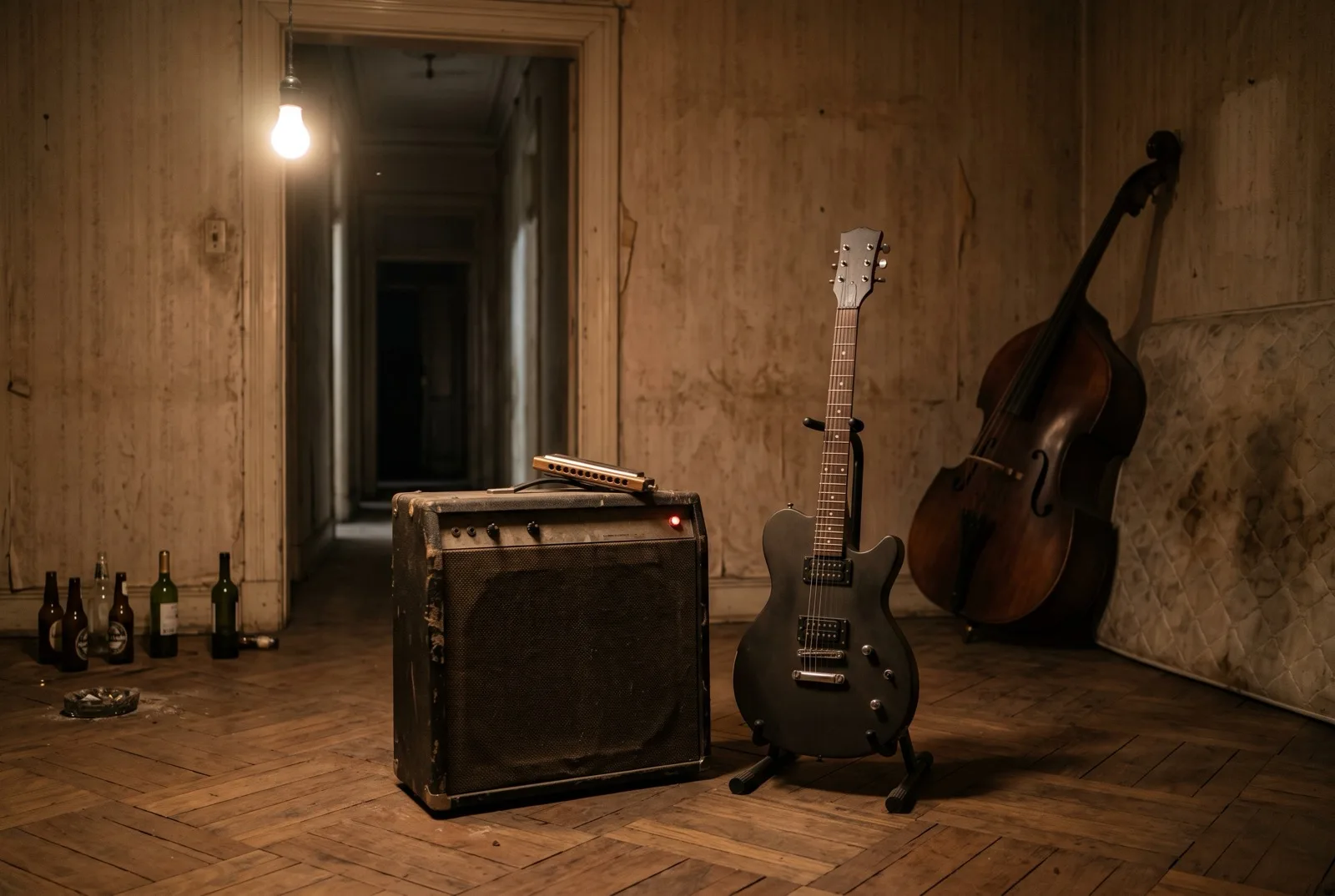
Ilustración: Rebobinados
The name is already a statement of principles: calling yourselves "Los Peores de Chile" — "The Worst in Chile" — is laughing at everything, starting with yourselves. And that was always their charm. In a Chilean scene that sometimes took itself too seriously, they turned up at the start of the nineties with humour, cheek and a mix of styles that sounded like nothing else: punk with pop, with blues, with rockabilly, all stirred together and played with a troublemaker's attitude. They did not want to be the best or the most refined. They wanted to have a good time, and along the way they earned a cult place.
The big old house on Avenida España
The band took shape in Santiago around 1990, incubating for more than a year and a half in a big old house on Avenida España, the kind of rambling place where so many Chilean bands came together through sheer hanging out and rehearsing. There they found their sound and their tone: irreverent, festive, with lyrics loaded with humour and nods to current events.
Out front was Mario "Pogo" Carneyro, on vocals, harmonica and leading the group, alongside the brothers Alejandro "Jando" Guzmán on guitar and vocals and Claudio "Klein" Guzmán on bass, plus Bruno Astele among the founders. Pogo was the one who put up the face and the character: a real frontman, one of those who can hold up an entire band on presence alone.
In a country coming out of dictatorship and recovering its appetite for laughing and shouting, Los Peores arrived with exactly the attitude many people needed: not taking anything too seriously.
The troublemaker anthems
Their first album, self-titled, came out in 1994 and put them on the map. From it came the songs that made them known: "Cicciolina" and "Síndrome Camboya" — the latter had appeared earlier on a 1993 compilation — became hits that played on the radio for months, sung back by an audience that identified with that sharp humour and that punk energy without solemnity. They were songs to jump to, to laugh to, to sing at the top of your lungs. In 1996 the press voted them band of the year's revelation, a recognition that something different and fresh was happening. In 1997 they released Trece Mordiscos de Amor.
Their formula was simple and difficult at the same time: make funny songs that still sounded good, with real craft behind the joke. Because underneath the cheek there were musicians who knew what they were doing, and several of their videos won awards.
Comings, goings and a loss
Like so many bands, they had their cycle: they split around 1998 and came back together in 2009, to meet an audience that had not forgotten them. Over the years they had become a cult band, the kind that were never mainstream but left a deep mark on those who followed them. After the return they kept recording.
On 3 October 2022 Pogo Carneyro died at sixty-five, of a lung cancer he had been carrying for some time, surrounded by his family and the band. He was not "one of its best-loved figures": he was the singer and the leader, and the whole Chilean press reported it that way. Those who remained carried on, holding up the legacy of a band that gave Chilean rock a much-needed dose of humour and freedom.
What to remember
Los Peores de Chile understood something that is sometimes forgotten: that music can also be pure joy, carefree spirit and the urge to laugh at life. With a name that was a gag and a sound that mixed everything without asking permission, they earned a cult place through honesty and good humour.
"Cicciolina" and "Síndrome Camboya" still play in the memory of a whole generation that jumped along with them. And there is something fitting in the fact that a band born from a year and a half of rehearsals in an old house should end up remembered for exactly that: not for a perfect album or a full stadium, but for an atmosphere. They were not the worst at anything; they were among the most genuine.
Sources
Los Peores de Chile is a Chilean band formed in Santiago around 1990, which incubated for more than eighteen months in a big old house on Avenida España. Their style fuses punk rock with pop, blues and rockabilly, with a humorous and irreverent stamp. Their line-up included Mario "Pogo" Carneyro (vocals, harmonica and guitar), identified by the Chilean press as the group's vocalist and leader, the brothers Alejandro "Jando" Guzmán (guitar and vocals) and Claudio "Klein" Guzmán (bass and backing vocals), and Bruno Astele among the founders. Their self-titled debut album came out in 1994 and included "Cicciolina"; "Síndrome Camboya" had appeared earlier on a 1993 compilation. In 1997 they released "Trece Mordiscos de Amor". They were voted revelation band by the press in 1996 and won awards for their videos. They split around 1998 and reunited in 2009, later releasing "No sabe / No contesta" (2012). Mario "Pogo" Carneyro died on 3 October 2022, aged 65, of lung cancer. Profile compiled for Rebobinados with fact-checking; interpretations of the meaning of the work are offered as the author's reading. No song lyrics are reproduced, for copyright reasons. Information drawn from La Tercera, Cooperativa, T13, musicapopular.cl and other coverage.
Keep rewinding
80s
punk
Billy Idol
His two anthems failed when they came out
"Rebel Yell" came out on 12 January 1984 and reached no. 46 on the Hot 100 and no. 62 in the United Kingdom; "White Wedding" got no further than no. 36 and did not chart in the United Kingdom in 1982. The two of them only reached no. 6 in Britain in the 1985 reissues, and "Dancing with Myself" never entered the Hot 100. His only no. 1 was a live "Mony Mony" from 1987 that knocked off Tiffany, whose hit was another Tommy James cover.
90s
punk
Fiskales Ad-Hok
The world tour started with them
On 13 September 1992 the Ramones made their debut in Chile, at the Velódromo, the cycling arena inside the Estadio Nacional grounds, and that date was not just another stop: it was the first night of the Mondo Bizarro world tour. It was opened by Fiskales Ad-Hok, a band from the Santiago underground born in 1986 and still without a record. Then came their own label C.F.A. in 1997, "Fiesta" (November 1998) at number 42 in Rolling Stone Chile, and the indefinite hiatus of February 2025.
00s
punk
Avril Lavigne
Six years with no album
Between her 2013 album and Head Above Water, of 15 February 2019, Avril Lavigne released no records because she was seriously ill with Lyme disease: diagnosed in December 2014, she told it on the cover of People in April 2015. The comeback album is about that, and Love Sux (2022) returned her to pop-punk on Travis Barker's label.
Rewind with us
Comments · 0
No one has commented yet. Open the conversation.