
Marciano Cantero
The Voice of Everyone's Adolescence
By Rebobinados · Published on September 5, 2026
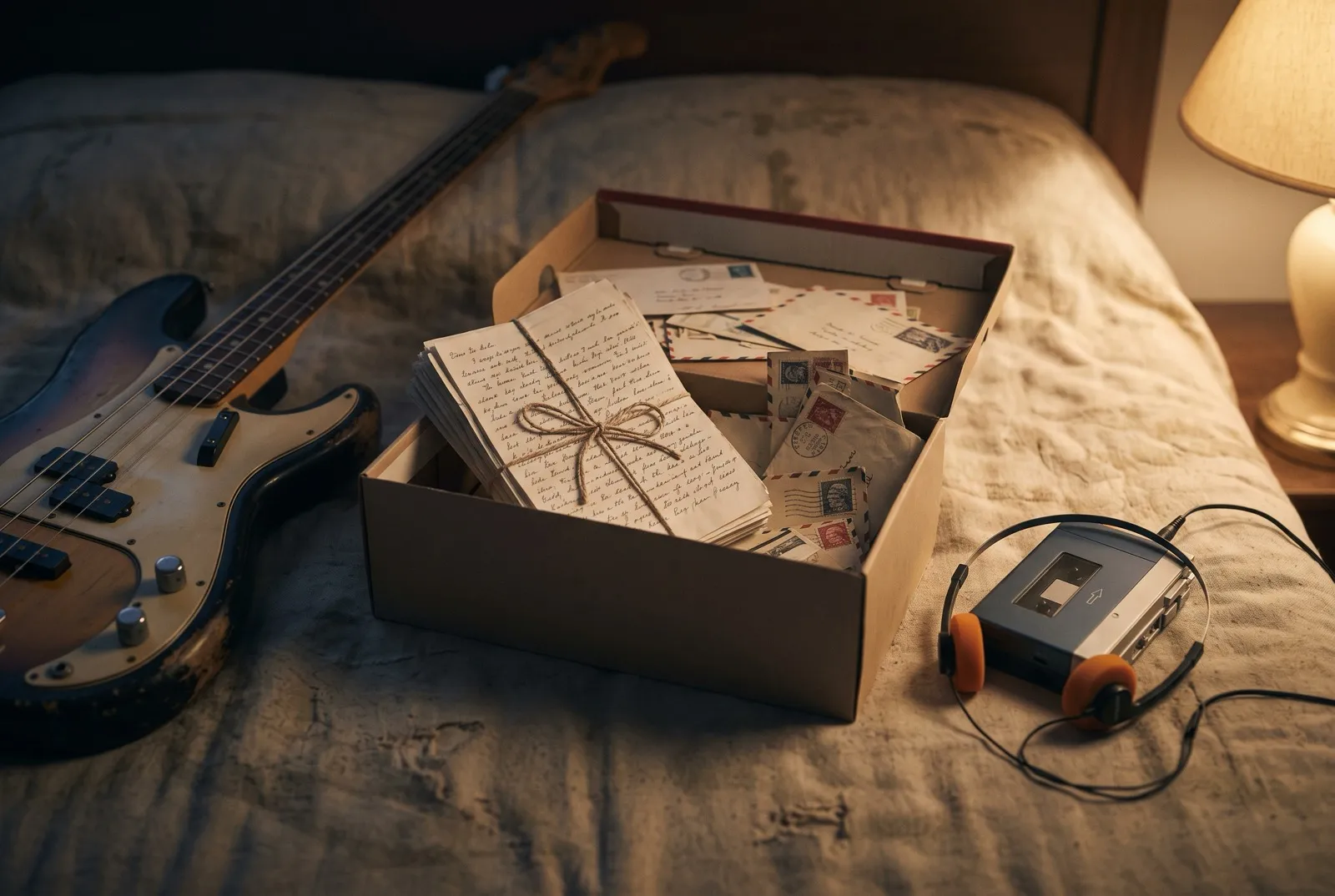
Ilustración: Rebobinados
There is a good chance that at some point in your life — a party, a barbecue, a long trip, a broken heart at fifteen — an Enanitos Verdes song was playing. "Lamento boliviano", "Tu cárcel", "La muralla verde". That is the first thing to understand about Marciano Cantero: his voice is a piece of furniture in the memory of millions of people, spread across an entire continent.
The voice of ordinary feelings
Marciano was born in Mendoza in 1960. One afternoon in 1979, in Felipe Staiti's bedroom, in that cold city, the two of them — him on bass, Staiti on guitar — started getting together to play with nothing but the dream of it, and out of that came Enanitos Verdes, with Daniel Piccolo on drums. Marciano was the voice and the bass in every line-up, always. And that voice — nasal, heartfelt, recognisable within a second — became the voice of the most ordinary and most universal feelings there are: loneliness, first love, nostalgia, friendship, those small heartbreaks that at seventeen feel enormous.
The people's band, not the critics'
It has to be said plainly, because it is part of his greatness: Enanitos Verdes never had the intellectual prestige of a Cerati or the cult mystique of a Luca Prodan. They were something else, perhaps harder: a mass love, across a whole continent. They wrote and sang the songs people actually sang, at every party, every barbecue, every school trip, every night spent getting over someone. They were not the critics' band; they were the people's band. And that, which some looked down on, is the hardest thing to achieve in music: slipping into the real lives of millions.
Why those songs never come loose
And there is a deep reason why those songs stick forever. "Mi primer día sin ti", "Tus viejas cartas", that guitar that sounds like being fifteen: they are songs that get in during adolescence, when identity is still soft, still forming, and that is why they never come loose. It is not that they are better than the ones you hear at forty; it is that they arrived while you were fresh material, and fused with the person you were beginning to be. "Tus viejas cartas", in fact, came out of a real love of Marciano's — a girl from Mendoza, Viviana, from when he was twenty-one, before the fame, and the letters they sent each other when the band moved to Buenos Aires: it is his own adolescence turned into a song. And Violeta Parra's "Volver a los 17" does exactly the same thing, even though one is a major poem and the other plays at parties: both return you to the time when you were turbulent and new, when everything was felt for the first time and therefore felt absolute. A song's greatness is not measured by its prestige but by its power to give you back the person you were. There, for once, the tragic folklorist and the pop band from Mendoza end up on the same shelf.
The letters he kept
And there is something in that song that may no longer say the same thing to someone younger, and it is worth pausing there. "Tus viejas cartas" speaks to anyone who ever wrote a letter and, above all, to anyone who waited for one. People used to write by hand, and that wait — the days between sending and receiving — was part of the love. Writing by hand also forced you to think slowly, to order what you felt before letting it out; there was a reason people kept diaries, to temper themselves in writing. Heidegger, in his lectures on Parmenides, argued that the written word belongs in origin to the domain of the hand, and that the machine tears it from there and degrades it into a mere means of transmission, into information: what is typed, he said, no longer comes from the hand that writes. In a handwritten letter the hand is still there, and with the hand, the person: the pulse, the pressure on the paper, the crooked or neat handwriting belong to one person in the world. A letter carries the identity of whoever wrote it even without a signature; you recognised who was writing before you read the name. Marciano kept Viviana's letters, and in that song he did not keep only a love: he kept a way of loving that has nearly disappeared.
Two anthems that were not his
And there is a curious detail that says a great deal about Marciano. Two of his biggest anthems were not even his. "Lamento boliviano" was a song by another band, Alcohol Etílico; "Tu cárcel" was by Los Bukis, written by Marco Antonio Solís. But Marciano sang them with such commitment that the whole continent forgot they were covers: they became Enanitos songs, and then everyone's songs. That is a rare and very valuable gift: taking a borrowed song and turning it into a piece of millions of lives. When Marciano died, Marco Antonio Solís himself said farewell by calling it more lamentable than "Lamento boliviano" itself.
The cold city that conquered a continent
The band from the cold city conquered the entire continent. The Big Bang tour, in 1994, was a hundred and twenty-nine shows across Argentina, Latin America and the United States, the longest an Argentine rock band had undertaken up to then. And there is one gesture that captures him: Marciano loved Mexico so much that he went to live there, in Hermosillo, for some fifteen years, and became Mexican too. Enanitos Verdes was as much Mexico's as Argentina's; their songs were sung the same in Buenos Aires as in Guadalajara. They were one of those bands that erase the border, that make a whole continent feel like a single neighbourhood.
Going home
He died on 8 September 2022, in Mendoza, the city where it had all begun, at sixty-two, a few days after his birthday, from complications following kidney surgery. He had gone home. He left quietly, without scandal, like someone who leaves the party early after having kept it alive for forty years.
Marciano is gone, but his voice is not. It still plays in every "Lamento boliviano" someone puts on at a party that makes the whole room sing at once, shouting, arm in arm; in every "Tu cárcel" someone chooses in order to feel a heartache all the way down. If you were ever fifteen and sang one of those at the top of your lungs, convinced nobody in the world had felt what you were feeling at that moment, then Marciano was there, keeping you company without your knowing. He did not write all of his most famous songs, but he made them everyone's. And in the end, looked at properly, it is the same thing.
Sources
Horacio Eduardo "Marciano" Cantero (Mendoza, 25 August 1960 – Mendoza, 8 September 2022) was the voice and bassist of Enanitos Verdes, a band formed in Mendoza in 1979 with Felipe Staiti on guitar and Daniel Piccolo on drums, the latter until 2009. Enanitos Verdes is one of the most popular and international bands in rock sung in Spanish, with fourteen studio albums across more than forty years. "Lamento boliviano", included on the album "Big Bang" (1990), is a version of a song by the band Alcohol Etílico, written by Raúl Federico Gómez and Natalio Faingold; the Enanitos version became the definitive one. "Tu cárcel" is a cover of Los Bukis, written by Marco Antonio Solís. Other hits: "La muralla verde", "Amigos", "Luz de día", "Igual que ayer", "Te vi en un tren", "Por el resto", "Mi primer día sin ti" and "Tus viejas cartas", the last written by Cantero and inspired by a real relationship of his youth in Mendoza, around 1981, and by the letters they exchanged after the band moved to Buenos Aires. The Big Bang tour (1994) totalled some 129 shows and was the longest by an Argentine rock band up to that point. The album "Tracción acústica" (1998) was nominated for the Grammy for Best Latin Rock or Alternative Album at the 1999 ceremony, which Maná won; the band was nominated again for "Néctar" in 2000. Cantero lived for around fifteen years in Hermosillo, Mexico, and held dual nationality. He died at 62 from complications following kidney surgery. After his death, Felipe Staiti became the band's leader. The reflection on handwriting draws, in paraphrase rather than direct quotation, on Martin Heidegger's lectures on Parmenides (1942-1943), where he argues that the written word belongs to the essential domain of the hand and that the typewriter tears it from that domain, degrading it into a means of transmission; the idea was discussed by Jacques Derrida, among others. No song lyrics are reproduced, for copyright reasons. Sourced from Wikipedia, Rolling Stone, El Espectador, Diario de Cuyo and other press coverage.
Keep rewinding

10s
pop
Bruno Mars
Eleven names in the credits
"Uptown Funk" came out on 10 November 2014 with six writers and today it has eleven. In February 2015 The Gap Band's publisher filed a claim over "Oops Up Side Your Head" in YouTube's copyright system —there was never a lawsuit— and on 28 April five names were added, with 17 % of the publishing. It happened weeks after the "Blurred Lines" verdict, and the song had been fourteen weeks at number one.

00s
pop
André Rieu
It was not from the jazz suite
The waltz with which André Rieu reached half the world is not from Shostakovich's Suite for Jazz Orchestra No. 2: it is from the Suite for Variety Orchestra, which the composer did not assemble, and it was born in 1956 as music for a Soviet film about settlers in Kazakhstan. The error comes from a misprint in volume 10 of the complete works (Muzyka, Moscow, 1984), corrected only in 2001. And the title "The Second Waltz" was invented by his wife, because the real one did not sell.

90s
pop
Daniela Mercury
She took the neighbourhood out of the song
"O Canto da Cidade" was written by Tote Gira, a composer from Nordeste de Amaralina who recorded the demo on a borrowed cassette, marking the beat on the door of a refrigerator; Mercury's team almost threw the tape away. She shares the credit because she deleted the references to the Pelourinho so that the song would serve all of Brazil. The album, from 20 September 1992, sold more than 2 million copies and nationalised axé. But she did not invent it: the name was a journalist's insult in 1987.
Rewind with us
Comments · 0
No one has commented yet. Open the conversation.