
Milli Vanilli
The tape that jammed
By Rebobinados · Published on September 2, 2026
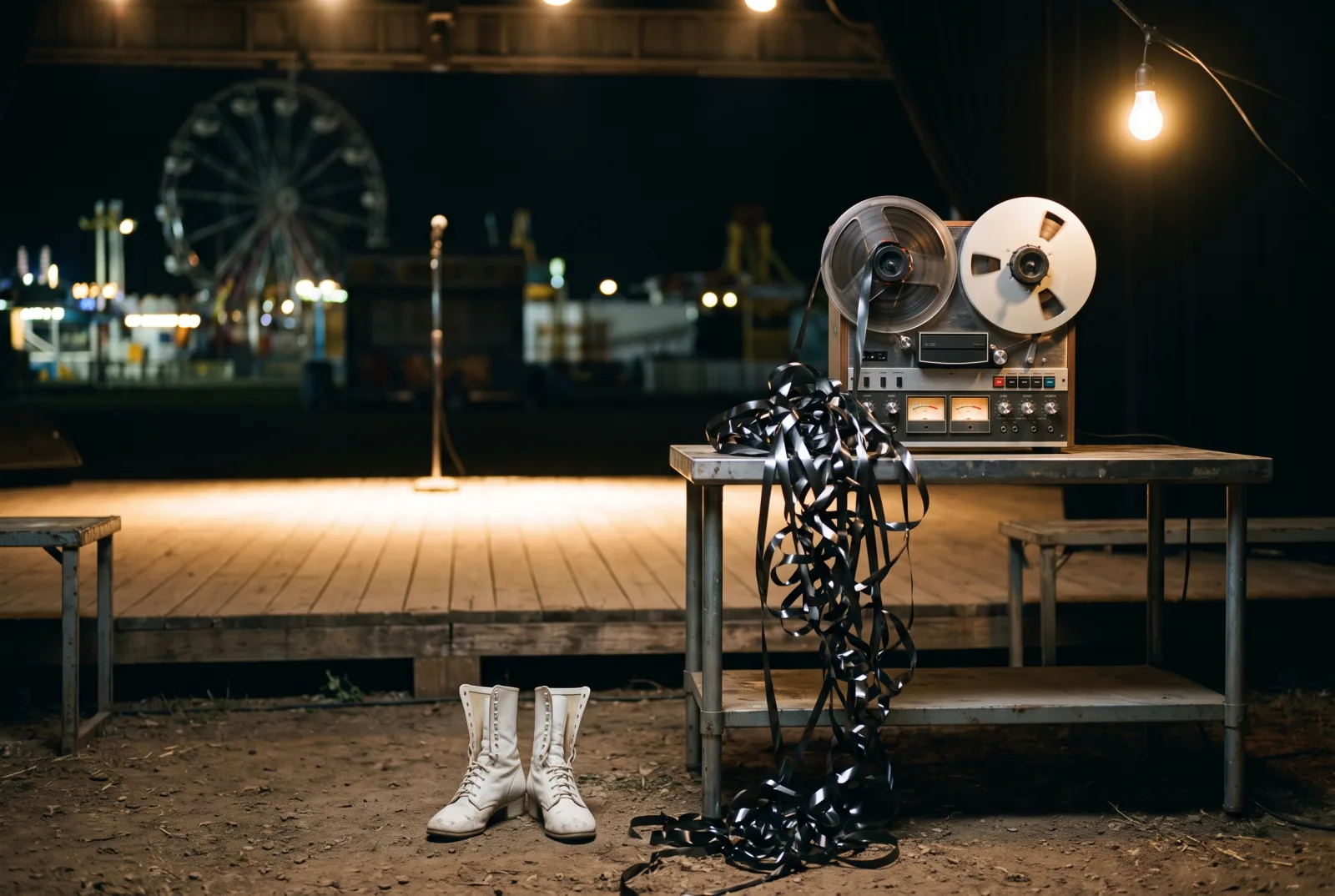
Ilustración: Rebobinados
Milli Vanilli starred in the biggest scandal in the history of pop music, and their story is a brutal parable about what this industry really values.
At the end of the eighties, this duo — two strikingly handsome, charismatic young men, with long hair and impeccable dance moves — conquered the world: three number ones, millions of records, and the Grammy for Best New Artist in February 1990.
And then it emerged that they did not sing. Not one note, on those records.
The Grammy was taken away from them. It remains the only one ever revoked in the history of the award.
But behind the scandal there are two stories, not one.
The architect: Frank Farian again
At the centre of everything there is a name Rebobinados already knows: Frank Farian, the German producer who had invented Boney M. with the same formula.
One face up front, one voice hidden away.
Farian did it again, on a larger scale and with worse consequences. In 1988 he put the project together in Munich, but he recorded the album at Far Studios, his own studio in Rosbach vor der Höhe, near Frankfurt: the same place where he had manufactured Boney M. He had it sung by real session professionals — powerful voices — and decided that those singers were not sellable: they did not have the image the MTV of the day wanted.
So he looked for two young, charismatic models to put up front: Rob Pilatus and Fab Morvan. They would dance, pose and lip-sync; the voices would still belong to other people.
And it worked, spectacularly, until it stopped working.
The tape that jammed
The moment the mask came off is straight out of a film.
On 21 July 1989, at the height of their run, Milli Vanilli were playing a concert at the Lake Compounce amusement park, in Bristol, Connecticut, broadcast by MTV.
"Girl You Know It's True" was playing, with Rob and Fab dancing and "singing". And suddenly the tape carrying the vocal jammed, and began repeating the same fragment over and over, like a scratched record.
In front of the cameras, in front of everyone, it was exposed.
They did not go on moving their mouths: they ran off the stage. They came back a while later, and only because Downtown Julie Brown, the host of Club MTV, talked them into going out again.
Pilatus summed it up afterwards: that was when he knew it was the beginning of the end.
The episode did not sink them right away. But the seed of doubt had been planted, and the press began to investigate.
Finally, on 14 November 1990, under pressure because Rob and Fab were demanding to really sing on the next record, Farian himself called a press conference in Munich and confessed everything. He fired them there and then.
Five days later, on 19 November, the Academy revoked the Grammy. The category was left without a winner that year.
The real voices
And here is the other half of the story, the half almost nobody tells.
The ones who actually sang were professional musicians with powerful voices: above all John Davis, Brad Howell and Charles Shaw, as well as Jodie and Linda Rocco.
Farian kept them hidden for one reason only: they did not fit the aesthetic mould the industry wanted to sell. They had the voice, but not the face.
Charles Shaw went so far as to reveal the truth before the scandal, and Farian paid him one hundred and fifty-five thousand dollars to retract it.
After the whole thing blew up, Farian tried to bring them into the light. He released an album with them up front, named with bitter irony "The Real Milli Vanilli". It was already too late: the name was burned, and the public did not want the talented people without a face, it wanted the scandal.
There is the complete parable. The ones who had the face but not the voice became world famous and were then destroyed. The ones who had the voice but not the face stayed invisible.
John Davis died on 24 May 2021, of complications from covid, without ever having had the fame his voice had produced for others.
Who paid the price
There is something deeply unjust about how this ended, and it has to be said carefully.
The brain behind the deception was Farian, a powerful producer who had already done it before. But the punishment and the mockery of the whole world fell on Rob and Fab, who, while guilty too for accepting the charade, were in part pawns in a game set up by someone else.
It was them, not Farian, who became the universal synonym for fraud.
Farian went on producing records for another thirty years and died on 23 January 2024, at his home in Miami, aged eighty-two.
For Rob Pilatus the blow was fatal. Humiliated and sunk in drugs, he died on 3 April 1998 in a hotel in Friedrichsdorf, near Frankfurt, of an accidental overdose of alcohol and prescription medication. Not even his date of birth was ever clear: the obituaries give him thirty-two or thirty-three years.
Fab Morvan survived, rebuilt his life little by little, and over the years told the story with an honesty that gave him back his dignity. In November 2025 he was nominated for a Grammy for the audiobook of his memoirs.
He lost. The ceremony was on 1 February 2026 and the award for best audiobook went to "Meditations", by the Dalai Lama. Thirty-five years after the revocation he came back to the Grammys with his own voice and lost fair and square, which is a far better ending than the nomination.
Some also noticed that the ferocity of the lynching had an ugly whiff about it: they were two young black men, foreigners, with strong accents, and for several critics the viciousness had a component of racism that was not applied with the same harshness to other artists who also used studio tricks.
There were lawsuits too, and they ended in a way that says a good deal about the public. On 24 March 1992 Judge Thomas O'Brien ordered Arista and BMG to give the money back to anyone who could prove with the barcode that they had bought the record before 27 November 1990: one dollar for a single, two for a cassette or vinyl, three for a CD. They kept the record anyway.
Ten million people were reckoned to be entitled to claim. When the deadline closed, Arista's lawyers had counted up to eighty thousand claims. The public that had demanded the scandal could ask for its money back, and ninety-nine per cent could not be bothered.
What to remember
Milli Vanilli is proof of an uncomfortable truth: that this industry often values the face more than the voice, and that it punishes the pawns without mercy when the trick is discovered, while the architects go on their way.
If you listen to "Girl You Know It's True", "Blame It on the Rain" or "Girl I'm Gonna Miss You", you are listening to well-made songs, sung by people with real talent whose names almost nobody knows.
It is a sad story on every side: for the voices condemned to invisibility for not being sellable, and for the two young men used as a front and then destroyed, one of them to the point of death.
The next time someone says "Milli Vanilli" as a synonym for a sham, it is worth remembering the whole story: that the fraud was not invented by the ones who put up their faces.
The face without a voice became famous; the voice without a face stayed in the shadows. That says more about the industry than about them.
Sources
Milli Vanilli, a pop project created in Munich in 1988 by the producer Frank Farian, the same man behind Boney M. Farian hired session singers —chiefly John Davis, Brad Howell and Charles Shaw, as well as Jodie and Linda Rocco— to record the vocals, and the models and dancers Fab Morvan and Rob Pilatus to lip-sync and be the public image of the group. Their album, released in Europe as "All or Nothing" (1988) and reissued in the United States as "Girl You Know It's True" (1989), was an enormous success, with three number ones —"Baby Don't Forget My Number", "Girl I'm Gonna Miss You" and "Blame It on the Rain"—, and won the Grammy for Best New Artist in February 1990. On 21 July 1989, in a performance broadcast by MTV from the Lake Compounce amusement park, in Bristol, Connecticut, the backing track of "Girl You Know It's True" jammed and stuck in a loop, exposing the lip-syncing. Charles Shaw had revealed the truth earlier, but Farian paid him 155,000 dollars to retract it. On 14 November 1990 Farian publicly confessed the fraud at a press conference in Munich, where he also fired the duo; the Grammy was revoked on 19 November 1990, the only time in the history of the award to date, and the category was left without a winner that year. Frank Farian died on 23 January 2024 at his home in Miami, aged 82. In 1991 Farian released "The Moment of Truth" under the name "The Real Milli Vanilli", with the real singers. Rob Pilatus died on 3 April 1998 in a hotel in Friedrichsdorf, near Frankfurt, of an accidental overdose of alcohol and prescription medication; sources disagree about his year of birth and give him 32 or 33 years. Fab Morvan continued his musical career and was nominated for a Grammy for the audiobook of his memoirs, "You Know It's True"; the award was decided on 1 February 2026 and went to "Meditations", by the Dalai Lama. John Davis died on 24 May 2021 of complications from covid-19. Some critics have pointed to a component of racism and xenophobia in the virulence of the scandal. Boney M. has its own profile in this series. Externally authored text, edited and verified for Rebobinados. Interpretations of the meaning of their work are offered as the author's reading. No song lyrics are reproduced, for copyright reasons. Information drawn from Rolling Stone, NPR, Mental Floss, Wikipedia and other coverage.
Keep rewinding

10s
pop
Bruno Mars
Eleven names in the credits
"Uptown Funk" came out on 10 November 2014 with six writers and today it has eleven. In February 2015 The Gap Band's publisher filed a claim over "Oops Up Side Your Head" in YouTube's copyright system —there was never a lawsuit— and on 28 April five names were added, with 17 % of the publishing. It happened weeks after the "Blurred Lines" verdict, and the song had been fourteen weeks at number one.

00s
pop
André Rieu
It was not from the jazz suite
The waltz with which André Rieu reached half the world is not from Shostakovich's Suite for Jazz Orchestra No. 2: it is from the Suite for Variety Orchestra, which the composer did not assemble, and it was born in 1956 as music for a Soviet film about settlers in Kazakhstan. The error comes from a misprint in volume 10 of the complete works (Muzyka, Moscow, 1984), corrected only in 2001. And the title "The Second Waltz" was invented by his wife, because the real one did not sell.

90s
pop
Daniela Mercury
She took the neighbourhood out of the song
"O Canto da Cidade" was written by Tote Gira, a composer from Nordeste de Amaralina who recorded the demo on a borrowed cassette, marking the beat on the door of a refrigerator; Mercury's team almost threw the tape away. She shares the credit because she deleted the references to the Pelourinho so that the song would serve all of Brazil. The album, from 20 September 1992, sold more than 2 million copies and nationalised axé. But she did not invent it: the name was a journalist's insult in 1987.
Rewind with us
Comments · 0
No one has commented yet. Open the conversation.