
Miranda!
Permission to have a good time
By Rebobinados · Published on September 7, 2026
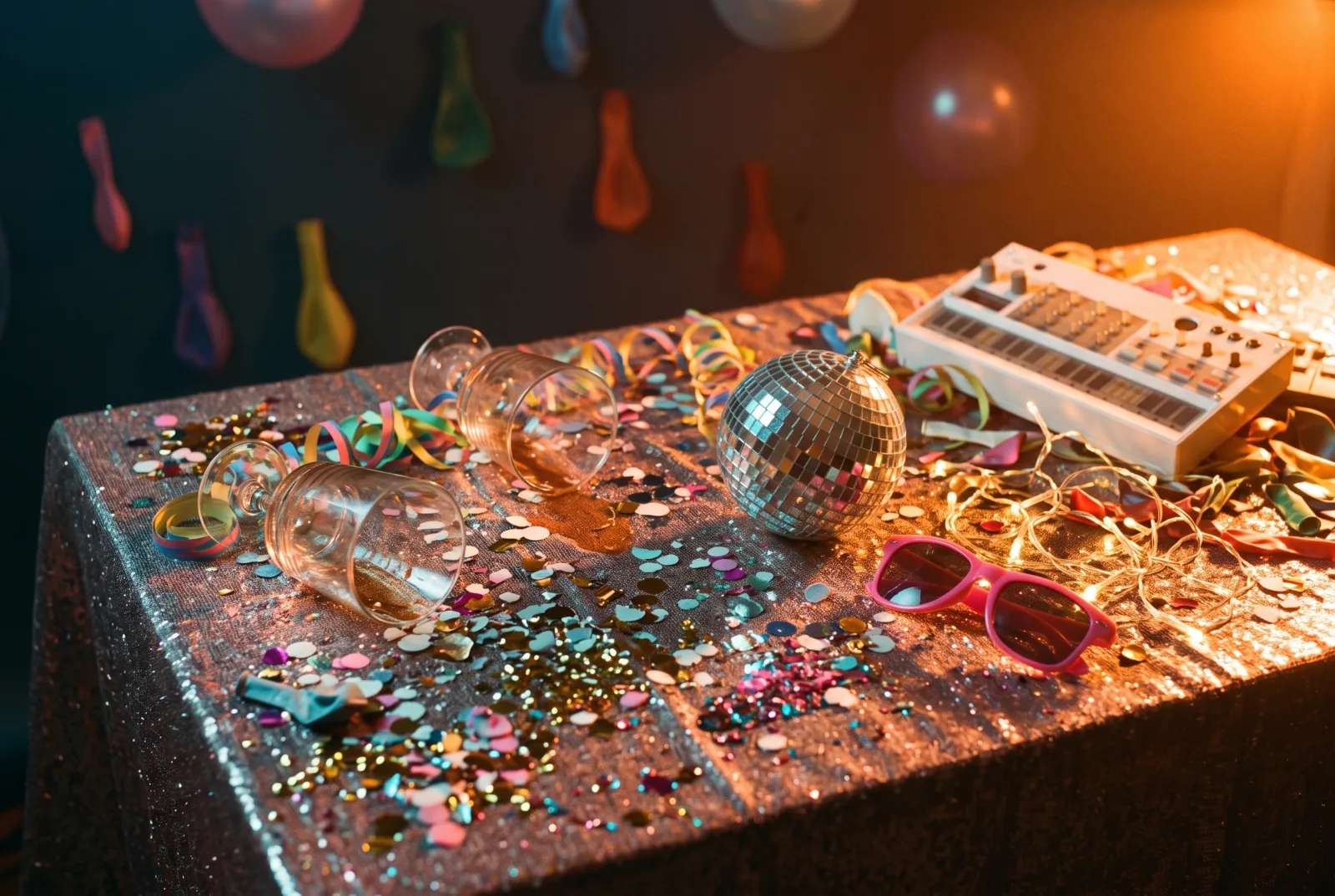
Ilustración: Rebobinados
In 2023 Miranda! did something that sounds like surrender and turned out to be the opposite: they took their own old songs and recorded them again with people twenty years younger. Hotel Miranda! came out on 19 April, eleven tracks from their own catalogue revisited with Lali, María Becerra, Ca7riel, Emilia, Andrés Calamaro, the Chilean Francisca Valenzuela and several more.
The following year that record won the Gardel de Oro, the award for album of the year in Argentina.
Think about it for a second, because it is extremely odd. A duo two decades into their career won their country's biggest prize with an album of covers of themselves. And "Perfecta", a song from 2007, finally reached the Argentine top ten — the first of their lives, sixteen years late.
The ones who brought the colour back
Miranda! formed in Buenos Aires in 2001. Today they are a duo: Alejandro Sergi and Juliana Gattas. The name is a tribute to the Argentine actor Osvaldo Miranda, whom they met at a festival in Palermo in December 2002. They define themselves as melodramatic electropop, and it should be taken literally: choruses that stick on the second attempt, dizzying falsettos, synthesisers, a whiff of eurodisco and, above all, colour.
And they arrived going against the traffic. In the early two thousands, rock in Spanish had turned rigid, serious, very conscious of its own importance. Miranda! did exactly the opposite: they brought back fun, glitter, irony and a shamelessly camp, playful and openly inclusive aesthetic, well before that was comfortable.
That is why they met resistance at first. Too frivolous, too corny, too much. It is the same old accusation, the one thrown at Dolly Parton over her sequins: mistaking the wrapping for the contents and assuming that anything that glitters cannot be serious.
The serious thing under the glitter
Because it was. Under the sequins they were doing three things that were not small.
First: they made joy legitimate again. In a scene where gravity was a synonym for quality, they argued that having a good time is also content, and not a guilty pleasure.
Second: they gave danceable pop in Spanish its dignity back, after a decade of being treated as rock's slow cousin.
And third, the one that weighs most: they made room for everyone who did not fit the macho rocker mould. They did not invent that fight — a generation earlier Federico Moura and Virus had fought it in a far more dangerous country, and paid dearly. Miranda! carried it on, with more glitter and at a moment when it could be won.
They turned the word "corny" from an insult into a flag. That is not done without craft.
The songs that stopped being theirs
Their songs are small melodramatic pop operas about love and heartbreak, sticky as confetti. "Don", from the 2004 album Sin Restricciones, was the one that made them continental: by 2005 it was one of the most downloaded ringtones in the world, which is a fairly literal way of being everywhere. Then "Yo te diré", "Perfecta" with Julieta Venegas, "Prisionero", "Tu misterioso alguien".
And then the thing happened that only happens to some songs: they stopped belonging to them. They now sit in the shared repertoire of any party, wedding or birthday on this side of the world. When a song becomes a fixture at other people's celebrations, it no longer belongs to whoever wrote it.
They hold eight Premios Gardel, twenty MTV Video Music Awards Latinoamérica and several Gaviotas from Viña del Mar.
Why the 2023 album matters
And here I go back to the beginning, because it is the most clear-sighted part of their whole career.
The normal thing, twenty years in, is to live off nostalgia: the greatest hits tour, an audience that comes to remember being young. Miranda! did something else. Instead of serving their songs to the people who already had them, they handed them to the next generation to sing alongside them. Not a tribute to themselves: a conversation between two eras inside the same track.
The result was the biggest success of their history, with grandparents and teenagers dancing to the same thing. The band that rock had resisted for being frivolous ended up an institution across several generations, and winning their country's big prize with it.
Miranda! are still active, together and bigger than ever twenty-odd years on. It is proof of something Rebobinados likes to defend: fun, made with craft and heart, ages rather better than solemnity.
If you ever danced to "Don" at a party, or sang "Perfecta" with somebody you fancied, or found in that bright, shameless pop a place where you could be exactly everything you are, they have already given you what they give best: permission to have a good time, out loud and without apologising. Long may the party last.
Sources
Miranda! is an Argentine electropop band formed in Buenos Aires in 2001; its current line-up is the duo of Alejandro Sergi (vocals, guitar, keyboards) and Juliana Gattas (vocals). The name pays tribute to the Argentine actor Osvaldo Miranda, whom they met in December 2002 at a festival in Palermo. The band define their style as melodramatic electropop, with influences from pop rock, dub, synthpop, indie pop and house. Their album "Sin Restricciones" (2004) marked their mainstream breakthrough and includes "Yo Te Diré" and "Don"; by 2005 "Don" was one of the most downloaded ringtones in the world. Among their other hits: "Perfecta" (with Julieta Venegas), "Prisionero" and "Tu misterioso alguien". They have won eight Premios Gardel, twenty MTV Video Music Awards Latinoamérica, one MTV Europe Music Award, two Latin Grammy nominations and several Gaviotas from the Viña del Mar International Song Festival. "Hotel Miranda!" was released on 19 April 2023 by Sony Music Argentina: eleven tracks from their own catalogue re-recorded with Ca7riel, Lali Espósito, María Becerra, FMK, Emmanuel Horvilleur, Juan Ingaramo, Emilia Mernes, Cristian Castro, Francisca Valenzuela, Andrés Calamaro, Chano, Sofía Reyes and Bandalos Chinos. "Uno los Dos" was their first song to enter the top 15 of the Argentina Hot 100 since that chart's creation in 2018, and "Perfecta" peaked at number 8, their first top ten. At the 26th Premios Gardel (2024) the album won the Gardel de Oro for album of the year, best pop group album and best long-form music video. The Hotel Miranda! tour began on 21 April 2023 in Buenos Aires and ended on 29 November 2023 in Mexico City, comprising thirteen Latin American dates. Interpretations of the meaning of their work are offered as the author's reading. No song lyrics are reproduced, for copyright reasons. Information drawn from Wikipedia and press coverage.
Keep rewinding

10s
pop
Bruno Mars
Eleven names in the credits
"Uptown Funk" came out on 10 November 2014 with six writers and today it has eleven. In February 2015 The Gap Band's publisher filed a claim over "Oops Up Side Your Head" in YouTube's copyright system —there was never a lawsuit— and on 28 April five names were added, with 17 % of the publishing. It happened weeks after the "Blurred Lines" verdict, and the song had been fourteen weeks at number one.

00s
pop
André Rieu
It was not from the jazz suite
The waltz with which André Rieu reached half the world is not from Shostakovich's Suite for Jazz Orchestra No. 2: it is from the Suite for Variety Orchestra, which the composer did not assemble, and it was born in 1956 as music for a Soviet film about settlers in Kazakhstan. The error comes from a misprint in volume 10 of the complete works (Muzyka, Moscow, 1984), corrected only in 2001. And the title "The Second Waltz" was invented by his wife, because the real one did not sell.

90s
pop
Daniela Mercury
She took the neighbourhood out of the song
"O Canto da Cidade" was written by Tote Gira, a composer from Nordeste de Amaralina who recorded the demo on a borrowed cassette, marking the beat on the door of a refrigerator; Mercury's team almost threw the tape away. She shares the credit because she deleted the references to the Pelourinho so that the song would serve all of Brazil. The album, from 20 September 1992, sold more than 2 million copies and nationalised axé. But she did not invent it: the name was a journalist's insult in 1987.
Rewind with us
Comments · 0
No one has commented yet. Open the conversation.