
Mötley Crüe
They needed a notary to be believed
By Rebobinados · Published on September 14, 2026
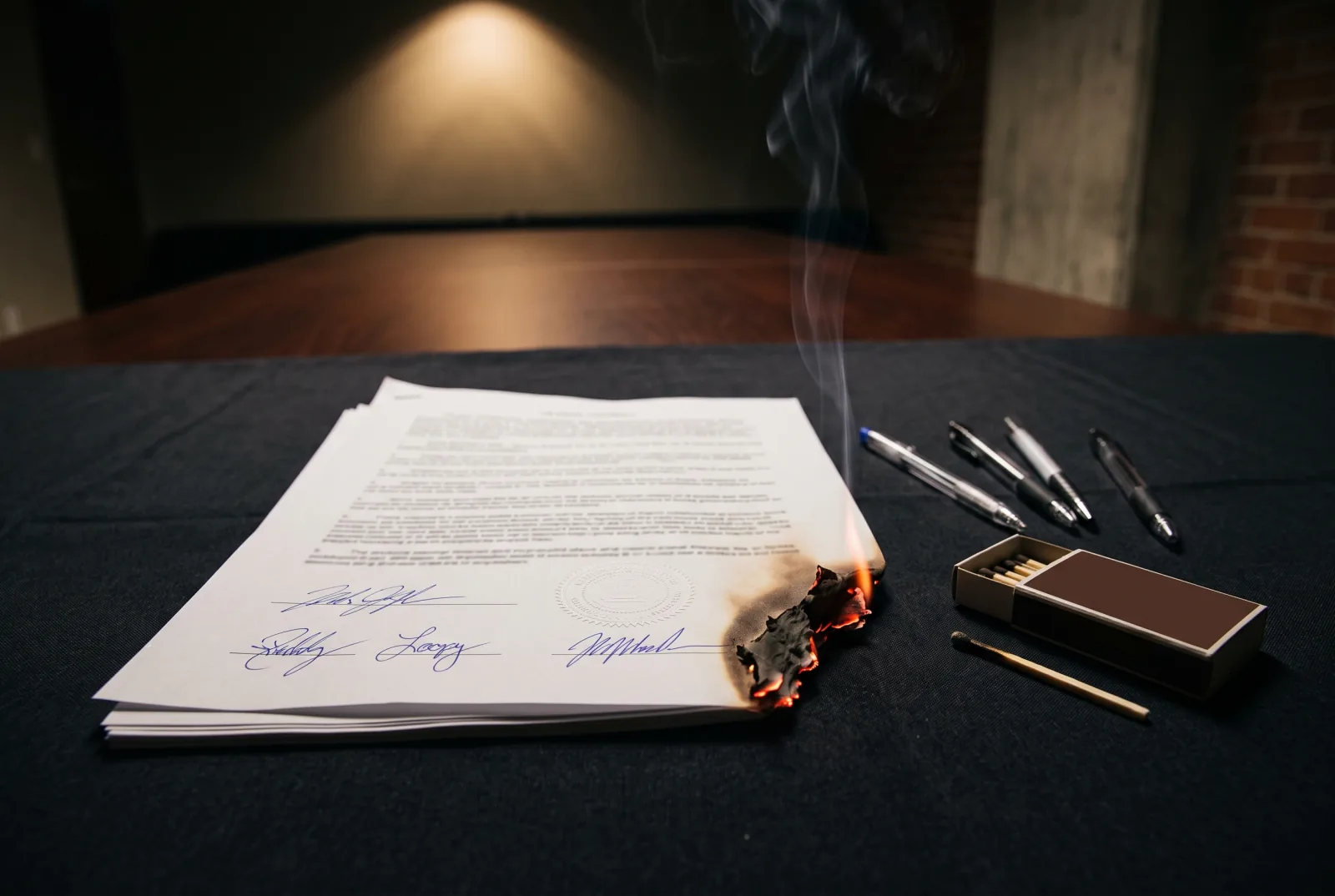
Ilustración: Rebobinados
On 28 January 2014, the four members of Mötley Crüe sat down at a press conference in Los Angeles and signed a piece of paper before a notary public. The paper said they would never tour again under that name. It was not a line for the press: it was a real contract, drawn up by the band's lawyer, with an exact date. After 31 December 2015, none of the four could use the name Mötley Crüe to go on tour.
No other band in the history of rock has done anything like it. And in that absurd, theatrical, slightly crooked gesture sits everything that makes Mötley Crüe great: they were never a band of songs, they were a band of spectacle, and even their goodbye they turned into a show.
The art of selling a farewell
What was the contract for? To sell tickets. The tour was called The Final Tour and the idea explained itself: this time it is not a trick, this time it is signed before a notary public, come and see it. Anyone who has watched a rock band say goodbye three times knows exactly why the paper was needed. Mötley Crüe, who understood a great deal about cynicism, knew it better than anyone, and instead of hiding it they put it at the centre of the poster.
The tour lasted eighteen months and ended with three nights in Los Angeles, the last on 31 December 2015, the exact day the contract came into force. They filmed the ending and put it in cinemas, with a title that left no room for doubt: "The End". The end. Full stop. They closed with a perfect slam of the door, rehearsed, sold down to the last seat.
The paper on fire
And here comes the best part, the part only Mötley Crüe could pull off. In 2019, Netflix premiered "The Dirt", the film about the band, and it was a huge hit: the soundtrack went into the top ten in the country. The definitive farewell suddenly had a new audience, and that audience wanted more.
Eight months later, they posted a video. The contract appears in the video. They blow it up with explosives and burn it. The explanation was, more or less, that they are the band that breaks the rules, and a piece of paper was not going to be the exception. They announced a stadium tour and they did it.
It is sheer nerve of such purity that it makes you laugh and admire them at the same time. They signed a farewell before a notary public, sold it, premiered the film of the ending, and then dynamited the document on camera to take it all back. Most bands would have tried to make it go unnoticed. Mötley Crüe turned breaking the contract into another show. They turned their own lie into content, and it worked.
The secret of the trick
Here is the fact almost nobody tells. The text of the contract was never published. Nobody outside the band's circle has read it. There is no record that any of the parties ever tried to enforce it, nor that there was an exit clause, nor that one was needed. The four signatories were the only ones who could demand it be honoured, and all four wanted to come back.
In other words: burning the paper was pure theatre. The contract stopped binding anyone the second the four of them decided to ignore it. The dynamite was not needed. But of course it was needed: without the dynamite there was no show. That is the band's perverse genius. They understood, before almost anyone else, that in rock the story around the music is worth as much as the music. And they built the best one.
What actually is signed
It is worth putting real numbers on the legend, without inflating it. Mötley Crüe says it has sold more than a hundred million records; that is a press-release figure, unaudited. What is certified in their own country is about twenty-five and a half million units. Four times less than the slogan, and still a mountain. They have one number one, "Dr. Feelgood", from 1989, six times platinum. The hundred-million slogan is not needed: twenty-five million real ones already make them one of the best-selling bands in hard rock. The truth was more than enough for them; exaggerating was simply part of the character.
The other paper, the one that hurt
Not everything in this story is comedy, and that has to be said. There is a second story of signatures, and it ends sadly. In 2023, Mick Mars —the original guitarist, the only one who played on every album— sued the band over his share of the business. The arbitration was decided in 2026 and he lost it outright: he had to retract under oath some of his accusations and give money back, because a clause he himself had demanded years earlier took the touring income away from anyone who stopped touring. His lawyer summed it up without ornament: that the ruling is terrible, that it is not fair, and that that band was never fair to Mick.
It is the bitter flipside of the spectacle. Behind the party and the dynamite there is an older guitarist, the one who was on every album, fighting in court with his own band brothers. Sometimes the show runs over the people who built it.
What to remember
Mötley Crüe signed before a notary public that it would not come back, sold that signature as its great farewell, premiered the film of the ending and then blew the contract sky-high to announce the return. The document, almost certainly, never bound anyone. It made no difference: the paper was not a contract, it was a magic trick, and they are magicians.
Remember it this way: it is the only band that needed a notary public for its farewell to be believed, and the only one with the cheek to burn the paper on camera to take it back. It is not an embarrassing footnote. It is, probably, the masterpiece of their real trade, which was never the music alone: it was the whole spectacle.
Sources
Mötley Crüe, an American band formed in Los Angeles in 1981 and made up of Vince Neil (vocals), Nikki Sixx (bass), Mick Mars (guitar, 1981-2022) and Tommy Lee (drums); since October 2022 the guitarist has been John 5. All five are alive; Vince Neil revealed in September 2025 that he had suffered four strokes. On 28 January 2014, at a press conference in Los Angeles, the four members signed before a notary public a "Cessation of Touring Agreement", drawn up by the band's lawyer Doug Mark, which barred them from touring under that name after 31 December 2015. The Final Tour began on 2 July 2014 in Grand Rapids and concluded with three concerts at the Staples Center in Los Angeles on 28, 30 and 31 December 2015; it was released as a film under the title "The End" (2016). After the premiere of "The Dirt" on Netflix on 22 March 2019, whose soundtrack reached number ten on the Billboard 200, the group posted on 18 November 2019 a video in which it destroys the document and announced its return; The Stadium Tour, with Def Leppard, Poison and Joan Jett, was announced for 2020, postponed because of the pandemic and held between June and September 2022. The text of the agreement has not been made public and there is no record that any of the parties tried to enforce it. RIAA certifications add up to some 25.5 million units in the United States, against the promotional figure of more than a hundred million worldwide, which no auditing body backs. "Dr. Feelgood" (1989) is its only number one on the Billboard 200 and is certified six times platinum. The group has three Grammy nominations without a single win: "Dr. Feelgood" (1990) and "Kickstart My Heart" (1991), both lost to Living Colour, and "Saints of Los Angeles" (2009), lost to The Mars Volta. In November 2021 BMG Rights Management acquired its recorded catalogue; the figure of 150 million dollars published by the press was not confirmed by the parties. In April 2023 Mick Mars sued the band alleging a reduction of his share from 25 to 5 per cent and maintaining that Nikki Sixx's bass on The Stadium Tour was pre-recorded; the arbitrator ruled in January 2026 in favour of the band, Mars retracted those statements under oath and was ordered to return tour advances. In August 2026 Nikki Sixx stated publicly that the group uses backing tracks only for elements it cannot perform live. Poison and Queen have their own profiles in this series. A Rebobinados rewrite of previously verified research; interpretations are offered as the author's reading. No song lyrics are reproduced, for copyright reasons. Information drawn from Wikipedia, Billboard, Rolling Stone, Variety, Ultimate Classic Rock, Loudwire, Blabbermouth, Consequence and other coverage.
Keep rewinding
90s
hard rock
Lenny Kravitz
He doesn't play that guitar
The riff of "Are You Gonna Go My Way" (9 March 1993) is not played by him: the guitar is Craig Ross's, the song is co-written with him and the Academy nominated them both for Best Rock Song in 1994. "Always on the Run" was written by Slash for Guns N' Roses. And one of his four straight male rock Grammys, the one of 23 February 2000, he won with "American Woman", by The Guess Who, from which he removed the guitar solo.
60s
hard rock
Steppenwolf
The motorcycle was a Ford Falcon
The century's biker anthem was not written by the band that sings it, and it was not about a motorcycle: Mars Bonfire wrote "Born to Be Wild" as a folk ballad about his battered Ford Falcon, and he had left the group in June 1967, before the name Steppenwolf existed. "The Pusher" is Hoyt Axton's, Easy Rider dropped it in as a temporary track, and the single stalled at no. 2 on the Hot 100 in 1968.
00s
hard rock
Thirty Seconds to Mars
The seven-year law
In August 2008, EMI sued them for thirty million dollars for breaching a 1999 contract they had signed before releasing a single record. They defended themselves with a Californian employment law that voids contracts of more than seven years, closed a settlement on 28 April 2009 and signed with the same label again. The Guinness record they ended up with is not a box-office one: it is three hundred and nine concerts on a single tour.
Rewind with us
Comments · 0
No one has commented yet. Open the conversation.