
Rammstein
The art of provocation
By Rebobinados · Published on September 17, 2026
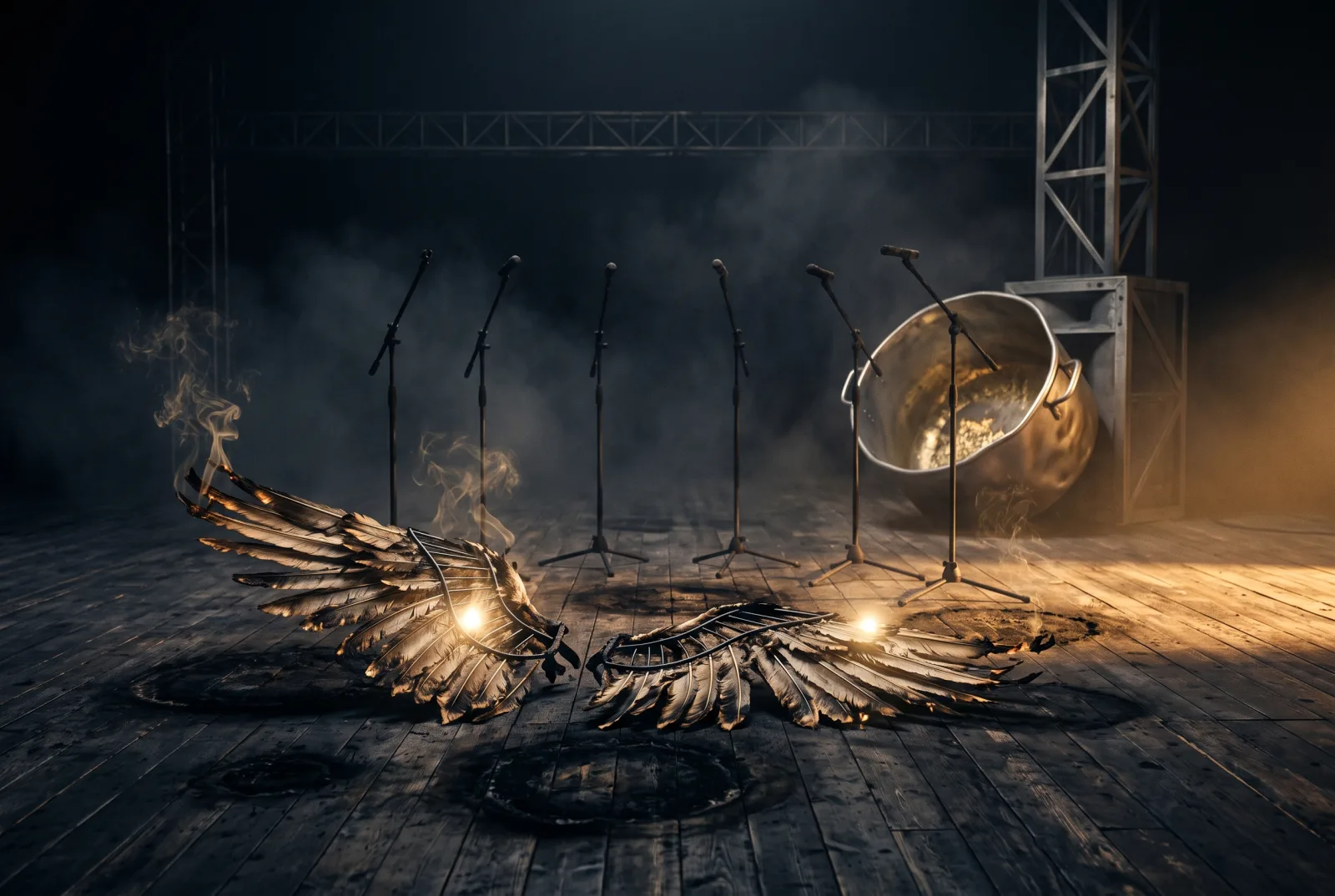
Ilustración: Rebobinados
There is something that should not work and does: a band that sings almost exclusively in German, with lyrics most of its audience does not understand, filling stadiums on five continents.
Rammstein is that, and much more: one of the strangest and most powerful phenomena in modern music.
Six men who made a show like nothing else out of the "hardest" language in rock, out of fire and out of provocation.
Six from the East
The band formed in Berlin in 1994, and there is one fact that explains a lot about its character: all six members were born and raised in East Germany, the communist one, before the fall of the Wall.
They come from a grey, closed world of scarcity, and that hardness is in their DNA. Kruspe, in fact, fled the GDR in 1989, after spending six days in detention for getting caught up in a protest.
The name has its own tangled history. At first the group was called Rammstein-Flugschau, a reference to the Ramstein air disaster of 1988, when a plane crashed into a crowd at an air show and some seventy people died. Over the years the band distanced itself from that explanation and maintains that the name comes from the Rammsteine, the ramming stones that protected old gateways. The second m, according to Paul Landers, was simply a spelling mistake that stuck.
Their music has its own name in their country: Neue Deutsche Härte, "new German hardness". Crushingly heavy industrial metal riffs, almost techno dance rhythms, and an almost operatic grandiosity, crowned by the deep, exaggeratedly Germanic voice of Till Lindemann.
With "Du Hast", in 1997 — a play on words between "you have" and "you hate" — they leapt into the world. And they did not stop: they have sold more than twenty million records, and are considered the most successful German-language band in history.
The fire
But the heart of the Rammstein phenomenon is not only in the records: it is on stage.
Their concerts are among the most spectacular that exist, and they revolve around fire. Lindemann comes out with flamethrowers, with burning wings, spitting fire; there are deranged theatrical sets, such as the giant pot in which he "boils" the keyboard player during a song about a real German cannibal.
It is a total assault on the senses: half metal concert, half macabre opera, half pyrotechnic circus.
People go to watch the stage burn as much as to hear the songs.
Provoking without being understood
And here is the most interesting key of all: Rammstein makes an art of provoking without being understood.
Since most of their audience does not speak German, the band plays with taboo, black humour, irony, historical trauma and provocation in lyrics that almost everyone experiences as pure sound and pure spectacle.
They sing uncomfortable, dark, ambiguous things, knowing that most listeners only hear the force and see the fire. They deliberately seek the misunderstanding; that bewilderment is part of the art.
The aesthetic and its accusations
That game has landed them in controversy, and it has to be told with balance.
Their aesthetic — the martial quality, the hard language, the mass spectacles, and above all their use in 1998, in the video for "Stripped", of images from "Olympia", the film Leni Riefenstahl shot at the Berlin Games of 1936 — has led many to accuse them of flirting with fascist iconography.
The band rejects it. Lindemann said so bluntly: we come from the East and grew up as socialists, we were punks or goths, we hate the Nazis. In 2001 they released "Links 2-3-4" as an explicit answer to those accusations. MTV Germany went as far as investigating them and concluded that they had no link whatsoever to the far right.
Their song "Deutschland", from 2019, was read by a good part of the critics as an uncomfortable, critical reckoning with German history, although the band, true to its method, avoided explaining it.
The debate about where the line lies is a real one, and we are not going to close it here.
The 2023 case
And there is a more serious and more recent controversy that has to be handled carefully and precisely, because it is easy to tell it wrong in both directions.
After the concert of 22 May 2023 in Vilnius, an attendee, Shelby Lynn, posted on social media that she believed she had been drugged at a party in the band's orbit. She herself stressed, then and afterwards, that she was not accusing anyone of rape.
In June, a joint investigation by the Süddeutsche Zeitung, NDR and WDR, and then a cover story in Der Spiegel, described an alleged system — "row zero" — for bringing fans close to Lindemann.
On 15 June 2023 the Berlin prosecutor's office opened proceedings against Lindemann over alleged sexual offences and offences against the narcotics law. It opened them on its own initiative and on the basis of complaints by third parties, not by the alleged victims.
On 29 August 2023 it closed the investigation for lack of sufficient grounds to bring charges. It is worth being precise about that: it is not a judicial declaration of innocence nor an acquittal, it is a decision about the insufficiency of the evidence to press charges.
Then came the civil courts, with mixed results. Lindemann obtained injunctions against Der Spiegel, the Süddeutsche and NDR in respect of certain insinuations; he lost other proceedings; and in October 2025 a Hamburg court barred Shelby Lynn from repeating that drugs had been mixed into her drink, because she had not been able to prove it.
The facts, then, are these: there were serious and very widely reported public accusations, a criminal investigation closed for lack of sufficient evidence, and a chain of civil litigation that did not settle the debate.
The matter has left society divided. There are those who still back the complainants and the questions they raised about power and abuse in the industry, and there are those who stick to the legal outcome and the denials. Rebobinados puts the facts on the table and does not hand down a verdict.
What to remember
Rammstein is a genuine phenomenon: six East Germans who conquered the planet in a language almost none of their fans speak, armed with fire, spectacle and a deliberate art of provocation.
They are the proof that music can skip language entirely — there are whole stadiums phonetically shouting a German they do not understand — and that discomfort and theatrical danger can be a form of art.
And they are, inevitably, a lightning rod: a band whose entire method is to provoke is going to attract controversy, partly for the imagery it plays with, partly over much more serious accusations.
Both things can be held at once: the spectacle and the questions.
If you put on "Du Hast", "Sonne" or "Deutschland", you will hear the most successful German-language band in history turning fire, taboo and its own difficult national history into something a stadium full of strangers roars back at them.
Provocation, in the end, is like their fire: it warms and it burns. And where the line falls between art that unsettles and art that harms is, precisely, the debate they take care to keep permanently alight.
This text mentions sexual violence. If you or someone you know has been through something like this, you are not alone and help is available. In Chile, the SernamEG Gender Violence Helpline is 1455, from 08:00 to 00:00 every day, with a silent WhatsApp service at +56 9 9700 7000. For emergencies during the night there are Carabineros' 149, plus 133 and 134. And in the case of a recent sexual assault you can go directly to any emergency service, without needing to have filed a report: care is guaranteed within the first 72 hours. Seeking support is an act of strength.
Sources
Rammstein, a German industrial metal band (Neue Deutsche Härte) formed in Berlin in 1994, with a line-up that has remained intact: Till Lindemann (vocals, lyrics), Richard Kruspe (lead guitar), Paul Landers (rhythm guitar), Oliver Riedel (bass), Christoph Schneider (drums) and Christian "Flake" Lorenz (keyboards). All were born and raised in the former German Democratic Republic; Kruspe fled the GDR in 1989 after being detained and questioned for six days. The group was initially called Rammstein-Flugschau, a reference to the Ramstein air disaster of 28 August 1988, in which some 70 people died, and had an early song about the accident; the band later distanced itself from that explanation and attributes the name to the Rammsteine, the ramming stones of old gateways, while Paul Landers has said that the second "m" was a spelling mistake. They sing almost exclusively in German; the certifications collected by the German discography add up to around 22.7 million units, and they are considered the most successful German-language band in history, a formula more attributable than measurable. Their single "Du Hast" (1997, from "Sehnsucht") marked their international breakthrough. They are celebrated for their shows with extensive pyrotechnics. Their aesthetic has generated recurring accusations of flirting with fascist iconography, in particular over the video for "Stripped" (July 1998, directed by Philipp Stölzl), edited with images from "Olympia", Leni Riefenstahl's film about the Berlin Olympic Games of 1936; MTV Germany investigated the matter and concluded that the band had no links to the far right. Lindemann told Rolling Stone, in words translated here from the German: "We come from the East and we grew up as socialists. We used to be punks or goths: we hate the Nazis!". "Links 2-3-4" (2001) was an explicit answer to those accusations, and "Deutschland" (2019) has been read by a good part of the critics as a critical look at German history and identity. On the 2023 case: after the concert of 22 May in Vilnius, the attendee Shelby Lynn stated publicly that she had been drugged at a party in the band's orbit, stressing that she was not accusing anyone of rape; a subsequent toxicological analysis in Lithuania came back negative. On 1 and 2 June 2023 the Süddeutsche Zeitung, NDR and WDR published a joint investigation, and on 10 June Der Spiegel devoted its cover to the matter, on the so-called "row zero". The Berlin prosecutor's office opened proceedings against Lindemann on 15 June 2023 over alleged sexual offences and offences against the narcotics law — on its own initiative and on the basis of complaints by third parties, not by the alleged victims — and closed the investigation on 29 August 2023 under § 170 Abs. 2 StPO, for lack of sufficient grounds to bring charges; that decision does not constitute a judicial declaration of innocence. Lindemann subsequently litigated before the civil courts with mixed results: he obtained injunctions against Der Spiegel, the Süddeutsche Zeitung and NDR in respect of certain insinuations, lost other proceedings, and on 24 October 2025 the Hamburg Regional Court barred Shelby Lynn from stating that drugs had been mixed into her drink, as she had not been able to prove it. This text presents the case even-handedly, without passing judgement on the facts. Externally authored text, edited and verified for Rebobinados. Interpretations of the meaning of their work are offered as the author's reading. No song lyrics are reproduced, for copyright reasons. Information drawn from Wikipedia, Rolling Stone, Der Spiegel, Süddeutsche Zeitung, LTO, Tagesspiegel and other press coverage.
Keep rewinding

10s
metal
Bring Me the Horizon
Twenty years to get back to the scream
Bring Me the Horizon started in 2006 with a deathcore record and their turn did not happen in 2013: the leap to metalcore was in September 2008 and the synthesisers and clean vocals arrived in October 2010. Jordan Fish, eleven years in the band, was the one who put in the electronics. On 10 July 2026 they re-recorded that first record for its twentieth anniversary, with Oli Sykes back on the guttural scream.
00s
metal
Staind
The sleeve that nearly cost them everything
In October 1997, Fred Durst tried to pull Staind off the bill at the Webster Theatre in Hartford over the sleeve of their home-made record; then he listened to them and signed them. In 2001, Break the Cycle debuted at number one on the Billboard 200 and "It's Been Awhile" spent sixteen weeks at number one on the Modern Rock. Jon Wysocki, founding drummer, died on 18 May 2024.

90s
metal
Marilyn Manson
The lawsuit he withdrew while paying
The triad of Antichrist Superstar, Mechanical Animals and Holy Wood, and a file that is still open: two out-of-court settlements, one sworn retraction, the prosecutor's office that ruled out charges in January 2025 on statute-of-limitations grounds, the defamation suit he withdrew while paying 327,000 dollars and a jury trial set for November 2027.
Rewind with us
Comments · 0
No one has commented yet. Open the conversation.