
Patricio Rey y sus Redonditos de Ricota
The band that asked no one's permission
By Rebobinados · Published on October 1, 2026
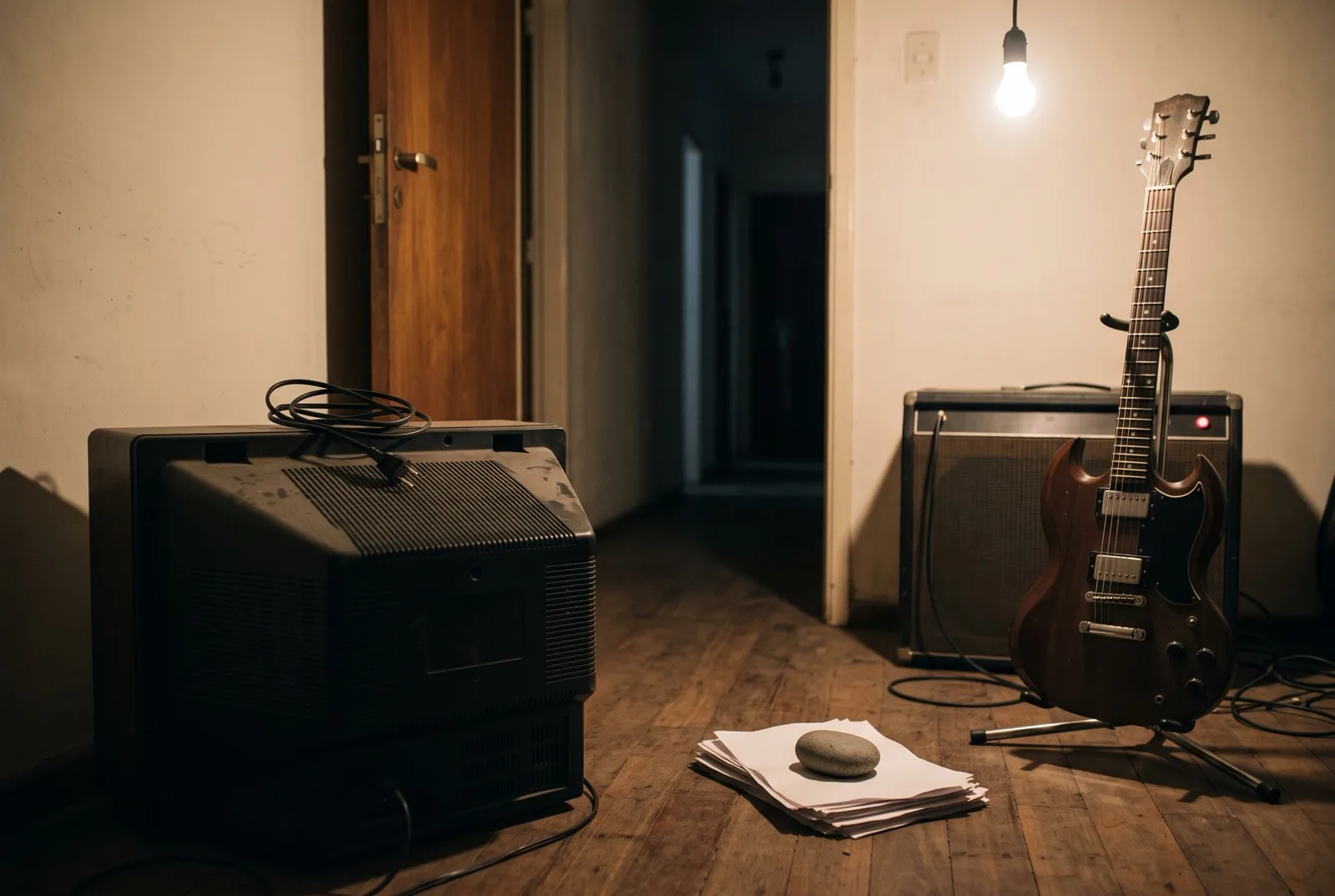
Ilustración: Rebobinados
There was a band in Argentina that became one of the biggest in Spanish-language rock practically with its back turned to television, giving almost no interviews, never letting the industry lay a finger on it. Los Redonditos de Ricota did almost everything the opposite way from what the success manual dictates, and for that very reason they became something more than a band: a secular religion, with its faithful — the "ricoteros" — its rituals and its codes.
La Plata and a brilliant partnership
Los Redondos were born in La Plata around 1976, and their heart was two opposite, complementary figures: el Indio Solari, the voice and the author of the lyrics, a dark, cryptic, brilliant poet; and Skay Beilinson, the guitarist, owner of an unmistakable sound and unmistakable riffs. Around them revolved a collective christened with the imaginary name "Patricio Rey", a kind of mythical character that encompassed the band and its whole tribe, with Semilla Bucciarelli on bass, Walter Sidotti on drums and Sergio Dawi on saxophone.
From the start they made one thing clear: they would do things their own way. No big labels giving orders, no outside rules, pure self-management at a time when that was nearly impossible. And television, which for any eighties band was the obligatory route, in their case barely existed: Solari once dismissed it as "a trip for the idiot eye". There were scattered appearances — an interview in 1985, the odd pass through the studios in the nineties — but as a strategy the decision was not to be there. The audience rewarded it with ferocious loyalty.
Oktubre and the ricotero phenomenon
Their music was powerful rock, with encrypted poetry that fans picked apart as if it were sacred text. Albums like Gulp! and above all Oktubre, from 1986, became monuments of Argentine rock, and songs like "Ji Ji Ji" turned into anthems that entire crowds sang while jumping.
Because a Redondos concert was not a show: it was a pilgrimage. Ricoteros came from all over the country, camped out days in advance, had their own look and their own language. Something tribal was generated that was like nothing else.
That phenomenon also had its dark side, and telling it in full is part of telling it properly. The concerts accumulated years of police operations, episodes of violence and municipal bans. In 1991, after a police raid at a concert by the band, Walter Bulacio died, a young man of seventeen who had been detained by the police; the case became one of the symbols of institutional violence in Argentina and reached the Inter-American Court. The story of Los Redondos cannot be understood without that shadow.
The breaking of the myth
Like every great creative partnership, the one between el Indio and Skay also cracked. The last concert was on 4 August 2001, at the Chateau Carreras in Córdoba, before some fifty thousand people. The split was announced three months later, on 2 November.
The reasons were more than a clash of egos: there were artistic differences, but also a dispute over control of the project and over the band's historical archives, and the accumulated wear of years of violence and bans around the concerts. Each went his own solo way — el Indio with his massive crowds, Skay with his own band — but Los Redondos, as such, never played again.
El Indio Solari, who lived with Parkinson's in his final years, died on 5 June 2026, at seventy-seven. His farewell was enormous: in squares all over Argentina the ricoteros gathered in spontaneous "misas" to mourn him and sing to him, there were flag-waving gatherings at the Obelisco and in Plaza de Mayo, and more than two hundred thousand people passed through the public wake in Avellaneda. A popular idol of a kind few of which are left had gone.
What to remember
Patricio Rey y sus Redonditos de Ricota taught rock that independence is possible, and that the deepest connection with people is not bought with advertising or with television: it is earned with consistency. They were a band that owned its own destiny, that turned its audience into a community and its concerts into ceremonies.
That community had a price that is not always named, and that a boy of seventeen paid in full. Saying so does not tarnish the legacy: it completes it. With el Indio's poetry and Skay's guitar they left a songbook that several generations still sing while jumping. When "Ji Ji Ji" plays and an entire crowd leaps as a single body, that is their greatest work: not an album, but a people. And that kind of legacy never goes out.
Sources
Patricio Rey y sus Redonditos de Ricota was an Argentine rock band formed in La Plata around 1976. Its central figures were el Indio Solari (Carlos Alberto Solari; vocals and lyrics) and Skay Beilinson (guitar), alongside Semilla Bucciarelli (bass), Walter Sidotti (drums) and Sergio Dawi (saxophone). They were known for their independence from the major labels and for staying almost entirely away from television, though they did make occasional appearances, among them a television interview in 1985. Their album "Oktubre" (1986) and songs such as "Ji Ji Ji" are emblems of Argentine rock; their concerts drew crowds of followers known as "ricoteros". On 19 April 1991, after a police raid at a concert by the band at Obras Sanitarias, Walter Bulacio, aged 17, was detained and died days later; the case became an emblem of institutional violence in Argentina and reached the Inter-American Court of Human Rights. The band's concerts were marked by police operations and municipal bans in several cities. Their last concert took place on 4 August 2001 at the Estadio Chateau Carreras in Córdoba, before some 50,000 people, and the definitive split was announced on 2 November of that year; beyond artistic differences between Solari and Beilinson, there were disputes over control of the project and the band's archives. The group never reunited. El Indio Solari, diagnosed with Parkinson's around 2016, died on 5 June 2026, aged 77; his death gave rise to spontaneous "misas ricoteras" in squares across the country, flag-waving gatherings in Plaza de Mayo and at the Obelisco, and a public wake in Avellaneda attended by more than 200,000 people. Profile compiled for Rebobinados with fact-checking; interpretations of the meaning of the work are offered as the author's reading. No song lyrics are reproduced, for copyright reasons. Information drawn from La Nación, Infobae, Rolling Stone en Español, El Destape and other coverage.
Keep rewinding

10s
pop
Bruno Mars
Eleven names in the credits
"Uptown Funk" came out on 10 November 2014 with six writers and today it has eleven. In February 2015 The Gap Band's publisher filed a claim over "Oops Up Side Your Head" in YouTube's copyright system —there was never a lawsuit— and on 28 April five names were added, with 17 % of the publishing. It happened weeks after the "Blurred Lines" verdict, and the song had been fourteen weeks at number one.

00s
pop
André Rieu
It was not from the jazz suite
The waltz with which André Rieu reached half the world is not from Shostakovich's Suite for Jazz Orchestra No. 2: it is from the Suite for Variety Orchestra, which the composer did not assemble, and it was born in 1956 as music for a Soviet film about settlers in Kazakhstan. The error comes from a misprint in volume 10 of the complete works (Muzyka, Moscow, 1984), corrected only in 2001. And the title "The Second Waltz" was invented by his wife, because the real one did not sell.

90s
pop
Daniela Mercury
She took the neighbourhood out of the song
"O Canto da Cidade" was written by Tote Gira, a composer from Nordeste de Amaralina who recorded the demo on a borrowed cassette, marking the beat on the door of a refrigerator; Mercury's team almost threw the tape away. She shares the credit because she deleted the references to the Pelourinho so that the song would serve all of Brazil. The album, from 20 September 1992, sold more than 2 million copies and nationalised axé. But she did not invent it: the name was a journalist's insult in 1987.
Rewind with us
Comments · 0
No one has commented yet. Open the conversation.