
Rick Astley
The one who served the tea
By Rebobinados · Published on September 27, 2026
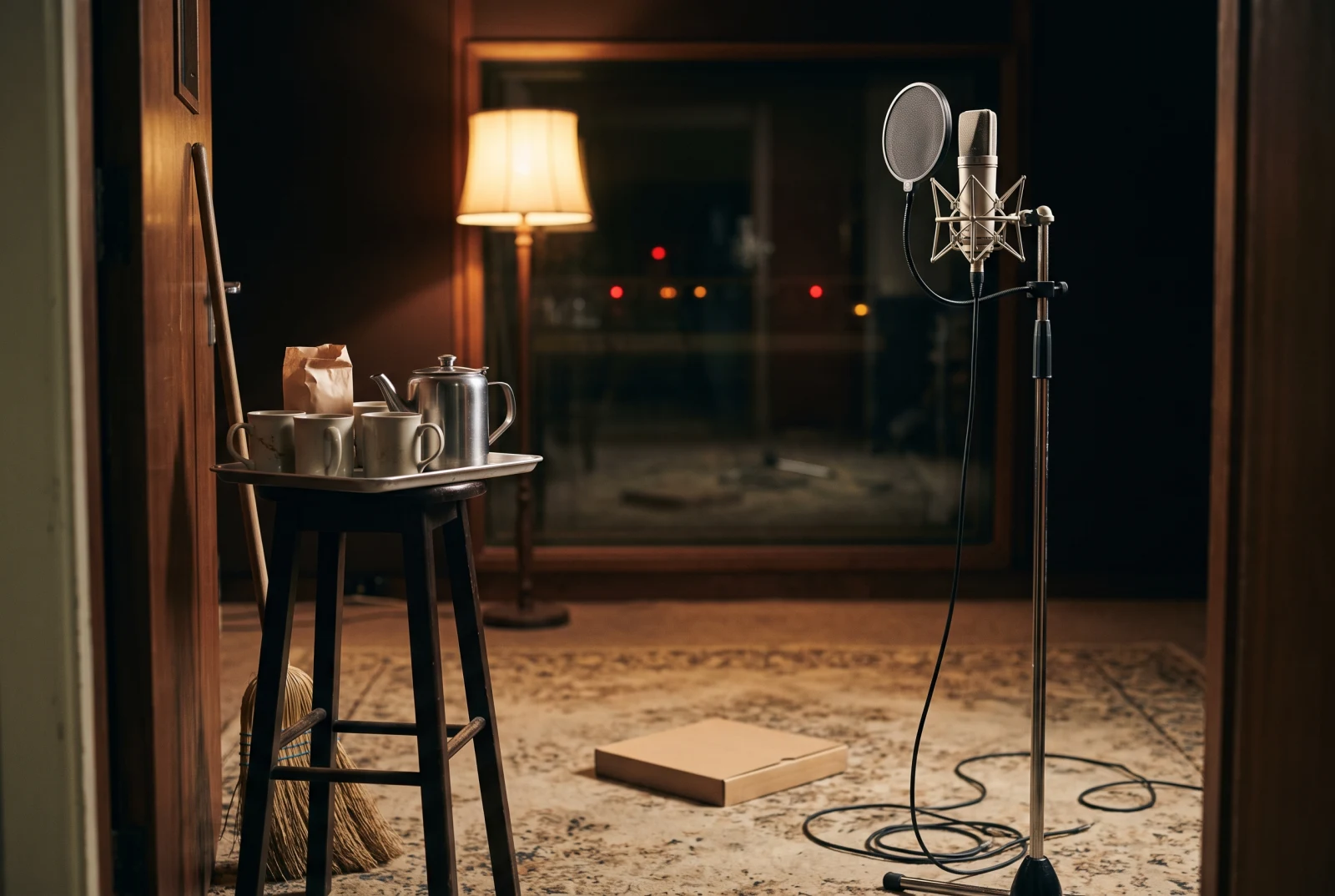
Ilustración: Rebobinados
Pete Waterman saw Rick Astley for the first time in 1985, singing and playing the drums in a soul band called FBI, at a club in Warrington. He liked the voice straight away. What he did next was take him off to his studios and put him to work as an errand boy and tape operator for about two years. The order matters, because it is always told the other way round: he was not an assistant in whom a voice was discovered one day. He was a singer who was put to serving the tea.
First he sang, and then he served the tea
Richard Paul Astley was born on 6 February 1966 in Newton-le-Willows, in the north-west of England. By the time Waterman signed him, he was already the frontman of a working band. At the PWL studios in London he spent two years hauling cables, making coffee and handling tapes while Stock, Aitken and Waterman manufactured hits a few metres away from him. The explanation for that wait comes from PWL's own circle: Astley was severely shy, and the idea was that the studio would knock it out of him before putting him in front of a microphone.
It sounds like factory cruelty and it was probably both things at once, cruelty and method. What is certain is that, when they finally recorded him, he had two years of seeing from the inside how a record is built. Few debutants arrive that well trained at the first attempt.
The factory, the voice and the U-turn at Heathrow
"Never Gonna Give You Up" came out in 1987 and was number one in more than twenty countries. The song is not his: it was written by Mike Stock, Matt Aitken and Pete Waterman, like almost everything that came out of that house. What was his, and what was the disconcerting part, was that impossible baritone voice coming out of a twenty-one-year-old face. Along came "Whenever You Need Somebody" and "Together Forever", and for a couple of years he was one of the most recognisable faces in pop.
In 1991 he released "Cry for Help", a soul ballad he co-wrote with Rob Fisher and on which the Andraé Crouch choir sings. It reached number seven in the United Kingdom and in the United States, and it was his last top ten. It sounded like a statement of intent: this is what I want to do when I get to choose.
Afterwards he did not leave straight away, as it is usually told. In between he released Body & Soul, in 1993, and that same year, at 27, he quit music. The documented scene is the Heathrow one: his daughter had just been born, he was on his way to the airport for another tour and he turned around. There was no scandal and no epic statement. There was a guy who decided he would rather be at home.
Twelve dollars
Rickrolling was not born of "reasons only the internet understands". It has a genealogy and a date. It comes from the duckroll, a 4chan joke from 2006 in which a promised link ended up at the image of a duck with wheels, and the handover happened on 15 May 2007, when somebody disguised the video for "Never Gonna Give You Up" as a leaked trailer for Grand Theft Auto IV. From then on, millions of tricked clicks.
His reaction is idealised too. Astley has said that at first it simply struck him as odd — he used the English word "bizarre" — and his record company went as far as settling the matter with the press by saying that he was not going to talk about it any more. In 2008, when the MTV Europe Music Awards gave him a prize born of an internet campaign, he did not go to collect it and called it nonsense. The patience and good humour with which he carries it today are real, but they came later, not from day one.
And there is one fact that puts everything else in order. Since he did not write the song, he is not paid for composition. In 2010 he said that his YouTube royalties from the phenomenon were around twelve dollars; Waterman declared eleven pounds for the year 2009. Tens of millions of plays, a global joke, and that in the account. The career did come back, and seriously: a British number one with 50 in 2016 and tours of full arenas. But the meme, on its own, did not pay for a single dinner.
What to remember
Rick Astley was a singer before he was an assistant, not the other way round: Waterman saw him with a soul band in Warrington in 1985 and only afterwards put him in the studio to serve coffees. He did not write "Never Gonna Give You Up" — it is by Stock, Aitken and Waterman — and he retired in 1993, at 27, after releasing one more record that almost nobody remembers. The return came two decades later by a route nobody would have designed.
What his story teaches is not that the internet is generous. It is that mass affection and money are two separate circuits: twelve dollars in royalties against a joke that went around the world. What he did with that — stopping fighting it, climbing aboard and turning it into a genuine second career — is his own achievement and it took a while to arrive. Almost nobody gets a second act. Fewer still get one out of a forum joke.
Sources
Rick Astley (Richard Paul Astley) was born on 6 February 1966 in Newton-le-Willows, England. Pete Waterman saw him perform in 1985 as singer and drummer of the soul band FBI at a club in Warrington and subsequently brought him into the PWL studios, where he worked for close to two years as an assistant and tape operator before recording. "Never Gonna Give You Up" (1987), written and produced by Mike Stock, Matt Aitken and Pete Waterman, reached number one in more than twenty countries; it was followed by "Whenever You Need Somebody" and "Together Forever". "Cry for Help" (1991), co-written with Rob Fisher and recorded with the Andraé Crouch choir, reached number seven in the United Kingdom and in the United States and was his last top ten. He released "Body & Soul" in 1993 and retired from music that same year, at 27, a decision he has linked to the birth of his daughter. The "rickrolling" phenomenon derives from 4chan's "duckroll" (2006) and originated on 15 May 2007, with the video for "Never Gonna Give You Up" presented as a trailer for "Grand Theft Auto IV". Astley has stated that he initially found it strange and did not go to collect the prize awarded to him by the 2008 MTV Europe Music Awards. In 2010 he said he had received around twelve dollars in YouTube royalties from the phenomenon; Pete Waterman put his own at eleven pounds for 2009. His album "50" (2016) reached number one in the United Kingdom, and since then he has toured large-capacity venues. Profile compiled for Rebobinados with fact-checking; interpretations of the meaning of the work are offered as the author's reading. No song lyrics are reproduced, for copyright reasons. Information drawn from The Guardian, BBC, Official Charts Company, Billboard, Wikipedia and other coverage.
Keep rewinding

10s
pop
Bruno Mars
Eleven names in the credits
"Uptown Funk" came out on 10 November 2014 with six writers and today it has eleven. In February 2015 The Gap Band's publisher filed a claim over "Oops Up Side Your Head" in YouTube's copyright system —there was never a lawsuit— and on 28 April five names were added, with 17 % of the publishing. It happened weeks after the "Blurred Lines" verdict, and the song had been fourteen weeks at number one.

00s
pop
André Rieu
It was not from the jazz suite
The waltz with which André Rieu reached half the world is not from Shostakovich's Suite for Jazz Orchestra No. 2: it is from the Suite for Variety Orchestra, which the composer did not assemble, and it was born in 1956 as music for a Soviet film about settlers in Kazakhstan. The error comes from a misprint in volume 10 of the complete works (Muzyka, Moscow, 1984), corrected only in 2001. And the title "The Second Waltz" was invented by his wife, because the real one did not sell.

90s
pop
Daniela Mercury
She took the neighbourhood out of the song
"O Canto da Cidade" was written by Tote Gira, a composer from Nordeste de Amaralina who recorded the demo on a borrowed cassette, marking the beat on the door of a refrigerator; Mercury's team almost threw the tape away. She shares the credit because she deleted the references to the Pelourinho so that the song would serve all of Brazil. The album, from 20 September 1992, sold more than 2 million copies and nationalised axé. But she did not invent it: the name was a journalist's insult in 1987.
Rewind with us
Comments · 0
No one has commented yet. Open the conversation.