
Santo & Johnny
The guitar that weeps
By Rebobinados · Published on September 5, 2026
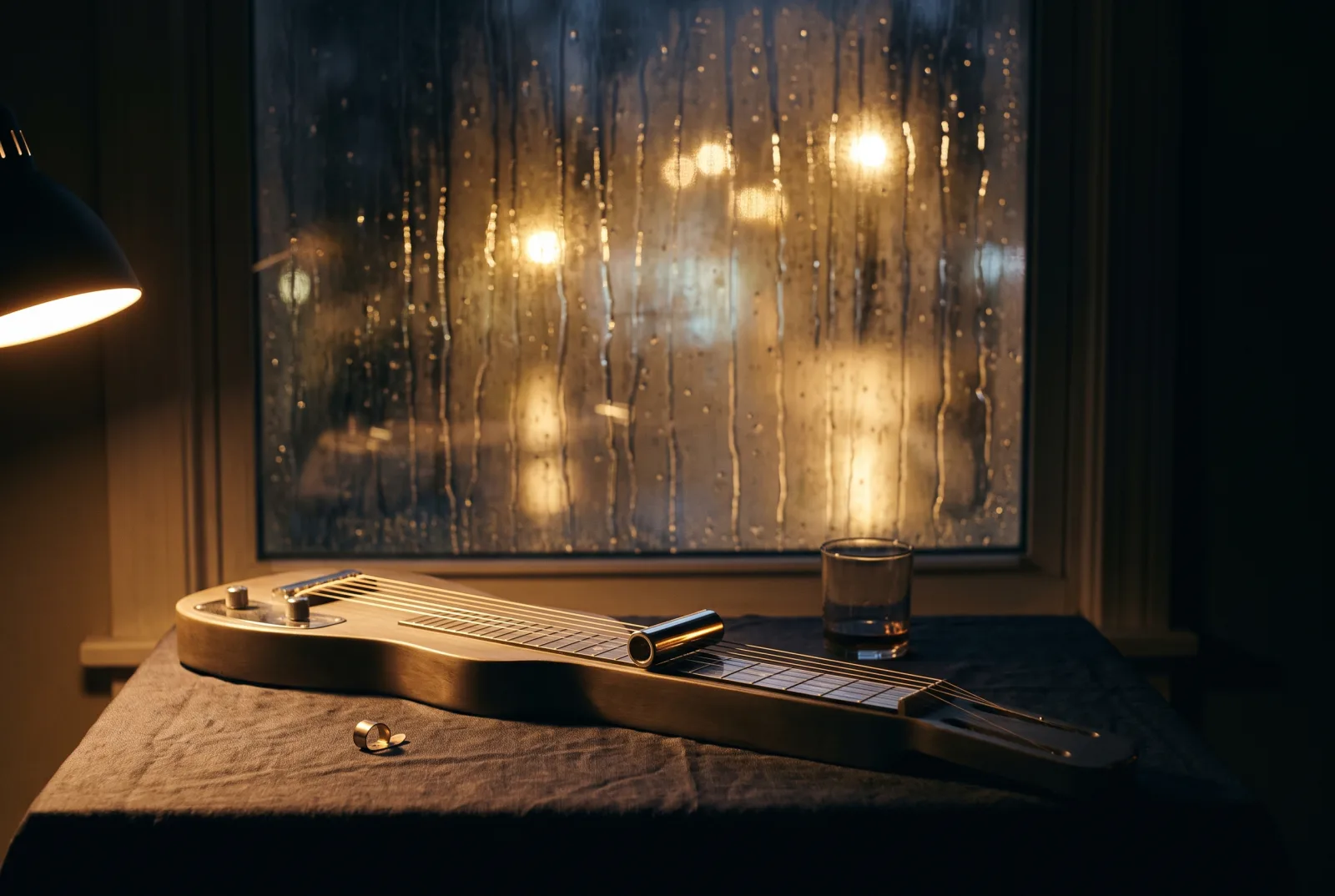
Ilustración: Rebobinados
In September 1959, the most listened-to song in the United States had no words.
It was called "Sleep Walk" and it had been recorded by two Italian American brothers from Brooklyn. It spent two weeks at number one. It was the last instrumental to reach the top in that decade.
At the height of the rock and roll explosion, with everyone shouting, what won out was a slow melody that seemed to weep.
A guitar you play lying down
The sound came from an uncommon instrument: the steel guitar, the one you play flat on its back, sliding a metal bar along the strings instead of pressing them against a neck.
Santo Farina, the older brother, played a Fender Stringmaster with three necks and eight strings each. Johnny, four years younger, backed him on an ordinary electric guitar.
That sliding does something no other guitar does: instead of jumping from one note to the next, it rises and falls without a break. There are no steps. The note drags.
That is exactly what a human voice does when it moans. And that is why "Sleep Walk" sounds like somebody grieving without saying a word.
No singer was needed. Santo's guitar was the voice.
What it cost to do that in 1959
It helps to understand what they were playing against.
1959 was the year of Chuck Berry, of Little Richard, of speed and scandal. Young people's music was noise and it was rebellion, and an eighteen-year-old boy was not supposed to want a slow, sad melody with no lyrics.
The Farinas cut the track at Trinity Music, in Manhattan. It is credited to Santo, Johnny and Ann Farina, Santo's wife, though Johnny would say later that her name was included by mistake.
And the whole country, those eighteen-year-olds included, put it at number one.
The long life of a melody
Some songs age along with their era. "Sleep Walk" did the opposite: it came loose from 1959 and became the sound of nostalgia itself.
It has turned up in dozens of films. The most remembered is "La Bamba", from 1987, where it carries the end of the story of Ritchie Valens — another boy of humble origins with a very short career, from those same years.
It inspired Fleetwood Mac's "Albatross", which in turn inspired the Beatles' "Sun King". A melody by two brothers from Brooklyn ended up, in two jumps, inside a Beatles record.
And the Brian Setzer Orchestra's version won a Grammy decades later.
What to remember
Santo & Johnny are proof that you do not need words to say something specific.
Put on "Sleep Walk" — at night, ideally — and you will understand what it is about without anyone explaining it. It is a song about walking in your sleep, about missing someone, about that hour when nothing can be fixed any more.
And it manages that with a metal bar sliding over six strings.
Remember them this way: not as a chart curiosity from the fifties, but as the two brothers who discovered that a guitar, laid down and dragged, weeps better than most voices.
Sources
Santo & Johnny, a duo made up of brothers Santo Farina (born 24 October 1937) and Johnny Farina (born 30 April 1941), from Brooklyn, New York, of an Italian American family. Santo played a Fender Stringmaster console steel guitar with three necks and eight strings each; Johnny played backing electric guitar. "Sleep Walk", recorded at Trinity Music (Manhattan), reached number one on the Billboard Hot 100 for two weeks in late September 1959 and was the last instrumental to top the chart in that decade. The composition is credited to Santo Farina, Johnny Farina and Ann Farina — Santo's wife — and on some editions also to Don Wolf; Johnny Farina later stated that Ann's credit was included by mistake. The song has appeared in dozens of films, among them "La Bamba" (1987), and influenced Fleetwood Mac's "Albatross", itself an acknowledged influence on the Beatles' "Sun King"; the Brian Setzer Orchestra's version won a Grammy for best pop instrumental performance. A note on a claim that circulates and that we have not been able to verify: some sources give Santo Farina as having died in 2023. We have found no obituary or record to support it, and it is on record that in June 2016 a false report of his death circulated and was denied the following day by Johnny Farina himself — the man who had died was a cousin of the same name. In the absence of a reliable source, this article does not assert his death. Externally authored text, edited and verified for Rebobinados. Interpretations of the meaning of their work are offered as the author's reading. No song lyrics are reproduced, for copyright reasons. Information drawn from Billboard, Wikipedia, AllMusic and other coverage.
Keep rewinding

10s
pop
Bruno Mars
Eleven names in the credits
"Uptown Funk" came out on 10 November 2014 with six writers and today it has eleven. In February 2015 The Gap Band's publisher filed a claim over "Oops Up Side Your Head" in YouTube's copyright system —there was never a lawsuit— and on 28 April five names were added, with 17 % of the publishing. It happened weeks after the "Blurred Lines" verdict, and the song had been fourteen weeks at number one.

00s
pop
André Rieu
It was not from the jazz suite
The waltz with which André Rieu reached half the world is not from Shostakovich's Suite for Jazz Orchestra No. 2: it is from the Suite for Variety Orchestra, which the composer did not assemble, and it was born in 1956 as music for a Soviet film about settlers in Kazakhstan. The error comes from a misprint in volume 10 of the complete works (Muzyka, Moscow, 1984), corrected only in 2001. And the title "The Second Waltz" was invented by his wife, because the real one did not sell.

90s
pop
Daniela Mercury
She took the neighbourhood out of the song
"O Canto da Cidade" was written by Tote Gira, a composer from Nordeste de Amaralina who recorded the demo on a borrowed cassette, marking the beat on the door of a refrigerator; Mercury's team almost threw the tape away. She shares the credit because she deleted the references to the Pelourinho so that the song would serve all of Brazil. The album, from 20 September 1992, sold more than 2 million copies and nationalised axé. But she did not invent it: the name was a journalist's insult in 1987.
Rewind with us
Comments · 0
No one has commented yet. Open the conversation.