
Opinion
To Be a Rocker Is to Live Without Fear
By Rebobinados · Published on August 20, 2026
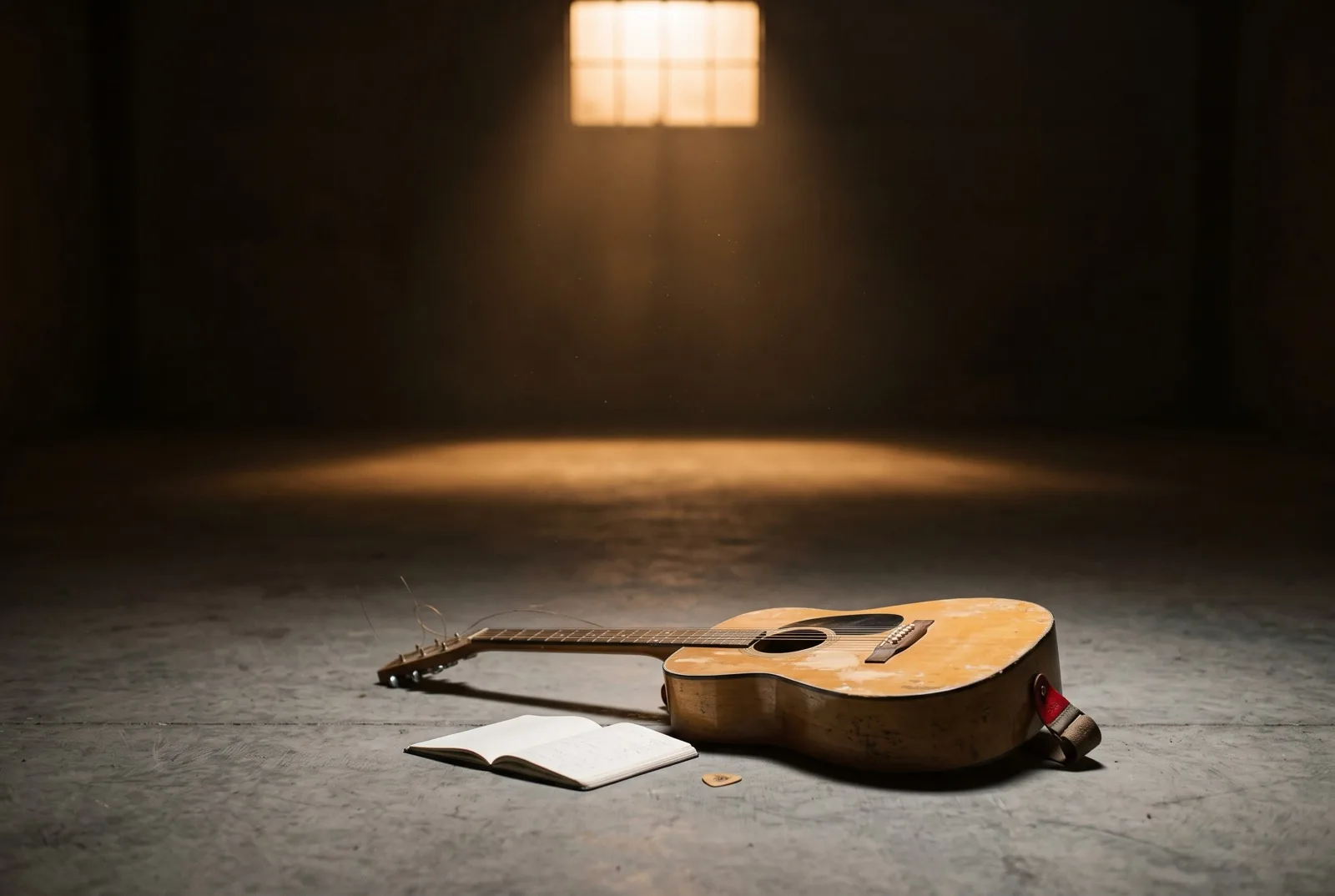
Ilustración: Rebobinados
Someone might ask what Víctor Jara is doing in a conversation about rock, given that he never played an electric guitar, that he came out of folk music and the theatre, that his songs sounded like the quena and the cueca long before they sounded like distortion. The answer is that rock, before it is a sound, is a stance towards authority. And on that ground Jara doesn't merely qualify: he leads.
Rock was born as insolence. Bodies moving the way they weren't supposed to, young people defying their parents and the church, people mixing where they weren't supposed to mix. The sound came afterwards; first came the gesture of standing in front of power and not lowering your eyes. If you accept that — that what is essential to rock is the attitude and not the guitar — then the question turns around: it isn't what Jara has to do with rock, it's how many rockers really deserve the name. Because Jara embodied the essence without needing the genre. He was more faithful to the spirit of rock than plenty of people who sounded like rock and made nobody uncomfortable.
A channel that can't be intercepted
And you have to understand why they killed him, because everything is there. They killed Jara because he terrified those in power. Not with weapons — he was a singer, a poet who spoke to people's hearts — but precisely because of that. Think of Chile in 1973: no internet, no social media, no algorithm. And even so, a man with a guitar had built a direct channel into the chest of a people, with no intermediaries and no permission. That is what power cannot stand, because it cannot intercept it. A pamphlet can be seized. A radio station can be shut down. A newspaper can be closed. But a song already inside thousands of people, hummed under the breath, kept in memory, cannot be confiscated. Jara was, in today's language, his own channel with total reach. And a channel like that, in the hands of someone with something true to say, is the most dangerous thing there is for anyone who wants to control everything.
What gives away power's fear
Foucault's lens throws light on this. Power isn't only what represses by force; it is also what watches, normalises and decides what may be said and what may not. And what it fears above all is whoever produces meaning outside its control: whoever gives people dignity, a "we", a reason, without going through the state. That's why the act of killing a musician gives power away more than anything else could. It reveals its fear. A military regime, with tanks and rifles, was so terrified of a man with a guitar that it needed to break his hands before killing him. That disproportion doesn't portray power's strength: it portrays its weakness. The powerful man who trembles before a singer is confessing that there is something his weapons cannot reach.
Dying of your demons or dying for what you say
There's an honest counterpoint to make here, because rock has its own mythology of death and it's worth not confusing it with this. A good part of the rock legend was built on the idol who destroys himself: the one who dies young of excess, the tormented one who goes by his own hand, the martyr of his inner demons. And that pain is often real — Kurt Cobain's was, and this is not about belittling it. But the difference has to be seen, because it's enormous. It is one thing to die fighting yourself, and another to be killed because what you say is dangerous to power. The first is an intimate tragedy that deserves respect. The second means your art mattered so much, had such an edge, that someone with power decided you could not remain alive. We romanticise the pose of the man who destroys himself, and sometimes we miss the greater courage: that of the man who was destroyed because an entire regime credited him with the power to destabilise it. Not dying of your own dramas, but having your voice outweigh your fear. That is what almost nobody dares.
The tenderness that doesn't kneel
And that courage, Jara's, wasn't the courage of the strongest or the toughest. It was the courage of tenderness that doesn't kneel. A man who sang softly, who worked from delicacy, who spoke to the heart and not to the fists, and who even so wasn't afraid of power. That is braver than any bravado, because it doesn't rest on force — where power does know how to fight — but on conviction, where power cannot get in. The courage that counts is the one chosen in spite of fear, not the one inherited from strength. Jara chose, knowing the risk, to go on singing what he believed. That is living without fear. That is being a rocker, even if it sounds like a wooden guitar.
That's why being a rocker, at bottom, has nothing to do with the genre you listen to or the clothes you wear. It is a form of courage, and it runs in two directions. Outwards: saying what you believe even when it costs you, not kneeling before whoever gives the orders, putting your strength on the side of the weak instead of on top of them. And inwards, which is the harder one: looking at yourself in the mirror without lying to yourself, and daring yourself to be better than you are. Jara had both. He sang for peasants and workers, for those who had no voice — he used his one power, a song, to defend those who had none — and he did it without the mask of the man who climbs on a stage to fake convictions he doesn't hold once he's off it.
You can't kill a pose
There is the law that separates Jara from almost the entire industry: he sang what he lived. That coherence between the song and the life is the only authenticity worth anything, not the kind hung up as a marketing label. If you're going to sing words that inspire, you have to live what you sing; if not, you're a commercial sham: the one who preaches courage and dines with power, the one who sings for the poor and uses them for his career. The sham always protects itself: it bends, it adapts, it sells. That's why you can't kill a pose. You can only kill someone who truly is what he sings, who has nowhere to hide because his life and his work say the same thing. They killed Jara because he was authentic all the way down, and his death was the ultimate proof that there was no pose: he paid with his body for the coherence others merely act out.
That is the bill life hands everyone sooner or later: the bill of coherence. Jara paid it in full, without hesitating. That's why, half a century later, his song is still standing while the poses of his time were carried off by the wind, and the men who killed him are names in a sentence. He won. He won because he was true, and what is true — the bond he wove with his people — is the kind of thing that cannot be seized.
Rewinding to Víctor Jara isn't visiting a martyr. It's learning something for living today, and you don't need a dictatorship to put it into practice: sing only what you're willing to live. Be brave outwards and inwards. Use whatever you have to protect whoever has nothing. And don't fake convictions you won't hold up when they cost you, because that, sooner or later, shows. The rest is noise. That is rock, and Jara understood it better than anyone without ever needing the name.
Keep rewinding
Opinion
Beneath the Language, the Pulse
Rock in Rio, 1985: how a continent split into two languages recognised itself at a single party. Brazil was coming out of twenty-one years of dictatorship and built the biggest festival Latin America had ever seen. A million and a half people discovering, without meaning to, that being Latin was never a language but a pulse running beneath Spanish and Portuguese.
Opinion
Music as Crowd Control and a Tool of Normalisation
How music shapes, disciplines and sometimes liberates crowds. From the Nuremberg rallies to Adorno, Foucault and the supermarket's piped music: why what feels like the freest of experiences is also one of the most effective instruments of control there is.
70s
folk
Florcita Motuda
Forty-nine years without a reissue
With "Brevemente… geeente" he won the best Chilean performer prize at Viña 1977, and he won it in the international competition because the folk one was not held that year. The album that contains it, released in 1977 on APRI —Antonio Prieto's label—, spent 49 years without a reissue: never on CD or streaming until it came back on vinyl in April 2026 and on digital on 11 July, the day he returned to the stage. The record for the longest title at the OTI is his, but it is from 1978 and not 1998.
Rewind with us
Comments · 0
No one has commented yet. Open the conversation.