
Opinion
Music as Crowd Control and a Tool of Normalisation
By Rebobinados · Published on August 9, 2026
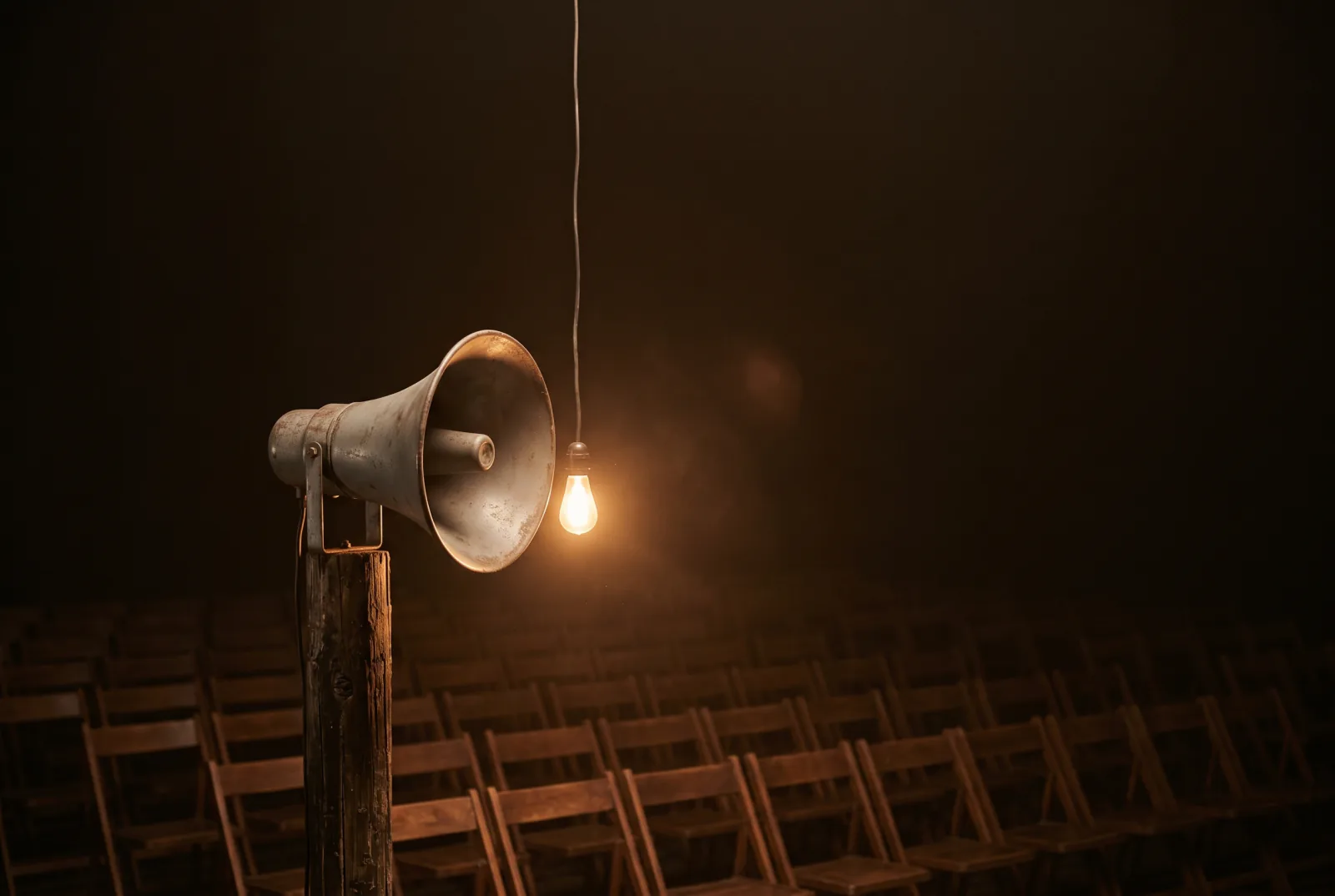
Ilustración: Rebobinados
There are few things we feel to be as free, as intimate, as much our own, as the music we love. We choose it, it moves us, it seems to speak straight to the soul with no intermediary. And precisely for that reason — because it lowers our defences, because it enters without asking permission, because it touches emotion before reason — music has been, throughout history, one of the most powerful tools ever used to shape crowds. What feels like the freest of experiences is also, looked at closely, one of the most effective instruments of control that exists.
This article explores that face of music. Not to ruin the songs you love, nor to fall into the paranoia that everything is a plot — it isn't — but to think seriously about something important thinkers have already thought: that music, like all mass culture, has a dimension that disciplines, normalises and sometimes manipulates. Understanding it doesn't make you cynical. It makes you freer, because you can only resist what you can see.
Why music is so good at controlling
Let's start with the basics: why music, specifically, works so well as an instrument of power. The answer was given with brutal clarity by Joseph Goebbels, the Nazi propaganda minister, who knew more about this than we would like: music affects the heart and the emotions more than the intellect. That's the whole of it.
Music bypasses rational thought and goes straight to emotion. You don't analyse it while you feel it; it runs right through you. And something that runs through you without passing the critical filter is an ideal vehicle for slipping in ideas, moods and loyalties you never examine. Music also synchronises: when many people sing, march or dance to the same rhythm, their bodies and their emotions fall into line, and out of that synchrony comes a feeling of unity, of belonging to something larger than oneself. That feeling is beautiful at a concert or in a stadium crowd — and it is extremely dangerous when directed by a power that seeks to dissolve the individual into the mass.
The totalitarian regimes of the twentieth century understood this perfectly. They grasped that music could skip past rational thought and influence the emotions directly, and they turned it into machinery.
Music as propaganda
The history of the deliberate use of music to control crowds is long and well documented, and its most chilling chapter is that of Nazi Germany.
For the Nazis, music wasn't entertainment: it was a weapon. They considered it the greatest "crowd-pleaser", the most effective way to seduce and move the masses. The party anthem, the Horst-Wessel-Lied, was sung daily in schools, factories and Hitler Youth meetings; by 1939 sheet music had been distributed to more than eight million members, with the explicit aim of instilling discipline and fervour. At the Nuremberg rallies, as many as four hundred thousand people marched in choreographed formations to the sound of the bands, amplified by loudspeakers and searchlights, in a hypnotic effect designed to bind those present psychologically to the regime's vision. Music transformed a crowd of individuals into a single obedient, synchronised, fervent mass.
And it wasn't only fervour: it was also exclusion. The regime censored and banned the music it deemed "degenerate" — jazz, the compositions of Jewish authors — controlling what could be listened to as much as what had to be sung. To define which music was acceptable was to define which world was acceptable. Nazi Germany didn't invent this — national anthems that ignite patriotism have existed since the eighteenth century, and "La Marseillaise" was born of the French Revolution — but it took it to an industrial scale and an unprecedented cynicism. The Soviet Union did its own version with socialist realism and its hymns to the glory of the State. The pattern repeats: wherever a power wants to move crowds without giving reasons, music appears to do the work argument cannot.
Everyday normalisation
But to focus only on the propaganda of brutal regimes would be to miss the most interesting and the closest part. Because control through music needs no dictators and no Nuremberg rallies. It operates, far more subtly and constantly, in the daily life of free societies. And to understand this we have to bring in two thinkers.
The first is Michel Foucault, with his idea of normalisation. Foucault showed that modern power doesn't work mainly by repressing from above, but by producing normality from everywhere: establishing, in a thousand diffuse ways, what is normal, expected, acceptable — and rendering deviant and correctable everything that departs from that norm. Nobody needs to order you what to feel; it's enough that a certain way of feeling becomes the air you breathe, the obvious, what everyone does. Mass music is an extraordinarily efficient factory of normality: by endlessly repeating certain themes, certain emotions, certain models of love, of success, of desire, it establishes, song after song, what is normal to feel and to want. It forbids you nothing. It teaches you, with a catchy melody, what is desirable. And what is desired without anyone imposing it is the most perfect control, because it doesn't even feel like control.
Adorno and the conformity factory
The second thinker, and the most direct on this, is Theodor Adorno, of the Frankfurt School, who along with Max Horkheimer coined the concept of the "culture industry" in 1944. His thesis is revealing, and that's why it's still relevant eighty years later: it names something we would rather not see about ourselves.
Adorno argued that popular music, under capitalism, is standardised: it uses the same formula over and over to reach the masses. He noted that almost all popular music has the same structure — verse, chorus, bridge — and that its elements are interchangeable without damaging the song. That standardisation, he held, isn't innocent: it produces standardisation in the listener. Formulaic music, made for easy consumption with no mental effort, trains the audience in passivity, in uncritical reception, in conformity. The song that doesn't ask you to think is teaching you not to think.
For Adorno, the culture industry deliberately manufactures sameness: standardised cultural products which, by pacifying and entertaining, maintain the social order and disable the capacity for resistance. Entertainment, in his ferocious analysis, is "putting things out of mind, forgetting suffering": amusement promises a liberation that is really liberation from thought. Popular music, on this reading, is a mechanism that keeps us docile by offering us pleasure in exchange for not thinking too much.
It has to be said that Adorno exaggerated, and that his contempt for popular music — including jazz, which he unfairly despised — has a great deal of cultural elitism in it, the kind that confuses the difficult with the valuable. Not all pop is a factory of docility; we've already seen, on another occasion, that popular music also carried real claims and real liberations. But it would be a mistake to dismiss Adorno as an elitist and lose his central warning, which holds: when music is produced industrially, to sell as much as possible, it tends towards formula, and formula tends towards passivity. There is a real, structural pressure towards the standardised — towards what doesn't force you to feel the pain, to name the fear, to take sides. Formula avoids, above all, what would knock you off balance: it prefers the song that strokes you to the one that shakes you, because the one that shakes you might also move you to think, or worse, to act. That pressure exists whether you feel it or not.
Manipulation measured in the laboratory
In case all of the above sounded like pure theory, it's worth knowing that music's manipulative effect has been measured, and the results are unsettling. Studies of background music in advertising have shown that positive music reduces awareness of an unethical message and increases acceptance of the product: in the presence of pleasant music, people remember less of the critical information and accept more of what is being sold to them. Music lowers the moral guard. It isn't a metaphor: it's an effect demonstrated in the laboratory.
There is the everyday, commercial version of control: the supermarket's ambient music calibrated so you buy more and walk at a certain pace, the advertisement's soundtrack designed so you associate a feeling with a brand, the piped music that makes a space feel pleasant and lowers your defences. There's no dictator here, only the market — but the mechanics are the same: using music to shape your behaviour beneath your awareness.
The music that liberates
And yet — and this is crucial if we're not to fall into paranoid pessimism — the history of music as control is only half the story. Because the same music that can discipline can liberate, and time and again it has.
The reason is that music has a quality that makes it uncontrollable in the long run: its polysemy, its capacity to mean many things, to be reinterpreted. A song made for one end can be taken over for the opposite one. "Lili Marleen", born in the German military milieu, was adopted and sung by soldiers on both sides of the Second World War. Under regimes that banned jazz, bootleg tapes circulated in secret — a sonic samizdat — carrying the forbidden music, and that clandestinity turned the music into an act of resistance. The very protest song a power tries to silence becomes the anthem of those who resist. Music slips out of the hands that want to steer it.
For every use of music to dominate, there is a use to liberate. The gospel that sustained the enslaved, the civil rights songs, the rock that frightened conservatives, the punk that spat at the system, the Latin American nueva canción, the hip-hop that gave the margins a voice. Music is a contested field, not the weapon of a single owner. Whoever uses it to normalise and control will always find, sooner or later, that someone is using it for the opposite. It is too powerful, and too free, to belong to one side.
Listening with your eyes open
So what do we do with all this? Not stop loving music — that would be absurd and sad. Nor become paranoid and hear a conspiracy in every chorus — there isn't one. What's called for is something more grown-up: listening with your eyes open. Knowing that music is never merely innocent entertainment, that it always carries within it a dimension that shapes, that there are interests — sometimes political, sometimes commercial, sometimes just the inertia of the industry — pushing at what you feel and desire. Knowing it doesn't take away the pleasure; it gives you back the choice.
Because the difference between being shaped and choosing is, precisely, awareness. Whoever doesn't know that music moves them is moved. Whoever knows it can decide when to let go and when to resist, what to make their own and what to refuse. Music will keep trying to normalise you — that's its nature in a mass society — but you can listen to it knowing that, and in that knowing lies your freedom. It isn't about ceasing to feel. It's about feeling without ceasing to think. Which is, in the end, the hardest and most valuable thing a human being can do in the face of anything that wants to move them without their permission.
Listen to everything. Love it, even. But never stop knowing what music is doing to you while it plays. That lucid vigilance, that wakeful feeling, is the only way the freest music in the world doesn't become, without your noticing, the subtlest of your chains.
Keep rewinding

Opinion
To Be a Rocker Is to Live Without Fear
Why Víctor Jara, who never played rock, embodied its essence more than almost anyone. If what is essential to rock is the attitude and not the guitar, the question turns around: it isn't what Jara has to do with rock, but how many rockers deserve the name. On power that fears a singer, tenderness that doesn't kneel, and the bond that can't be seized.
Opinion
Beneath the Language, the Pulse
Rock in Rio, 1985: how a continent split into two languages recognised itself at a single party. Brazil was coming out of twenty-one years of dictatorship and built the biggest festival Latin America had ever seen. A million and a half people discovering, without meaning to, that being Latin was never a language but a pulse running beneath Spanish and Portuguese.
60s
hard rock
Steppenwolf
The motorcycle was a Ford Falcon
The century's biker anthem was not written by the band that sings it, and it was not about a motorcycle: Mars Bonfire wrote "Born to Be Wild" as a folk ballad about his battered Ford Falcon, and he had left the group in June 1967, before the name Steppenwolf existed. "The Pusher" is Hoyt Axton's, Easy Rider dropped it in as a temporary track, and the single stalled at no. 2 on the Hot 100 in 1968.
Rewind with us
Comments · 0
No one has commented yet. Open the conversation.