
Skank
Joy, properly made
By Rebobinados · Published on September 17, 2026
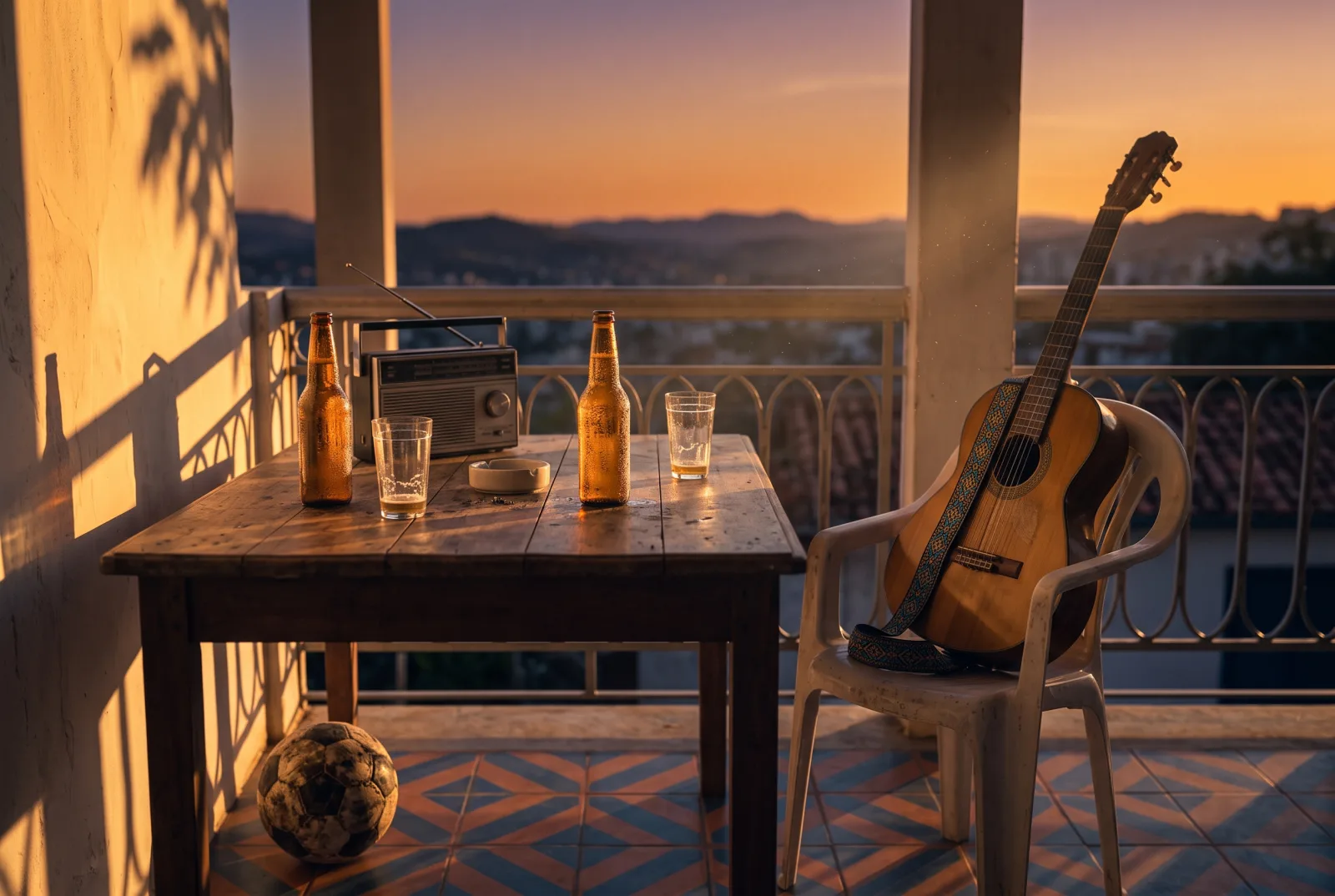
Ilustración: Rebobinados
There is a silly idea worth taking apart: that happy music is minor music.
Skank are the proof of the opposite.
For three decades, these four guys from Belo Horizonte made warm, danceable pop built with impeccable craft, music that sounds like a sunny day, like a beer with your friends, like a football and someone you fancy.
Making people happy is not a minor art, and they mastered it like few others.
Minas Gerais, 1991
Skank were born in Belo Horizonte, the capital of Minas Gerais, in 1991, around Samuel Rosa—guitarist, singer and author of the music and, a lovely detail, a qualified psychologist from the state's federal university—with Henrique Portugal on keyboards, Lelo Zaneti on bass and Haroldo Ferretti on drums.
They started with a bold idea: mixing Jamaican dancehall and reggae with Brazilian rhythms, inventing a kind of Brazilian dancehall that sounded like nothing else around.
And in their DNA they also carried the inheritance of the Clube da Esquina, the legendary musical movement of Minas—that of Milton Nascimento and Lô Borges—that tradition of sophisticated melodies and rich harmonies which separates a good composer from a mere manufacturer of hits.
It is worth explaining how the workshop worked, because it is often told badly: Samuel Rosa made the music, and most of the lyrics were written by Chico Amaral, whom they called the fifth Skank. Nando Reis, Arnaldo Antunes and Lô Borges also passed through. Samuel Rosa is, for many, one of the great composers of Brazilian popular music, and he is one as a melodist.
The hits
But the hits, ah, the hits.
With "Calango" in 1994 and above all with "O Samba Poconé" in 1996—certified diamond, with declared sales of close to one million eight hundred thousand—Skank became a machine for songs that an entire country knew by heart.
"Jackie Tequila", the portrait of a character from the night of any bar. "Garota Nacional", which they even recorded in a Spanish version, "Chica Nacional", for the rest of the continent. "Te Ver", a tender ballad that showed they also knew how to drop the revs and break your heart.
When they wanted to, they bit
And it was not all party, mind you.
"Esmola", from "Calango", is a reggae of apparent lightness with a very hard lyric about Brazilian inequality: the weariness of handing out alms on every corner to the blind, the children, the unemployed, the poor of a country that left too many people behind.
And a warning that still stands: if the country is not for each person, it will end up being for no one.
Skank knew how to wrap social criticism in a melody that made you dance, and that is a refined way of saying serious things: smuggling conscience inside joy.
Their sound was a party in good taste—reggae, ska, pop and Brazilian melody—but a party that, when it had to, also did some thinking.
Football
And there is a song that sums up something very much theirs, very much of Minas: "É uma partida de futebol", which they wrote with Nando Reis.
The band have football in their DNA. Samuel Rosa and Henrique Portugal support Cruzeiro; Haroldo Ferretti and Lelo Zaneti, Atlético Mineiro: the two great rivals of Belo Horizonte, two and two, inside the same group.
In 1997 they turned that passion into an anthem that is still sung in the stands today, and they filmed the video in the middle of the derby, on 16 March, during an Atlético-Cruzeiro at the Mineirão stadium.
Skank understood that in Brazil music, football and joy are the same thing, and they celebrated it without embarrassment.
The perfect ending
After more than thirty years, the four friends decided to close the circle.
They did a long farewell tour all over Brazil, and finished it on 26 March 2023 exactly where it made sense to finish: at the Mineirão, their stadium, in their city, in front of fifty thousand people who sang and cried through every song for more than three hours.
And there was a perfect gift. Milton Nascimento, the god of the music of Minas, the father of them all, who had said his own farewell to the stage a few months earlier in that same stadium, came up to sing alongside Samuel Rosa. It was his first public appearance since his own goodbye.
The generation that had inspired them, blessing the ending. You could not ask for a rounder close: finishing at home, in tears, with your elders seeing you off.
What to remember
Skank are the demonstration that a happy song, well made, is one of the most valuable things there is.
They gave a soundtrack to the summers, the loves and the matches of a whole generation in Brazil and across Latin America.
If you put on "Garota Nacional", "Jackie Tequila", "É uma partida de futebol" or "Te Ver", you are going to hear the sound of a good day: sun, friends, a football, a beer, someone you fancy.
Four guys from Minas Gerais who knew a secret that many more "serious" artists never understood: that giving people reasons to smile and to dance is also a very high form of art.
They put music to happiness, and that is no small thing. It is almost everything.
Sources
Skank, Brazilian reggae, rock and ska band formed in Belo Horizonte (Minas Gerais) in 1991 and dissolved in 2023; its members were Samuel Rosa (guitar, vocals and author of the music; graduate in Psychology from the UFMG), Henrique Portugal (keyboards), Lelo Zaneti (bass) and Haroldo Ferretti (drums). Most of the lyrics were written by Chico Amaral, the band's main lyricist from 1992; among their other partners are Nando Reis, César Maurício, Arnaldo Antunes, Lô Borges and Fausto Fawcett. They began by mixing dancehall and reggae with Brazilian rhythms and were influenced by the Clube da Esquina, the Minas Gerais musical movement of Milton Nascimento and Lô Borges. Among their albums and hits: "Skank" (1993, with "Jackie Tequila"), "Calango" (1994, with "Esmola"—social criticism about inequality and poverty in Brazil—"Te Ver" and "Pacato Cidadão"), "O Samba Poconé" (1996, certified Diamond by the ABPD, that is one million units, with sales declared by the label of close to 1.8 million; it includes "Garota Nacional"—with a partly Spanish-language version, "Chica Nacional"—and "É Uma Partida de Futebol", co-written with Nando Reis) and "Cosmotron" (2003). The video for "É Uma Partida de Futebol", directed by Roberto Berliner, was filmed on 16 March 1997 during an Atlético Mineiro-Cruzeiro match in the Campeonato Mineiro at the Mineirão stadium, with some scenes shot at the Maracanã. Football is part of their identity: Samuel Rosa and Henrique Portugal support Cruzeiro; Haroldo Ferretti and Lelo Zaneti, Atlético Mineiro. Their last concert was on 26 March 2023 at the Mineirão, in front of some 50,000 people and lasting more than three hours, with the participation of Milton Nascimento, who had said farewell to the stage in that same stadium on 13 November 2022. Externally authored text, edited and verified for Rebobinados. Readings of the meaning of their work are offered as the author's interpretation. No song lyrics are reproduced, for copyright reasons; the reference to the content of "Esmola" is descriptive. Information drawn from Wikipedia, Estado de Minas, Superesportes, Scream & Yell, Correio Braziliense and other press coverage.
Keep rewinding
80s
reggae
Os Paralamas do Sucesso
Singing again
One of the finest rock bands Latin America has produced, and the story of a man who lost his wife, the use of his legs and part of his memory in a single second, and went back to writing songs anyway.

90s
reggae
Los Pericos
Reggae was already there
It is often said they brought reggae to Argentina. It had been playing there six years earlier, and Luca Prodan was playing it. What they did was something else, with its own merit: they made it mainstream.
90s
grunge
Eddie Vedder
His dead father sings on his record
He grew up in San Diego called Edward Mueller and learned at 17 that his father was the lounge musician he had been introduced to as a friend of the family, dead of multiple sclerosis in January 1981. Out of that came "Alive", "Once" and "Footsteps", written in a single day on 13 September 1990. Thirty-one years later, the credits of *Earthling* include one line: "Edward Severson Jr. – vocals (13)".
Rewind with us
Comments · 0
No one has commented yet. Open the conversation.