
Slipknot
They erased their faces so you would look at the music
By Rebobinados · Published on September 15, 2026
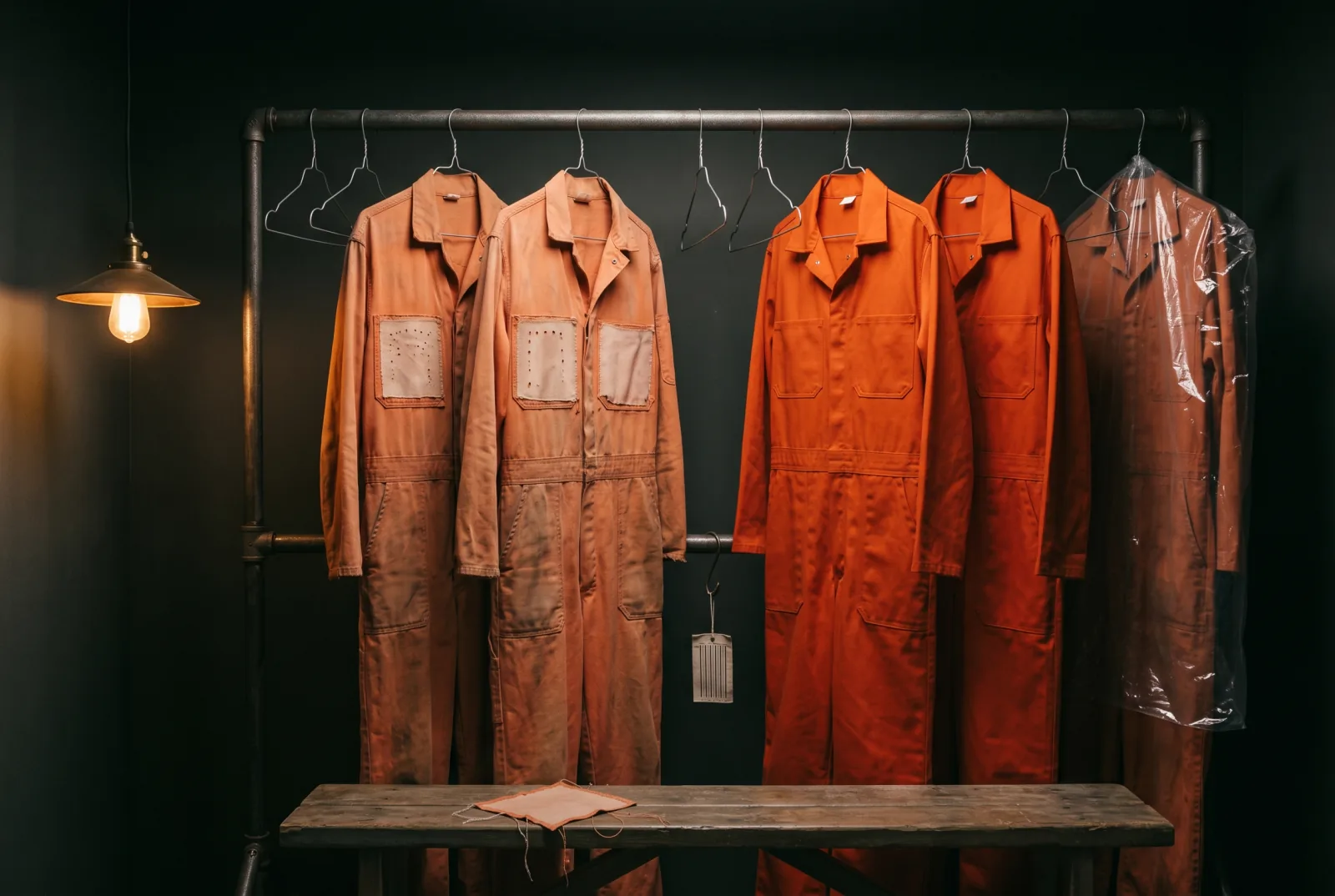
Ilustración: Rebobinados
Nine masked men, orange boiler suits, a barcode stitched across the back and a number sewn on, from 0 to 8. In 1999, when MTV was a factory of pretty faces and everybody was elbowing their way to the front of the shot, a band from Des Moines, Iowa — a place nobody expected anything from — did the exact opposite: they covered their faces, put on a uniform and turned themselves into numbers. The bet was brutal and counterintuitive: take the ego out of it and listen to what we're playing. And it worked like few things have ever worked in metal.
Let's start with the thing everyone takes for a mystery and which is really just the human heart at work.
The numbers aren't a code: they're an argument between friends
For twenty-five years, half of humanity hunted for the secret system behind Slipknot's numbers. There is no system, and the truth is far better than any code. They divvied them up among themselves, arguing about it, like people picking seats in a car.
Shawn Crahan, the one in the clown mask, wanted 6 and was ready to fight anyone for it. He didn't have to: nobody else wanted it. Mick Thomson demanded 7 because it's his lucky number. Corey Taylor asked for 8 because the eight on its side is the symbol for infinity. And when the last one arrived in 1998, DJ Sid Wilson grabbed the one still free at the bottom with the best explanation of the lot: that he isn't a number, that he's a zero, that he's garbage. Superstition, jokes, self-loathing and a wind-up. That's what sits underneath the great enigma. And it's infinitely more endearing than any numerology.
The mask that made everything else possible
It's worth saying that the costume wasn't a marketing trick: it was an idea, and one that paid off. Nine blokes from a corner of Iowa put out a debut album that became the first platinum record in their label's history, and ended up double platinum. Nobody knew what they looked like. In the age of the image, hiding it was the most radical gesture available, and it gave them precisely what they were after: that the conversation be about the wall of sound nine people made at once, not about who they were.
Nine years later, "All Hope Is Gone" gave them their first number one in the United States. They have a Grammy, for "Before I Forget". A band that started out looking like a nine-headed nightmare ended up one of the biggest and most respected metal acts of its generation, without having shown its face to anyone for years.
The ghost who played bass
Before we count the losses, there's a story that explains how they survived the worst of them. On 24 May 2010, Paul Gray — number 2, founding bassist, one of the band's main songwriters — was found dead in an Iowa hotel at the age of thirty-eight, of an overdose. It was the first real blow, the kind that splits a band down the middle.
They didn't replace him. What they did was call Donnie Steele, a guitarist who had founded the group in 1995 and left before the first album existed. Steele played bass with Slipknot between 2011 and 2014 without the audience ever seeing him: off stage, no number, not listed in the line-up. For three years, Slipknot's bass was played by a ghost, and that ghost was the man who had left before it all began, and came back quietly to hold the band up at its most fragile moment. Nobody applauded him because nobody knew he was there. That's loyalty too.
The ones who went
The years took more of them. Joey Jordison, number 1, the drummer who wanted to be the one — one of the best of his generation — died in 2021, at forty-six. The cause was never made public, and there's no need to invent one; what is known is that in 2016 he had revealed he had transverse myelitis, a neurological illness that at one point left him unable to use his legs. That a drummer of that force faced that says something about the mettle behind the mask.
Four of the original nine remain. And in August 2026 the band announced that Sid Wilson, number 0, was no longer associated with the group. The one who had said he wasn't a number didn't stay either, in the end.
The system nobody needs any more
There's one detail that puts everything in order, and it's beautiful in its own way. The band that invented numbered anonymity hasn't numbered anybody in years. The ones who joined in 2014, in 2019, in 2024 have no number. It isn't inherited: when an original is gone, his number is simply left empty, like a seat nobody ever fills again.
And there's one delicious exception. In 2023 a sampling musician joined whose identity the band has never confirmed: no number, no name, not a single interview. Which means the only member of Slipknot who is genuinely anonymous today is the one who turned up twenty-five years late, when the men who invented anonymity were already familiar faces with published books. The costume worked so well that it stopped being necessary, and by then it only worked on new people.
What to remember
Slipknot's numbers don't mean anything: they were chosen by squabbling, out of superstition, on a joke about infinity, out of self-loathing. What does mean something is what they did with them: nine blokes from Iowa who covered their faces so people would look at the music, and sold millions precisely because of it, at a time when everyone else was competing to be seen. They lost two of their own and carried on. And one of the fallen was replaced, in secret, by the man who had left before it all began.
Remember it this way: they put on a uniform to disappear, and ended up impossible to forget.
This piece mentions a death by overdose. If you or someone you know is struggling with alcohol or drug use, in Chile SENDA's Drugs and Alcohol helpline answers free of charge 24 hours a day on 1412.
Sources
Slipknot, an American band formed in Des Moines, Iowa, in 1995. The line-up on their debut album (1999) consisted of nine members identified by numbers from 0 to 8: Sid Wilson (0), Joey Jordison (1), Paul Gray (2), Chris Fehn (3), Jim Root (4), Craig Jones (5), Shawn Crahan (6), Mick Thomson (7) and Corey Taylor (8). As Crahan has recounted, the assignment followed no hierarchical system: he claimed 6 unopposed, Mick Thomson chose 7 because he considers it his lucky number and Corey Taylor took 8 for its resemblance to the symbol for infinity; Sid Wilson, who joined in 1998, chose 0. The uniforms included barcodes. The album "Slipknot" (1999) was the first record certified platinum by Roadrunner Records and went on to reach double platinum; "All Hope Is Gone" (2008) was their first number one on the Billboard 200. The group has won one Grammy from eleven nominations: best metal performance in 2006 for "Before I Forget". Paul Gray, born on 8 April 1972, was found dead on 24 May 2010 in Urbandale, Iowa; the autopsy determined an overdose of morphine and fentanyl, alongside advanced heart disease. Between 2011 and 2014 the live bass was played by Donnie Steele, a founding guitarist from 1995 who had left the group in 1996, without appearing before the audience or being listed in the official line-up. Joey Jordison, born on 26 April 1975, died on 26 July 2021 at the age of forty-six; the cause has not been made public. Jordison had revealed in 2016 that he had transverse myelitis and stated publicly that his 2013 departure from the group was not voluntary. The members who joined later — Alessandro Venturella (2014), Michael Pfaff (2019) and Eloy Casagrande (2024) — have no number assigned, nor does the musician in charge of samples since 2023, whose identity the band has not confirmed. On 14 August 2026 the group announced Sid Wilson's departure. Of the nine members on the debut album, four remain in the band. A Rebobinados rewrite of previously verified research; interpretations are offered as the author's reading. No song lyrics are reproduced, for copyright reasons. Information drawn from Wikipedia, Billboard, Loudwire, Blabbermouth, NPR, Consequence, Variety, Rolling Stone, Music Feeds and other coverage.
Keep rewinding
10s
metal
Bring Me the Horizon
Twenty years to get back to the scream
Bring Me the Horizon started in 2006 with a deathcore record and their turn did not happen in 2013: the leap to metalcore was in September 2008 and the synthesisers and clean vocals arrived in October 2010. Jordan Fish, eleven years in the band, was the one who put in the electronics. On 10 July 2026 they re-recorded that first record for its twentieth anniversary, with Oli Sykes back on the guttural scream.
00s
metal
Staind
The sleeve that nearly cost them everything
In October 1997, Fred Durst tried to pull Staind off the bill at the Webster Theatre in Hartford over the sleeve of their home-made record; then he listened to them and signed them. In 2001, Break the Cycle debuted at number one on the Billboard 200 and "It's Been Awhile" spent sixteen weeks at number one on the Modern Rock. Jon Wysocki, founding drummer, died on 18 May 2024.
90s
metal
Marilyn Manson
The lawsuit he withdrew while paying
The triad of Antichrist Superstar, Mechanical Animals and Holy Wood, and a file that is still open: two out-of-court settlements, one sworn retraction, the prosecutor's office that ruled out charges in January 2025 on statute-of-limitations grounds, the defamation suit he withdrew while paying 327,000 dollars and a jury trial set for November 2027.
Rewind with us
Comments · 0
No one has commented yet. Open the conversation.