
Smash Mouth
The song that beat its own joke
By Rebobinados · Published on September 16, 2026
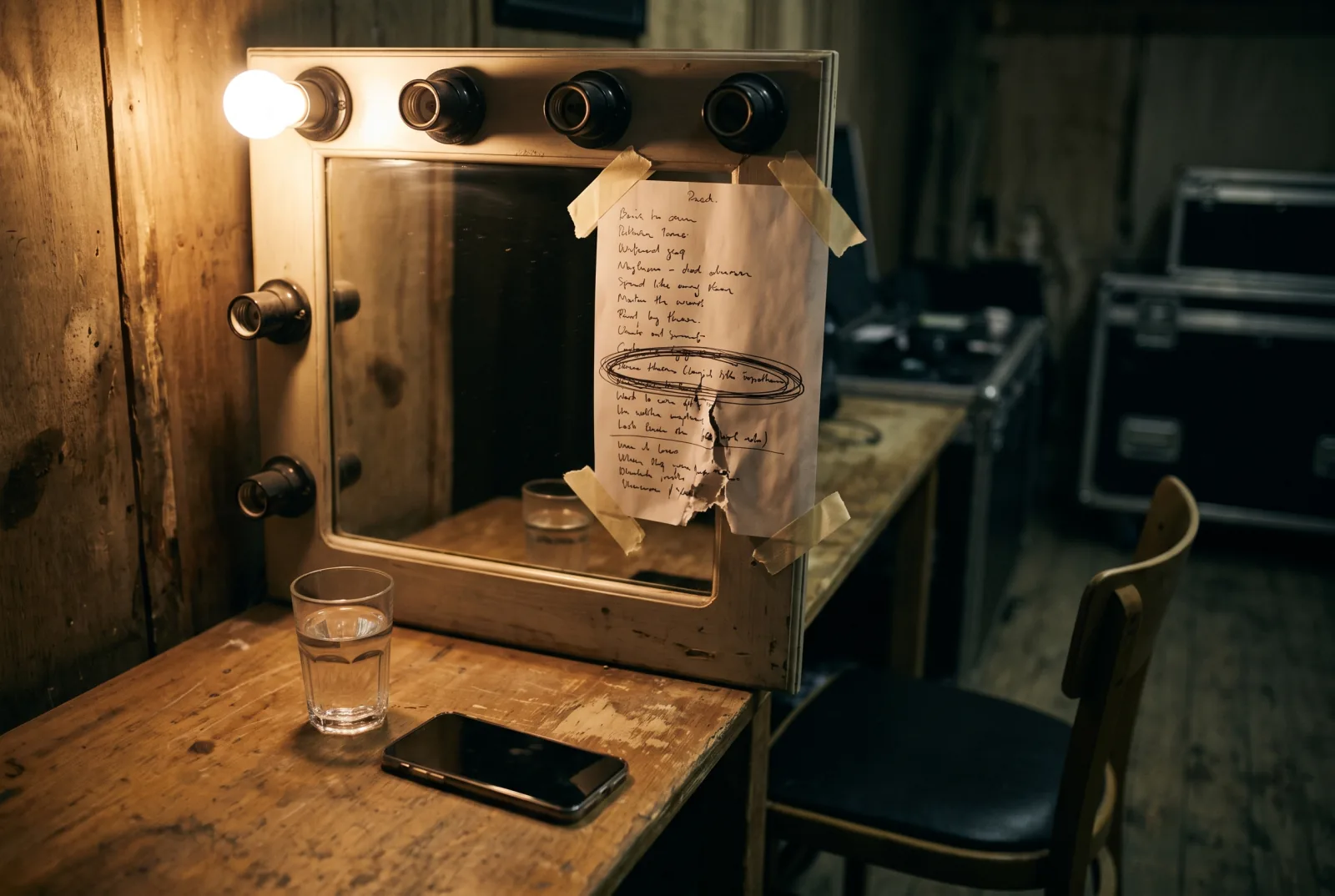
Ilustración: Rebobinados
Very few songs survive the internet turning them into a joke. "All Star" did more than survive: it came out the other side bigger than it went in. It is, most likely, the most parodied song in the history of the web —sung over other people's instrumentals, spliced into national anthems, played on impossible instruments, shoved into every corner where it had no business being— and even so, an entire generation knows it by heart, and no longer entirely in jest. That is a rare feat, and it is worth understanding, starting by clearing away three things almost everybody gets wrong.
Three myths, quickly
It was not written for "Shrek". It came out in 1999, two years earlier, and its first home was the soundtrack of a different film. "Shrek" arrived later and gave it a second push, but the song already existed and was already a hit.
The singer did not write it. Greg Camp, the guitarist, wrote it: he is the one credited as its author and the one who ended up nominated for a Grammy for it. Behind the anthem of optimism stood the man with the guitar, not the man with the face.
And it was not number one on the main chart: it reached number four. It was number one on two radio charts. A huge hit, with no need to inflate the figures.
A great pop song, guilt-free
Something the irony of the internet buried for years is worth saying plainly: "All Star" is an excellent pop song. It has one of those openings nobody ever forgets, a chorus built to be sung by a crowd, and words made of pure momentum, of getting up and going out to take on the world. It is put together with the craft of someone who knows exactly which spring to press. Becoming a meme does not make it any worse; quite the opposite, only songs with a perfect hook can take a thousand misshapen versions without breaking. Whatever is flimsy falls apart at the first parody. "All Star" withstood thousands.
The second life
And here is the astonishing part of the story. The meme is slower than you would think: the first identified parody dates from 2009, ten years after the song. The turning point comes in 2016, when a YouTuber starts singing the words over the instrumentals of other tracks and racks up more than a hundred million views. The effect can be measured: the official video went from twenty-one thousand plays a day to nearly half a million. Between 2017 and 2021 it was one of the most streamed rock tracks in the world.
Read that again: a song from 1999 became massive all over again at eighteen years of age. Most hits die and never come back. This one was resurrected as a joke, and the joke kept it alive until it stopped being only a joke. Greg Camp, who at first feared that tying themselves to a children's film would sink them, ended up flattered, and even became friends with the YouTuber who parodied it the most. He read what was happening correctly: they were not laughing at the song, they were claiming it as their own.
The man behind the face
The other timeline has to be told, and told with respect, because it ran at the same time as the party and never once touched it.
While the song was running its second career, Steve Harwell, the singer, was carrying a far harder life. In 2001 his son Presley was born, and died at six months old, of leukaemia. Harwell set up a research foundation in his name. In the years that followed he fell ill: a heart condition and a neurological disorder linked to prolonged alcohol use. His final years on stage were difficult and very public, marked by that illness, until in 2021 he retired for health reasons. He died in September 2023, at fifty-six.
There is a quiet cruelty in the coincidence. The man whose voice sang the sunniest anthem of end-of-century optimism —the one about everything turning out fine, so get out there and shine— was living, in parallel, through some of the heaviest things that can happen to a person. The two stories, the cheerful song and the man who sang it, ran through the same years without ever brushing against each other. The internet's joke did not know, and had no reason to know, what was on the other side of the microphone.
What is left
The band goes on: he retired, not the group. Since 2021 Zach Goode has been the singer, and in August 2026 they released their first album of new material in fourteen years. And "All Star" ended up where songs that beat their own mockery end up: it no longer makes you laugh, or not only that. It is a track from 1999 that a generation knows by heart for reasons that have nothing to do with 1999, and that by now is sung with something close to affection.
What to remember
It was not written for "Shrek", the singer did not write it and it was not number one on the main chart. But it was a great pop song, so well made that it withstood fifteen years of parodies and came out more popular than ever. It had two lives, and the second was longer and kinder than the life of the man who sang it.
Remember it this way: the internet turned "All Star" into a joke, and without meaning to it did the song the favour of making it eternal. If only life had been as generous with Steve Harwell.
This piece mentions an illness arising from prolonged alcohol use and the death of a child. If you or someone you know is struggling with alcohol or drug use, in Chile SENDA's Drugs and Alcohol helpline answers free of charge 24 hours a day on 1412.
Sources
Smash Mouth, an American band formed in San Jose, California, in 1994 by Steve Harwell (vocals), Greg Camp (guitar), Paul De Lisle (bass) and Kevin Coleman (drums). "All Star", written by Greg Camp, was released on 4 May 1999 on the album "Astro Lounge" and was included that same year on the soundtrack of the film "Mystery Men"; its appearance in "Shrek" came later, in 2001. The track reached number four on the Billboard Hot 100 on 14 August 1999 and number one on the Adult Top 40 and Mainstream Top 40 charts, and is certified triple platinum by the RIAA. It was nominated for the Grammy for best pop performance by a duo or group with vocal at the ceremony held on 23 February 2000, which was won by "Maria Maria" by Santana. The spread of the track as parody material on the internet is documented from 2009, with a turning point in 2014 and a sharp increase from 2016; the official video went from some 21,000 plays a day to 155,000 in December 2016 and to a peak of 478,000 a day in 2017, and between 2017 and 2021 the track was among the most listened to in rock on streaming. Greg Camp has said that he initially feared the association with "Shrek" and later felt flattered by the parodies. Presley Scott Harwell, the singer's son, was born on 26 January 2001 and died in July that year, at six months old, of acute lymphocytic leukaemia; his father set up a research foundation in his name. In 2013 he was diagnosed with a cardiomyopathy and Wernicke's encephalopathy. After a performance in October 2021 at the Bethel Woods Center for the Arts, at which he appeared disoriented, he announced his retirement on 12 October 2021. He died on 4 September 2023 in Boise, Idaho, at fifty-six, of acute liver failure. The band continues with Zach Goode as its singer since 2021 and released "Mercury Comet" on 12 August 2026, its first album of original material since 2012. A Rebobinados rewrite of previously verified research; interpretations are offered as the author's reading. No song lyrics are reproduced, for copyright reasons. Information drawn from Wikipedia, Billboard, RIAA, Rolling Stone, NPR, The Washington Post, CNN, ABC Double J and other coverage.
Keep rewinding

10s
pop
Bruno Mars
Eleven names in the credits
"Uptown Funk" came out on 10 November 2014 with six writers and today it has eleven. In February 2015 The Gap Band's publisher filed a claim over "Oops Up Side Your Head" in YouTube's copyright system —there was never a lawsuit— and on 28 April five names were added, with 17 % of the publishing. It happened weeks after the "Blurred Lines" verdict, and the song had been fourteen weeks at number one.

00s
pop
André Rieu
It was not from the jazz suite
The waltz with which André Rieu reached half the world is not from Shostakovich's Suite for Jazz Orchestra No. 2: it is from the Suite for Variety Orchestra, which the composer did not assemble, and it was born in 1956 as music for a Soviet film about settlers in Kazakhstan. The error comes from a misprint in volume 10 of the complete works (Muzyka, Moscow, 1984), corrected only in 2001. And the title "The Second Waltz" was invented by his wife, because the real one did not sell.

90s
pop
Daniela Mercury
She took the neighbourhood out of the song
"O Canto da Cidade" was written by Tote Gira, a composer from Nordeste de Amaralina who recorded the demo on a borrowed cassette, marking the beat on the door of a refrigerator; Mercury's team almost threw the tape away. She shares the credit because she deleted the references to the Pelourinho so that the song would serve all of Brazil. The album, from 20 September 1992, sold more than 2 million copies and nationalised axé. But she did not invent it: the name was a journalist's insult in 1987.
Rewind with us
Comments · 0
No one has commented yet. Open the conversation.