
The Smashing Pumpkins
Cathedrals made of sadness
By Rebobinados · Published on September 16, 2026
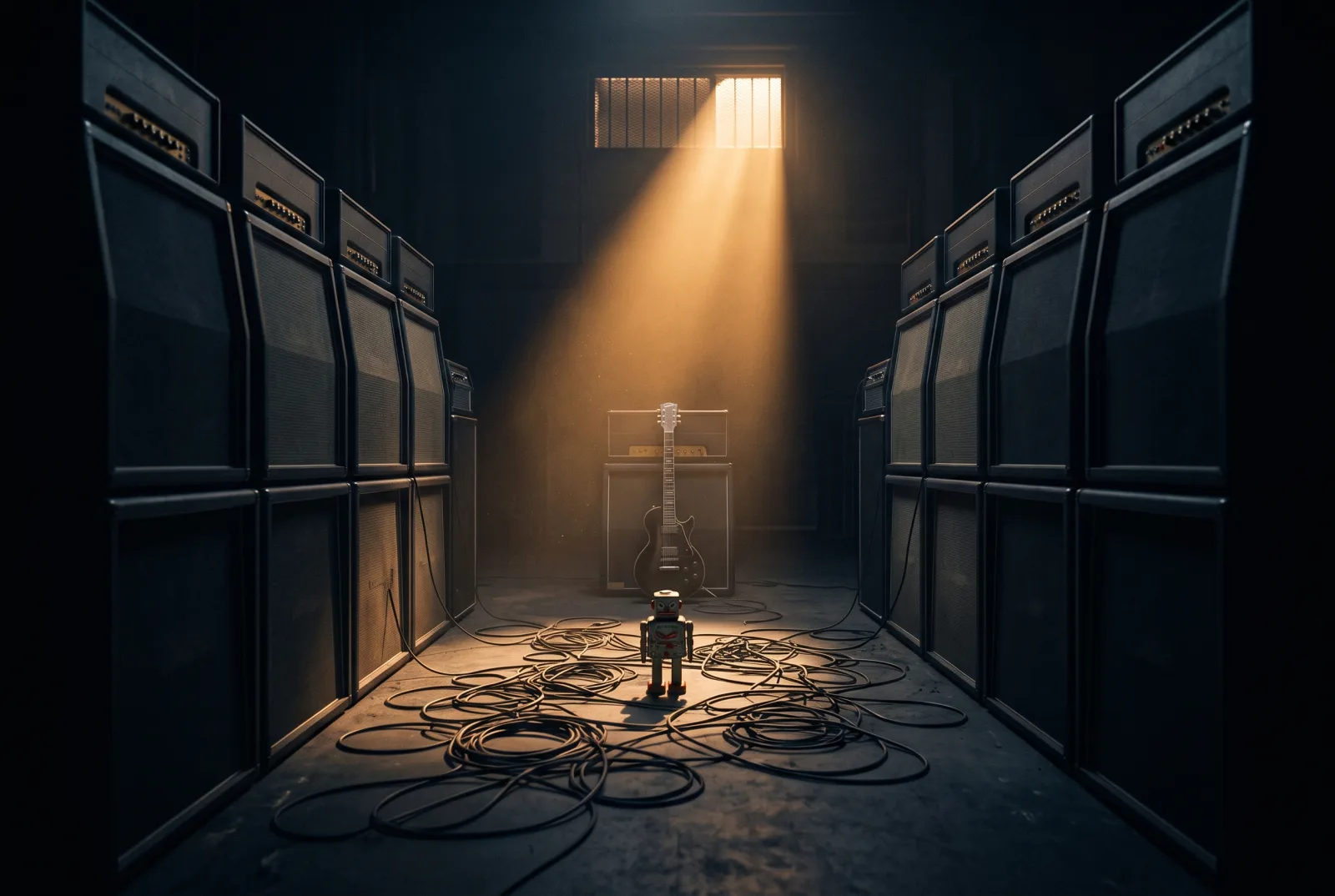
Ilustración: Rebobinados
The Smashing Pumpkins were, deep down, the vision of one man: Billy Corgan.
An obsessive perfectionist, a control freak, a difficult genius who built some of the most beautiful and monumental music of the nineties almost through sheer force of will, layer upon layer of guitars, until he had raised actual cathedrals of sound.
That obsession was, at the same time, his greatness and his doom.
Going the other way
The band formed in Chicago in 1988 around Corgan — voice, guitar and brains of the whole thing — with James Iha on guitar, D'arcy Wretzky on bass, and Jimmy Chamberlin, a jazz drummer of brutal power.
Their sound was like nobody else's. While the alternative rock of the time despised excess and went back to raw punk, the Pumpkins headed for the dense, the heavy, the layered: walls of distorted guitars, a mix of metal, psychedelia and dream, with Corgan's nasal, anguished voice on top.
It was maximalist rock, ambitious, immense.
The method
Their first album, "Gish", put them on the map, but it was "Siamese Dream", in 1993, that made them giants: "Today", "Disarm", "Cherub Rock".
And the obsessive Corgan method was already visible there. A perfectionist to the point of illness, he re-recorded most of the guitar and bass parts his bandmates had played, stacking dozens of tracks, pushing the sessions to the edge of collapse, in the middle of tensions with the band and his own depression.
Two years later came the masterpiece: "Mellon Collie and the Infinite Sadness", a colossal double album, number one, with seven Grammy nominations, of which it won one, best hard rock performance for "Bullet with Butterfly Wings".
"Tonight, Tonight", "1979", "Zero". It was a huge, beautiful portrait of adolescence, mortality and sadness. The title itself — the infinite sadness — said it all.
Where that sadness came from
Because that sadness was not a pose.
Corgan came from a hard childhood, a broken home, abuse he spoke about years later, an absent musician father.
All that immense melancholy filling his music came from a real place: "Disarm", one of his most harrowing songs, is about his own upbringing.
Corgan took a deep wound and turned it into something vast and beautiful.
And there is the paradox of his genius: the same obsessive control that made it impossible to share a band with him — that drove his bandmates away and caused endless line-up changes — was what made the music reach that grandeur.
His flaw and his gift were the same thing.
The peak and the fall
The peak brought tragedy too.
On 12 July 1996, at the height of it all, the keyboard player touring with them, Jonathan Melvoin, died of a heroin overdose in a New York hotel, alongside Chamberlin, who survived his own.
The band fired Chamberlin five days later, and everything started to fall apart.
Corgan turned towards the electronic on "Adore", and in 2000 the Smashing Pumpkins broke up.
But Corgan, unable to let his creature go, revived it years later, with shifting line-ups. Chamberlin and eventually Iha came back, and the band kept releasing ambitious records, including a rock opera in three acts, "Atum", which he put out in instalments between late 2022 and the middle of 2023.
Corgan is also a poet, and even the owner of a wrestling company, the NWA, because he was never a one-dimensional guy.
What he built with it
They should be remembered for what they were: the work of a difficult genius who refused to compromise, and who for that very reason gave the nineties some of its most monumental and most moving music.
Put on "Tonight, Tonight", "1979", "Disarm" or "Mayonaise", and you will hear a man turning a hard childhood and a bottomless sadness into something gigantic and beautiful: the very sound of adolescence, with all its grandiloquence and all its pain.
The same maniacal control that isolated him from almost everyone was what made that music take off.
A complicated genius who built beauty out of his sadness, and who, decades later, is still building.
Sources
The Smashing Pumpkins, American alternative rock band formed in Chicago in 1988 by Billy Corgan (vocals, guitar; Elk Grove Village, Illinois, 17 March 1967; main songwriter and only constant member), James Iha (guitar), D'arcy Wretzky (bass) and Jimmy Chamberlin (drums). Their dense, layered sound mixed alternative rock, metal, psychedelia, gothic and dream pop. They released "Gish" (1991) and "Siamese Dream" (1993, with "Today", "Disarm" and "Cherub Rock"); during the recording of the latter, Corgan himself re-recorded most of Iha and Wretzky's guitar and bass parts. "Mellon Collie and the Infinite Sadness" (1995), a double album, debuted at number one on the Billboard 200, received seven Grammy nominations at the 1997 ceremony and won one, best hard rock performance for "Bullet with Butterfly Wings"; it included "Tonight, Tonight", "1979" and "Zero". Corgan has spoken of a difficult childhood — a broken home and episodes of abuse — that influenced the melancholy of his work, for example on "Disarm". On 12 July 1996, touring keyboard player Jonathan Melvoin died of a heroin overdose; Chamberlin, who survived his own overdose, was fired on 17 July. After the electronic album "Adore" (1998), the group broke up in 2000. Corgan reformed the band in 2006-2007 with shifting line-ups; Chamberlin and later Iha (2018) returned. The three-act rock opera "Atum" was released in instalments: the first act on 15 November 2022, the second on 31 January 2023 and the third on 5 May 2023. Corgan is also a poet and, since 2017, the owner of the wrestling company National Wrestling Alliance. Externally authored text, edited and verified for Rebobinados. Interpretations of the meaning of his work are offered as the author's reading. No song lyrics are reproduced, for copyright reasons. Data gathered from AllMusic, Britannica, Grammy.com, Wikipedia and other press coverage.
Keep rewinding
90s
indie
Portishead
A short film got them the record deal
Before the record they shot *To Kill a Dead Man*, eleven minutes of film noir written by the three of them: Geoff Barrow plays a sniper and Beth Gibbons a widow. That soundtrack got them the record deal, and the cover of *Dummy* is a still from the short. The rest is told wrong too: *Dummy* sold 3,600,000 copies and won the 1995 Mercury ahead of Oasis, Tricky and PJ Harvey. Three records in fourteen years, and eighteen without a fourth.
00s
indie
Peter Bjorn and John
The whistle was provisional
Björn Yttling whistled the melody of "Young Folks" as a placeholder, only so as not to forget it, and they decided to keep it. The single came out on 7 August 2006, with Victoria Bergsman as guest, and it was not no. 1 anywhere: no. 13 in the United Kingdom, no. 9 in Finland. Live it is whistled by Peter Morén, and the trio never broke up: nine albums.
00s
indie
Florence + the Machine
The catharsis had a name
The band formed in London in 2007 and "the Machine" comes from the keyboard player Isabella Summers. Florence Welch has said that she stopped eating at seventeen and that she stopped drinking around 2014: the catharsis in her music has a concrete content. She has five British number ones, the last with Everybody Scream (31 October 2025), nominated for the 2026 Mercury.
Rewind with us
Comments · 0
No one has commented yet. Open the conversation.