
The Human League
The one per cent the name cost him
By Rebobinados · Published on September 27, 2026
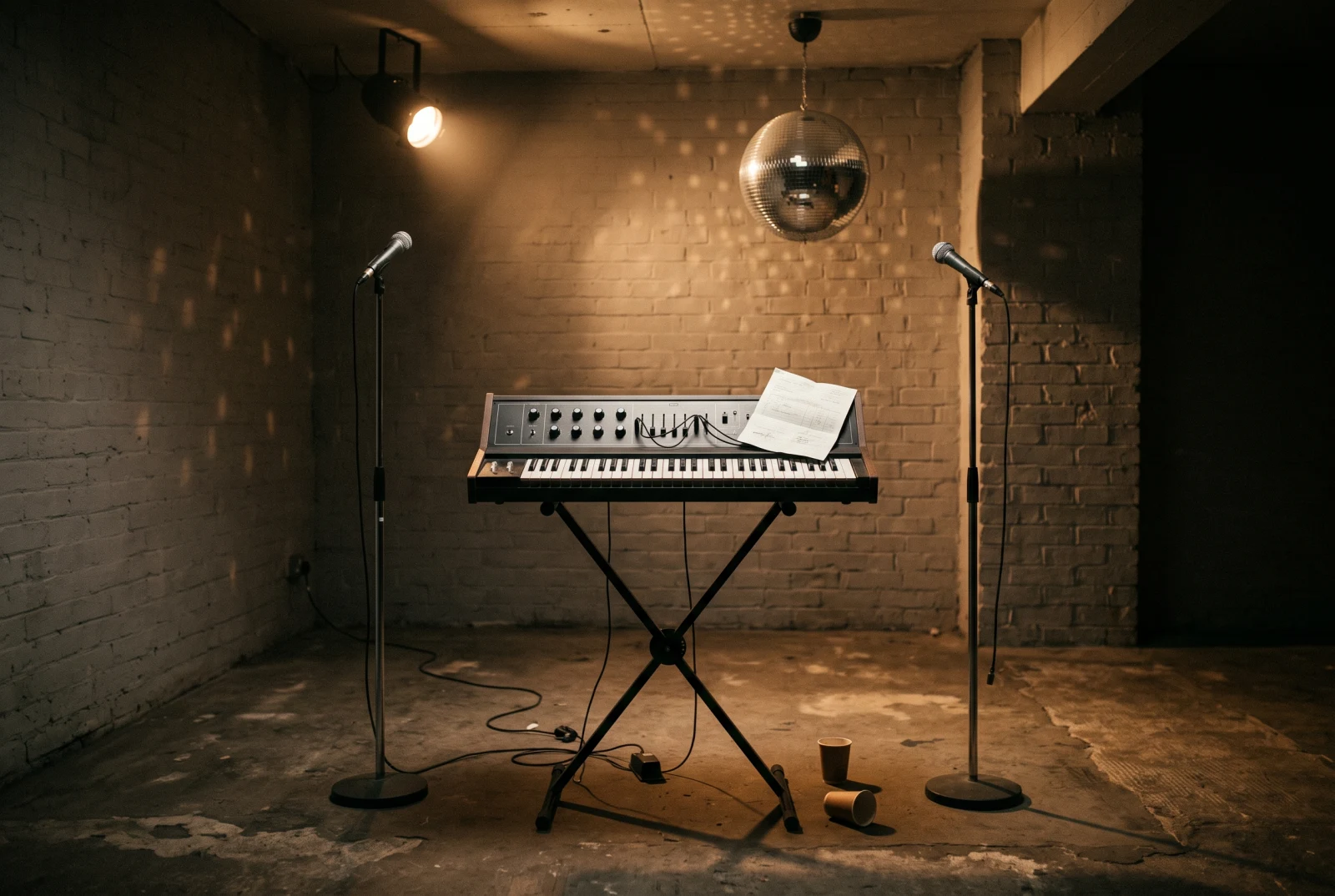
Ilustración: Rebobinados
In October 1980, Phil Oakey found himself with no band and a tour looming. The two partners who had founded The Human League with him were leaving, and with them went the technical half of the project. Something more awkward remained to be settled: who would keep the name. Oakey kept it, and he paid for it. He took on all the group's debts and agreed to hand the departing pair one per cent of the royalties from the next album. That album turned out to be Dare, triple platinum. It is the fact that almost never gets told and it is, in truth, the spine of the whole story.
The price of keeping the name
The Human League had formed in Sheffield in 1977, in a city of steelworks and smoke, with a proposition that at the time sounded like a provocation: electronic music, no guitars, closer to art than to pop. That manifesto belongs to the first line-up, the one with Martyn Ware and Ian Craig Marsh, and it is worth dating it properly, because what came afterwards contradicts it point by point.
Ware and Marsh left in October 1980. They set up the British Electric Foundation first and out of it Heaven 17, with Glenn Gregory as singer, and they did reasonably well. Oakey, meanwhile, shouldered the debts and the one per cent. The arithmetic of that deal is what makes the story: the percentage looked cheap at a moment when there was no record, and it became expensive in exactly the measure that the next record worked.
Four signings, not two
The legend says Oakey went into a disco and came out with two teenagers. The disco part is true and it has an address: the Crazy Daisy Nightclub, on High Street, Sheffield, in October 1980. Susan Ann Sulley was 17 and Joanne Catherall was 18. He hired them as vocalists and dancers, and the girls' parents made it a condition that Oakey look after them. The bit about the critics thinking he was mad is not verifiable; the bit about the parents' condition is.
But he signed four, not two, and the other two are the ones who explain the change of sound. Ian Burden came in on bass and synthesizers. And in April 1981 came Jo Callis, formerly of the Rezillos, who is a guitarist. That is to say: the band of the no-guitars manifesto hired a guitarist. Add to that the producer Martin Rushent, and you have the real explanation for why Dare sounds like nothing the group had done before.
The song the frontman did not want
"Don't You Want Me" is credited to Jo Callis, Phil Oakey and Philip Adrian Wright. The song that tends to be presented as the proof of the electronic manifesto was written, in part, by the guitarist who had just arrived. Oakey considered it filler and called it the weakest track on the record; he did not want it released as a single. The man who forced it through was Simon Draper, an executive at Virgin. Oakey gave in on one condition: that the seven-inch come with a large colour poster.
What happened next is easy to summarise and hard to overstate. Five weeks at British number one at Christmas 1981, and the best-selling single in the United Kingdom across that whole year, with 1.15 million copies. In the United States it reached number one on the Hot 100 on 3 July 1982 and stayed there three weeks. The female part of the dialogue is sung by Susan Ann Sulley, chosen by chance between the two of them.
Then came "(Keep Feeling) Fascination" and "Mirror Man", and in 1986 a second American number one with "Human". There too some precision is in order: "Human" was written and produced by Jimmy Jam and Terry Lewis, not by the band.
What to remember
The Human League is one of the founding bands of synth-pop and its best song is a break-up dialogue sung by a man who despised it and a seventeen-year-old girl who had never sung before. That is already quite a lot. But the story that really holds it up is an accounting one: to keep five letters, Oakey took on the debts and signed away one per cent of a record that did not yet exist.
He bet blind and won, with the detail that winning cost him more than losing. The ones who left collected their percentage on the band's biggest album, a triple platinum made without them and against almost everything they had preached together. Rarely does a contract explain a catalogue so well.
Sources
The Human League is a British synth-pop group formed in Sheffield in 1977 by Martyn Ware and Ian Craig Marsh together with Philip Oakey. Ware and Marsh left the group in October 1980 and founded the British Electric Foundation and, out of it, Heaven 17, with Glenn Gregory as vocalist. To keep the group's name, Oakey took on the band's debts and agreed to pay Ware and Marsh one per cent of the royalties from the next album, which turned out to be "Dare" (1981), certified triple platinum. In October 1980, at the Crazy Daisy Nightclub on High Street, Sheffield, Oakey recruited as vocalists and dancers Susan Ann Sulley, aged 17, and Joanne Catherall, aged 18; the parents of both made their joining conditional on Oakey taking responsibility for their care. Also joining were the bassist and keyboard player Ian Burden and, in April 1981, the guitarist Jo Callis, formerly of the Rezillos. The album was produced by Martin Rushent. "Don't You Want Me" is credited to Jo Callis, Philip Oakey and Philip Adrian Wright; Oakey considered it filler and the weakest track on the record and opposed its release as a single, which was imposed by the Virgin executive Simon Draper, on the condition that the seven-inch edition include a large colour poster. The single spent five weeks at British number one at Christmas 1981 and was the best-selling single in the United Kingdom that year, with 1.15 million copies; it reached number one on the Billboard Hot 100 on 3 July 1982, where it remained three weeks. The female part of the track is performed by Susan Ann Sulley. Their later hits include "(Keep Feeling) Fascination" and "Mirror Man"; "Human", number one in the United States in 1986, was written and produced by Jimmy Jam and Terry Lewis. Profile compiled for Rebobinados with fact-checking; interpretations of the meaning of the work are offered as the author's reading. No song lyrics are reproduced, for copyright reasons. Information drawn from The Guardian, Sound on Sound, the Official Charts Company, Billboard, Wikipedia and other coverage.
Keep rewinding

10s
pop
Bruno Mars
Eleven names in the credits
"Uptown Funk" came out on 10 November 2014 with six writers and today it has eleven. In February 2015 The Gap Band's publisher filed a claim over "Oops Up Side Your Head" in YouTube's copyright system —there was never a lawsuit— and on 28 April five names were added, with 17 % of the publishing. It happened weeks after the "Blurred Lines" verdict, and the song had been fourteen weeks at number one.

00s
pop
André Rieu
It was not from the jazz suite
The waltz with which André Rieu reached half the world is not from Shostakovich's Suite for Jazz Orchestra No. 2: it is from the Suite for Variety Orchestra, which the composer did not assemble, and it was born in 1956 as music for a Soviet film about settlers in Kazakhstan. The error comes from a misprint in volume 10 of the complete works (Muzyka, Moscow, 1984), corrected only in 2001. And the title "The Second Waltz" was invented by his wife, because the real one did not sell.

90s
pop
Daniela Mercury
She took the neighbourhood out of the song
"O Canto da Cidade" was written by Tote Gira, a composer from Nordeste de Amaralina who recorded the demo on a borrowed cassette, marking the beat on the door of a refrigerator; Mercury's team almost threw the tape away. She shares the credit because she deleted the references to the Pelourinho so that the song would serve all of Brazil. The album, from 20 September 1992, sold more than 2 million copies and nationalised axé. But she did not invent it: the name was a journalist's insult in 1987.
Rewind with us
Comments · 0
No one has commented yet. Open the conversation.