
The Police
They knew when to leave
By Rebobinados · Published on September 17, 2026
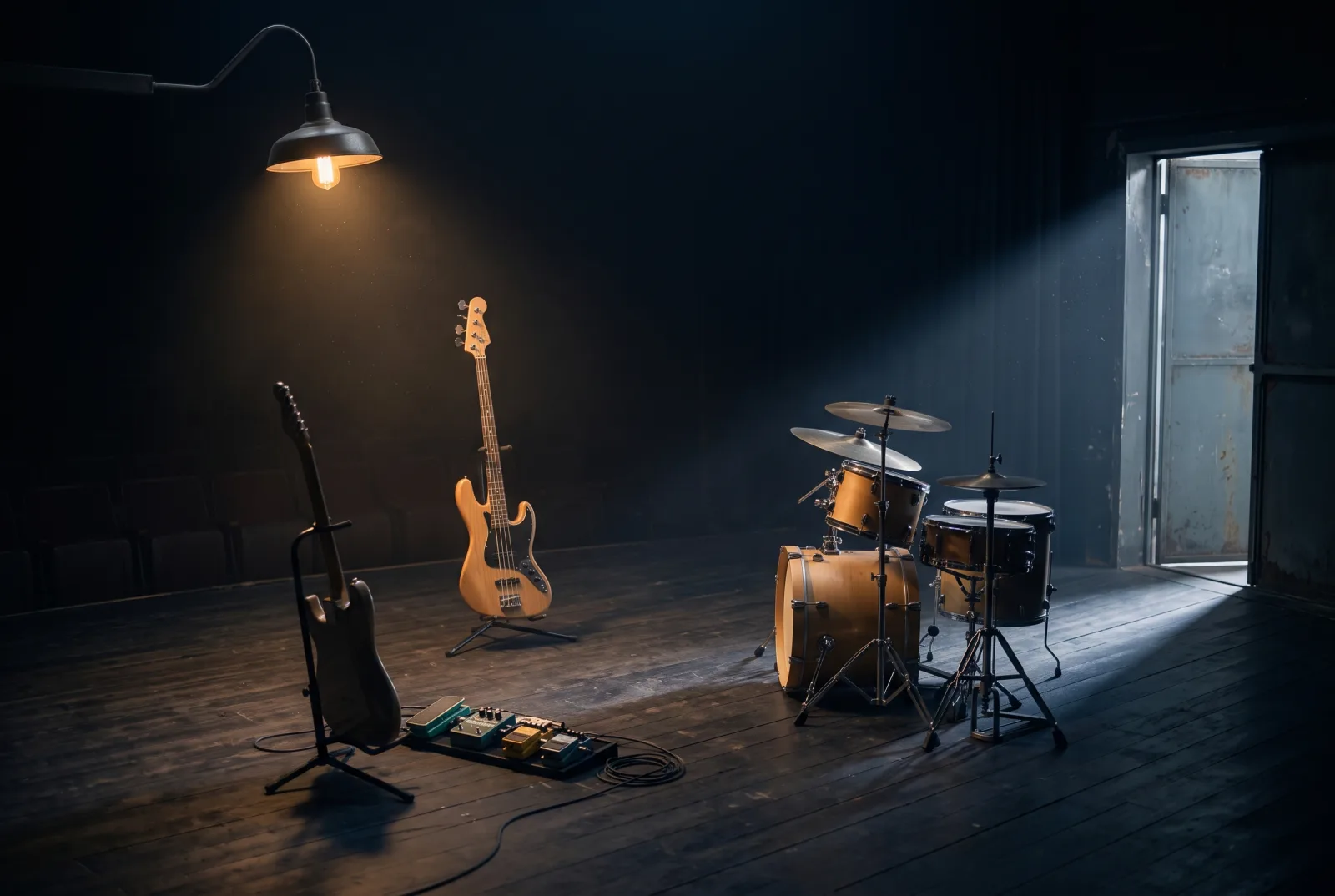
Ilustración: Rebobinados
The Police are one of those bands whose music sounds easy until you look at it closely.
They sound light, catchy, made for the radio. But underneath there are three extraordinary musicians doing something far more sophisticated than it seemed: mixing punk, reggae, jazz and pop with clockwork precision.
They were, perhaps, the most perfect trio in rock: each one a virtuoso, the three of them pulling in different directions, and out of that tension came a flawless music.
Too good to be punks
The Police formed in London in 1977, in the middle of the punk explosion, and at first they wanted to ride that wave. But there was a charming problem: they could play far too well.
Sting, the bassist and singer, came from jazz and had an exceptionally fine ear for melody.
Stewart Copeland, the drummer, was a force of nature, able to slip reggae and jazz rhythms into places where others merely hit things.
And Andy Summers, the guitarist —who came in to replace the first one, Henry Padovani— was the veteran: a seasoned musician, with a guitar full of texture and effects, nothing at all like punk's three furious chords.
Three virtuosos dressed up as punks. Punk, deep down, was too small for them.
"White reggae"
And out of that mixture their trademark was born.
The Police took Jamaican reggae —those syncopated rhythms, that space, that way of letting the music breathe— and crossed it with pop and rock, into something that was called, half as a joke, "white reggae".
Listen to "Roxanne", "Walking on the Moon" or "Message in a Bottle": they don't sound like punk, or like plain rock. They sound like that strange, luminous fusion, with the guitar floating, the drums playing with silence, and Sting's high voice on top.
They released five albums between 1978 and 1983, and on each one they sounded more ambitious, taking in jazz, textures, ideas that grew ever more complex, without ever losing the pop hook.
Few bands have made such intelligent music sound so easy to hum.
The song everybody got backwards
Their peak was "Synchronicity", in 1983, and out of it came their most famous song: "Every Breath You Take", eight weeks at number one in the United States and one of the most played songs in history.
And there is a delicious misunderstanding that almost everyone still carries around. People take it for a romantic love song and play it at weddings, when it is exactly the opposite.
Sting wrote it as the monologue of an obsessive man watching every movement of the person who left him. He himself has described it without a shred of tenderness: "a nasty little song, really rather evil… about jealousy and surveillance and ownership".
Millions of couples have danced their first waltz to a song that, if they listened to the words, would give them chills.
The riff that never got the credit
And there is an injustice tangled up in that same song, one that is still open today.
That hypnotic, unsettling guitar riff, the thing that makes the track the track, was invented by Andy Summers, and he recorded it in a single take. But the songwriting credit went to Sting, and to Sting alone. And on a song that has been playing everywhere for forty years, that is a mountain of money.
In 1977 the band had agreed on compensation for Summers and Copeland for their arrangements, but the matter was never fully settled. In August 2025 the two of them sued Sting in a London court over unpaid royalties, and in January 2026 he agreed to pay them around six hundred thousand pounds. The dispute over the rest is still running.
Forty years on, the trio's most famous song still has them at odds.
Stopping at the top
And here is the gesture that defines their story.
The chemistry between the three of them, which had been explosive in the good sense, turned explosive in the bad one. They fought constantly —three enormous egos, three leaders in a three-piece band— and the sessions were a battlefield.
So, in 1984, with "Every Breath You Take" sweeping all before it and The Police the biggest band on the planet, they did what almost nobody has the courage to do: they stopped.
It wasn't a door slammed overnight. Sting threw himself into his solo career, the band entered a pause that never quite closed, they managed to record a new version of "Don't Stand So Close to Me" and to play together for Amnesty International. Their last concert was on 15 June 1986, at Giants Stadium in New Jersey.
They left with more than seventy-five million records sold, before they could decline or repeat themselves.
Decades later, in 2007, they got back together for a reunion tour that travelled the world, took in some three hundred and sixty million dollars over a hundred and forty-three concerts, and became one of the highest-grossing tours in history. They gave themselves the pleasure, and split up again, this time in peace.
They knew when to go, twice.
What remains
The Police are the proof that sometimes the hardest thing, and the wisest, is knowing when to stop.
Three musicians who were too good for punk and too restless to sit still, who fused reggae with pop like nobody else and created a handful of perfect songs that sound as fresh today as they did forty years ago.
If you play "Roxanne", "Message in a Bottle", "Walking on the Moon" or "Every Breath You Take", you will hear the elegance of three virtuosos making the complex sound light, with that creative tension humming underneath.
They didn't stay around to ruin their legend; they left while they were the best. And that is why, four decades later, their music hasn't a single wrinkle.
They wanted to be the band of an era, and they ended up being eternal.
Sources
The Police, British rock band formed in London in 1977; their classic line-up was Sting (vocals, bass and main songwriter), Andy Summers (guitar) and Stewart Copeland (drums); the original guitarist, Henry Padovani, who recorded the debut single "Fall Out" (1977), was soon replaced by Summers. Emerging from the punk scene, they developed a new wave style with a strong reggae influence, as well as jazz and pop. They released five studio albums between 1978 and 1983 —"Outlandos d'Amour", "Reggatta de Blanc", "Zenyatta Mondatta", "Ghost in the Machine" and "Synchronicity"— with hits such as "Roxanne", "Message in a Bottle", "Walking on the Moon", "Don't Stand So Close to Me" and "Every Breath You Take". The last of these spent eight weeks at number one on the Billboard Hot 100 in 1983 and four weeks at number one in Britain; despite being perceived as a romantic ballad, it deals with obsession, jealousy and surveillance: Sting has described it as "a nasty little song, really rather evil… about jealousy and surveillance and ownership". Its guitar riff was created by Andy Summers, recorded in a single take, but the songwriting credit appears in Sting's name alone; in 1977 the band had agreed compensation for arrangements for Summers and Copeland, and in August 2025 the two sued Sting in the High Court in London over unpaid royalties, a case in which Sting agreed in January 2026 to pay them some 600,000 pounds, with the rest of the matter left open. After the hiatus began in 1984, the band recorded "Don't Stand So Close to Me '86" and took part in Amnesty International's Conspiracy of Hope tour; their last concert was on 15 June 1986 at Giants Stadium, and the break-up is dated to that year. Their sales exceed 75 million records. They entered the Rock and Roll Hall of Fame on 10 March 2003, in their first year of eligibility. Their 2007-2008 reunion tour grossed some 358.8 million dollars over 143 concerts, with 3.7 million tickets sold, according to Billboard Boxscore. Sting has a profile of his own on Rebobinados. Externally authored text, edited and verified for Rebobinados. Readings of the meaning of their work are offered as the author's interpretation. No song lyrics are reproduced, for copyright reasons; the reference to the content of "Every Breath You Take" is descriptive. Information drawn from Wikipedia, Billboard, Rolling Stone, Songfacts, Rock Hall and other press coverage.
Keep rewinding

10s
pop
Bruno Mars
Eleven names in the credits
"Uptown Funk" came out on 10 November 2014 with six writers and today it has eleven. In February 2015 The Gap Band's publisher filed a claim over "Oops Up Side Your Head" in YouTube's copyright system —there was never a lawsuit— and on 28 April five names were added, with 17 % of the publishing. It happened weeks after the "Blurred Lines" verdict, and the song had been fourteen weeks at number one.

00s
pop
André Rieu
It was not from the jazz suite
The waltz with which André Rieu reached half the world is not from Shostakovich's Suite for Jazz Orchestra No. 2: it is from the Suite for Variety Orchestra, which the composer did not assemble, and it was born in 1956 as music for a Soviet film about settlers in Kazakhstan. The error comes from a misprint in volume 10 of the complete works (Muzyka, Moscow, 1984), corrected only in 2001. And the title "The Second Waltz" was invented by his wife, because the real one did not sell.

90s
pop
Daniela Mercury
She took the neighbourhood out of the song
"O Canto da Cidade" was written by Tote Gira, a composer from Nordeste de Amaralina who recorded the demo on a borrowed cassette, marking the beat on the door of a refrigerator; Mercury's team almost threw the tape away. She shares the credit because she deleted the references to the Pelourinho so that the song would serve all of Brazil. The album, from 20 September 1992, sold more than 2 million copies and nationalised axé. But she did not invent it: the name was a journalist's insult in 1987.
Rewind with us
Comments · 0
No one has commented yet. Open the conversation.