
Tool
In praise of patience
By Rebobinados · Published on September 17, 2026
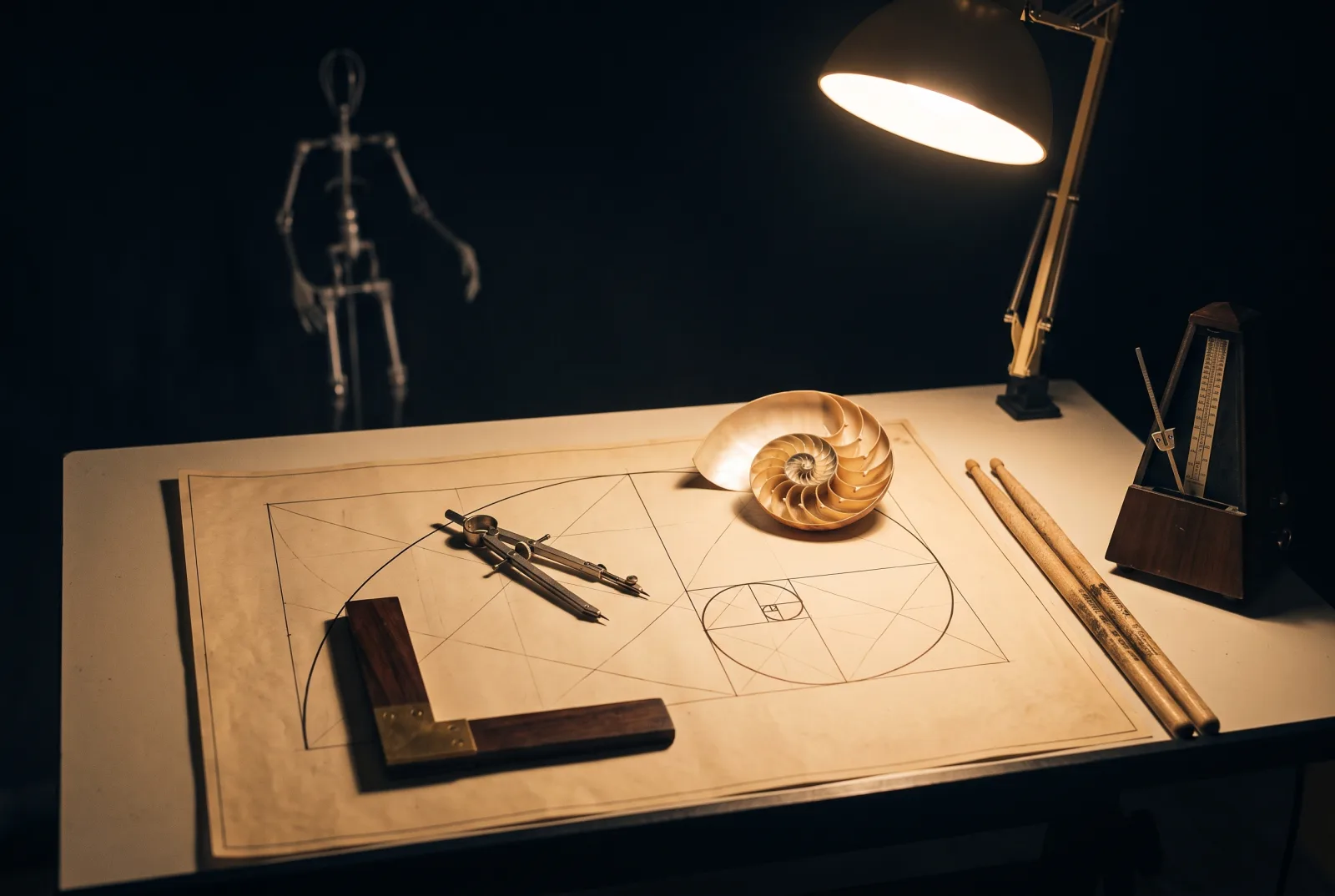
Ilustración: Rebobinados
Tool are probably the most demanding and most obsessive rock band ever to have had massive success.
They don't make songs to hum: they make labyrinths of sound, long, dense, full of impossible time signatures, that demand you sit down and go under.
And yet they fill stadiums all over the world, win Grammys, and have one of the most fanatical followings in music. Four men who decided the audience would have to come to them, and not the other way round.
Labyrinths with a purpose
Tool formed in Los Angeles in 1990, with Maynard James Keenan on vocals, Adam Jones on guitar, Danny Carey on drums and, from 1995, Justin Chancellor on bass, who replaced the founder Paul D'Amour and made his debut on "Ænima".
Their music is progressive metal: songs that last eight, ten, fifteen minutes, that change shape several times, built on very odd rhythms, with layers piling one on top of another until the whole thing detonates.
Jones's guitar is heavy and spacious at the same time. Danny Carey's drumming —he is considered one of the best living drummers— is a marvel of precision and impossible patterns. And over the top there is Maynard's voice, which can whisper, sing and howl, and which he uses as one more instrument inside the architecture.
Albums like "Ænima" (1996), "Lateralus" (2001) and "Fear Inoculum" (2019) are not collections of singles: they are works meant to be heard whole, from beginning to end, the way you read a book.
The spiral
And here is one of the nuances that turns Tool into a cult obsession. They don't do complexity on a whim: there is structure, there is geometry, there is a hidden number.
The most famous case is "Lateralus". The bars of the chorus keep changing —nine, then eight, then seven— and the syllables Maynard sings in the verses follow the Fibonacci sequence, that mathematical series that shows up in the spirals of snails, in flowers, in galaxies. The song, on top of that, is about spirals and about expanding the mind.
But there is a detail that is almost never told, and that is better than the legend. According to Danny Carey, the working title of the track was simply "9-8-7", after the bars. It was afterwards, looking at it again, that they realised 987 is one of the Fibonacci numbers.
In other words: first the intuition, then the discovery. The band didn't impose mathematics on the song; they found it inside.
Carey also applies ideas from sacred geometry to his rhythms. Tool don't play music: they design it the way you design a cathedral, with proportions most people don't notice but do feel. For their fans, decoding those layers is half the fun.
Secrecy as a banner
Another nuance, and one of the rarest in this day and age: Tool are a deliberately mysterious band, almost militant in their secrecy.
In a world where every artist is on display every second, Tool do the opposite. They hardly ever appear in their own videos —those disturbing videos, with stop-motion animation, directed or co-directed by Adam Jones himself, who is a visual artist and used to work in film special effects. They give very few interviews.
And above all, they take their time: thirteen years passed between "10,000 Days" (2006) and "Fear Inoculum" (2019).
Thirteen years between two albums. While any other band would have vanished off the map, Tool made their audience wait more than a decade, and when the record finally came out it went straight in at number one. One of its tracks, "7empest", won the Grammy for best metal performance the following year.
That is the power of a band that never betrayed its own pace or its own mystery: scarcity and patience as part of the art.
Maynard, the enigma
And at the centre of it all is Maynard James Keenan, one of the most singular characters in rock.
He was a soldier in the United States Army before he was a musician, and passed through the West Point preparatory school, though he turned down the officer's place. He studied art. Besides Tool, he leads two other very different bands —A Perfect Circle and Puscifer— as if one were not enough for him.
And today he lives half in seclusion in Arizona, where he has vineyards and makes his own wine, seriously, like a monk of the desert.
On stage he often sings from the back, in the half-dark, letting the music and not his figure be the centre. He is an ironic, philosophical man, hard to pin down, who treats fame with an almost mocking distance.
His lyrics speak of personal evolution, of psychology, of spirituality, of healing pain, always with a density that invites you to chew.
What to remember
Tool are the proof that you don't have to water art down to reach a lot of people: you can be as complex, as demanding and as mysterious as you like, and still find an enormous audience that is grateful to be treated as intelligent.
If you play "Schism", "Lateralus", "Ænima" or "Parabola", you are not going to hear easy songs: you are going to hear architectures of sound, with mathematics inside, with philosophy inside, made to get lost in and to find yourself in.
It isn't background music; it is music to sit down and enter.
Four men who turned metal into a way of thinking, who make you wait years for every work, and who never asked anyone's permission to be exactly as strange and as deep as they wanted to be.
In a world of everything fast and everything easy, Tool are a hymn to patience, depth and mystery. And that, perhaps, is why their fans don't listen to them: they revere them.
Sources
Tool, American rock band formed in Los Angeles in 1990, made up of Maynard James Keenan (vocals), Adam Jones (guitar), Danny Carey (drums) and Justin Chancellor (bass, from 1995, replacing the founder Paul D'Amour; his recording debut with the band is "Ænima", 1996). Exponents of progressive and alternative metal, celebrated for their complex structures, irregular time signatures and long songs. They have released five studio albums: "Undertow" (1993), "Ænima" (1996), "Lateralus" (2001), "10,000 Days" (2006) and "Fear Inoculum" (2019). They have won three Grammy awards as a band, all three for best metal performance —"Ænema" (1998), "Schism" (2002) and "7empest" (2020)—; a fourth Grammy, for best recording package for "10,000 Days" (2007), went to Adam Jones, Alex Grey and Mackie Osborne as art directors. On "Lateralus", the bars of the chorus are 9/8, 8/8 and 7/8 and the vocal phrasing of the verses follows the Fibonacci sequence (1-1-2-3-5-8-5-3); according to Danny Carey, the working title was "9-8-7" after the bars and the link with Fibonacci —987 is the sixteenth number in the series— was a later discovery. Carey has noted his interest in sacred geometry. Adam Jones, a visual artist who previously worked in special effects with Stan Winston, directs or co-directs the band's videos, with stop-motion animation, and the members rarely appear in them; the group is known for its secrecy and for the long intervals between albums: thirteen years between "10,000 Days" and "Fear Inoculum", which even so debuted at number one on the Billboard 200 with some 270,000 units. Maynard James Keenan served in the US Army and passed through the West Point preparatory school, also leads A Perfect Circle and Puscifer, and is a winemaker in Arizona (Caduceus Cellars and Merkin Vineyards). Externally authored text, edited and verified for Rebobinados. Readings of the meaning of their work are offered as the author's interpretation. No song lyrics are reproduced, for copyright reasons. Information drawn from Wikipedia, grammy.com, Billboard, AllMusic and other press coverage.
Keep rewinding
10s
metal
Bring Me the Horizon
Twenty years to get back to the scream
Bring Me the Horizon started in 2006 with a deathcore record and their turn did not happen in 2013: the leap to metalcore was in September 2008 and the synthesisers and clean vocals arrived in October 2010. Jordan Fish, eleven years in the band, was the one who put in the electronics. On 10 July 2026 they re-recorded that first record for its twentieth anniversary, with Oli Sykes back on the guttural scream.
00s
metal
Staind
The sleeve that nearly cost them everything
In October 1997, Fred Durst tried to pull Staind off the bill at the Webster Theatre in Hartford over the sleeve of their home-made record; then he listened to them and signed them. In 2001, Break the Cycle debuted at number one on the Billboard 200 and "It's Been Awhile" spent sixteen weeks at number one on the Modern Rock. Jon Wysocki, founding drummer, died on 18 May 2024.

90s
metal
Marilyn Manson
The lawsuit he withdrew while paying
The triad of Antichrist Superstar, Mechanical Animals and Holy Wood, and a file that is still open: two out-of-court settlements, one sworn retraction, the prosecutor's office that ruled out charges in January 2025 on statute-of-limitations grounds, the defamation suit he withdrew while paying 327,000 dollars and a jury trial set for November 2027.
Rewind with us
Comments · 0
No one has commented yet. Open the conversation.