
Tori Amos
The piano as a confessional
By Rebobinados · Published on September 17, 2026
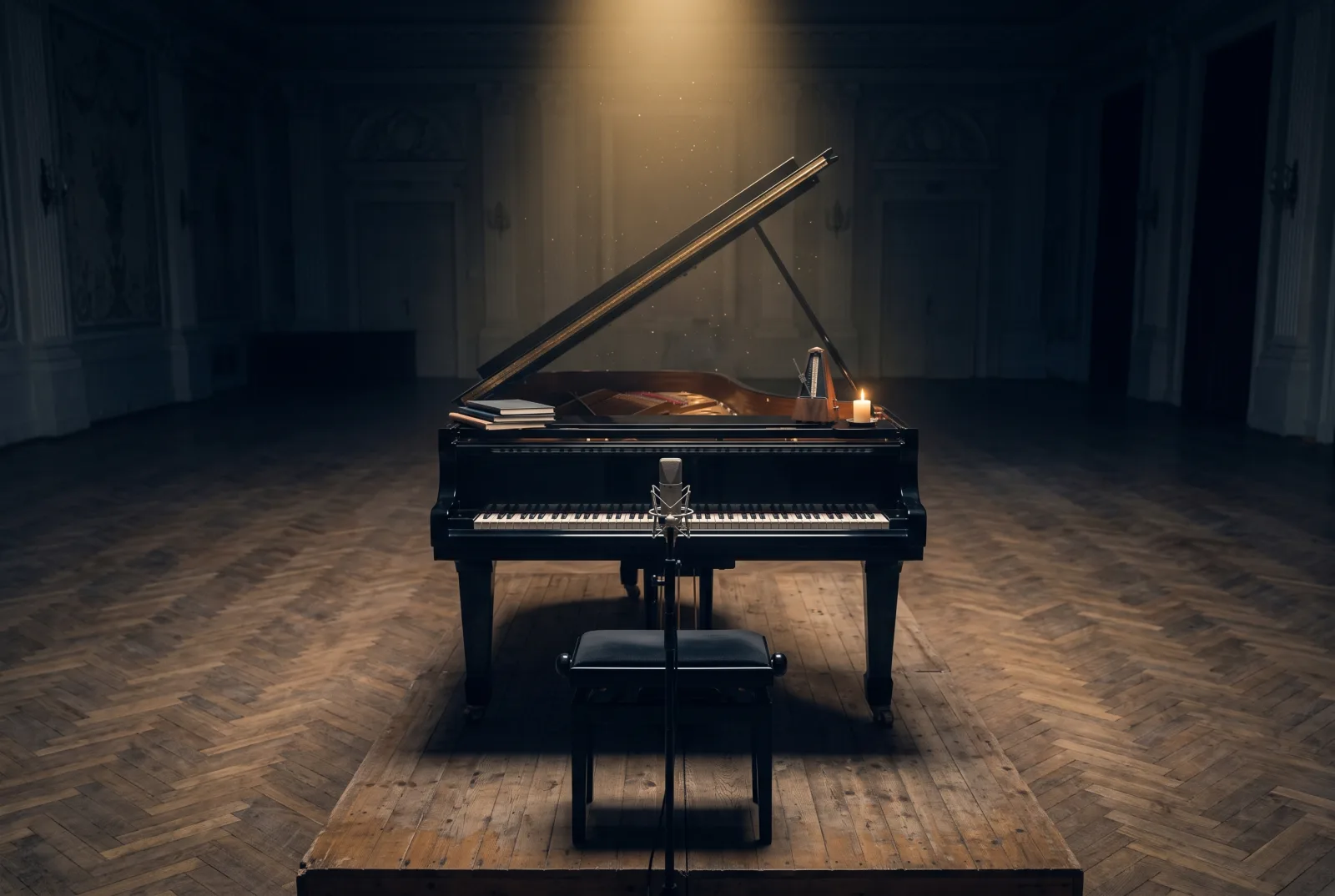
Ilustración: Rebobinados
Tori Amos did something with the piano that almost nobody had done: she turned it into an instrument that was intimate and ferocious at once, able to whisper a secret and to scream with rage.
Sitting at the keyboard, with that voice that leaps from sweetness to devastation, she wrote some of the most confessional and courageous songs of the nineties. Songs that spoke about things women, until then, sang about in metaphors or did not sing about at all.
She is one of the most singular songwriters of her generation, and one who used her music for something bigger than herself.
The child prodigy
First of all, Tori Amos was a musical phenomenon.
She was born in 1963 in North Carolina, the daughter of a Methodist minister, and from very early on she showed an astonishing gift: at two and a half she could already pick out by ear, on the piano, whatever she heard around her. At three she was composing.
At five she entered the preparatory division of the Peabody Conservatory in Baltimore on a full scholarship. Her biography holds that she was the youngest student ever admitted in the institution's history; the conservatory has never confirmed it, so it is best taken for what it is: part of her legend, not a verified record.
What is clear is what happened next. Tori did not want to read scores and repeat the dead masters: she wanted to play by ear, improvise, invent. That rebelliousness ended up costing her the scholarship at eleven.
It defines who she is: a virtuoso with the technique of a concert pianist and the soul of a songwriter who needed to say her own thing.
From failure to "Little Earthquakes"
The road was not a straight one.
In the late eighties, Tori tried to make it with a glam rock band, Y Kant Tori Read. It was an outright failure: the label dropped the promotion within a few months and the group fell apart. She was left humiliated.
And there, nearly thirty and with her first project in pieces, she was handed the most valuable opportunity of all: the chance to be honest with herself and start again.
She dropped the rock star costume, sat down alone at her piano again, and wrote "Little Earthquakes", her first album as a singer-songwriter, in 1992.
It was a before and an after. "Silent All These Years", "Crucify", "Winter" and "Precious Things" revealed a completely new artist: raw, personal, poetic, singing about the religion that raised her, about male chauvinism, about guilt, about what it means to be a woman, with the piano as a confessional.
She was compared to Kate Bush and to Joni Mitchell, but she was herself. Alone with her keyboard, she put the piano back at the centre of rock, playing it with a very strange mixture of tenderness and aggression.
The song that broke a silence
And here is the hardest and bravest edge of her story, which has to be told with respect.
On "Little Earthquakes" there is a song, "Me and a Gun", that Tori sings completely a cappella, with no instrument at all, only her voice trembling in the silence.
In it she recounts, with unprecedented frankness, without a single metaphor to protect her, her own experience as the survivor of a rape, which happened when she was twenty-one, after a concert. Her attacker threatened her with a knife; she changed the weapon in the lyric.
Almost no artist had exposed anything like that, so directly, so nakedly, in front of the world. Listening to her is almost uncomfortable, and that was the idea: to force people to look straight at something society preferred to keep quiet.
With that song, and with the courage to tell her story out loud when almost nobody did, Tori Amos gave thousands of people permission to name what had happened to them.
She did not stop at the song. In 1994, when RAINN was founded, the main American network helping victims of sexual abuse, she backed its launch and became its first national spokesperson. She turned her wound into a tool for standing by others.
Decades before the movement that pushed women to speak out existed, Tori had already broken that silence, alone, with a piano and her voice.
What to remember
Tori Amos is the proof that the most extreme vulnerability can also be the greatest form of strength.
A child prodigy who refused to be what she was told to be, a woman who took her most private pain and turned it into art and then into help for others.
If you play "Silent All These Years", "Cornflake Girl", "Winter" or "Crucify", you will hear one of the finest pianists and songwriters in pop-rock, an unmistakable voice singing about what really matters, without ornament and without fear.
And behind those songs there is an artist who understood that telling your own truth, however hard it may be, can be a gift to everyone who cannot find a way to tell theirs.
She gave the voice back to a lot of people who had lost it. There are few more valuable things a musician can do.
This text mentions sexual violence. If you or someone you know has been through something like this, you are not alone and help can be asked for. In Chile, SernamEG's Gender Violence Guidance Line is 1455, from 08:00 to 00:00 every day, with a silent WhatsApp service on +56 9 9700 7000. For emergencies during the night there are Carabineros' 149, and 133 and 134. And in the case of a recent sexual assault you can go directly to any emergency service, without needing to have made a report: care is guaranteed within the first 72 hours. Seeking support is an act of strength.
Tori Amos (Myra Ellen Amos; Newton, North Carolina, 22 August 1963), singer, pianist and songwriter, daughter of the Methodist minister Edison Amos; the family soon moved to the Baltimore area. A child prodigy, she played by ear at two and a half and was composing at three; she entered the preparatory division of the Peabody Institute in Baltimore on a full scholarship at the age of five, where she studied between 1968 and 1974, until she lost the scholarship at eleven because of her unconventional style. The claim that she was the youngest student ever admitted in the conservatory's history circulates in her biography and in the press, but is not confirmed by the institution. After the failure of her glam rock band Y Kant Tori Read (1988), whose label dropped the promotion within a few months, she released her debut as a singer-songwriter, "Little Earthquakes" (United Kingdom, January 1992; USA, February 1992), which reinvented the piano as a rock instrument, with confessional songs such as "Silent All These Years", "Crucify" and "Winter"; it was followed by "Under the Pink" (1994, with "Cornflake Girl"), among many other albums. The a cappella song "Me and a Gun", released earlier as a single on 21 October 1991, recounts her own experience as the survivor of a rape at the age of 21, after a concert in Los Angeles; Amos has explained that her attacker threatened her with a knife and that she changed the weapon in the lyric. RAINN (Rape, Abuse & Incest National Network) was founded in 1994 by Scott Berkowitz; Amos backed its launch, took the ceremonial call that opened the helpline and was its first national spokesperson. She has been nominated for the Grammys several times and is considered one of the most influential artists in alternative rock made by women. Externally authored text, edited and verified for Rebobinados. Readings of the meaning of her work are offered as the author's interpretation. No song lyrics are reproduced, for copyright reasons. Information drawn from Wikipedia, rainn.org, AllMusic, Paste, SernamEG, ChileAtiende and other press coverage.
Sources
Keep rewinding
90s
indie
Portishead
A short film got them the record deal
Before the record they shot *To Kill a Dead Man*, eleven minutes of film noir written by the three of them: Geoff Barrow plays a sniper and Beth Gibbons a widow. That soundtrack got them the record deal, and the cover of *Dummy* is a still from the short. The rest is told wrong too: *Dummy* sold 3,600,000 copies and won the 1995 Mercury ahead of Oasis, Tricky and PJ Harvey. Three records in fourteen years, and eighteen without a fourth.
00s
indie
Peter Bjorn and John
The whistle was provisional
Björn Yttling whistled the melody of "Young Folks" as a placeholder, only so as not to forget it, and they decided to keep it. The single came out on 7 August 2006, with Victoria Bergsman as guest, and it was not no. 1 anywhere: no. 13 in the United Kingdom, no. 9 in Finland. Live it is whistled by Peter Morén, and the trio never broke up: nine albums.
00s
indie
Florence + the Machine
The catharsis had a name
The band formed in London in 2007 and "the Machine" comes from the keyboard player Isabella Summers. Florence Welch has said that she stopped eating at seventeen and that she stopped drinking around 2014: the catharsis in her music has a concrete content. She has five British number ones, the last with Everybody Scream (31 October 2025), nominated for the 2026 Mercury.
Rewind with us
Comments · 0
No one has commented yet. Open the conversation.