
Twisted Sister
The most sensible man in the room
By Rebobinados · Published on September 27, 2026
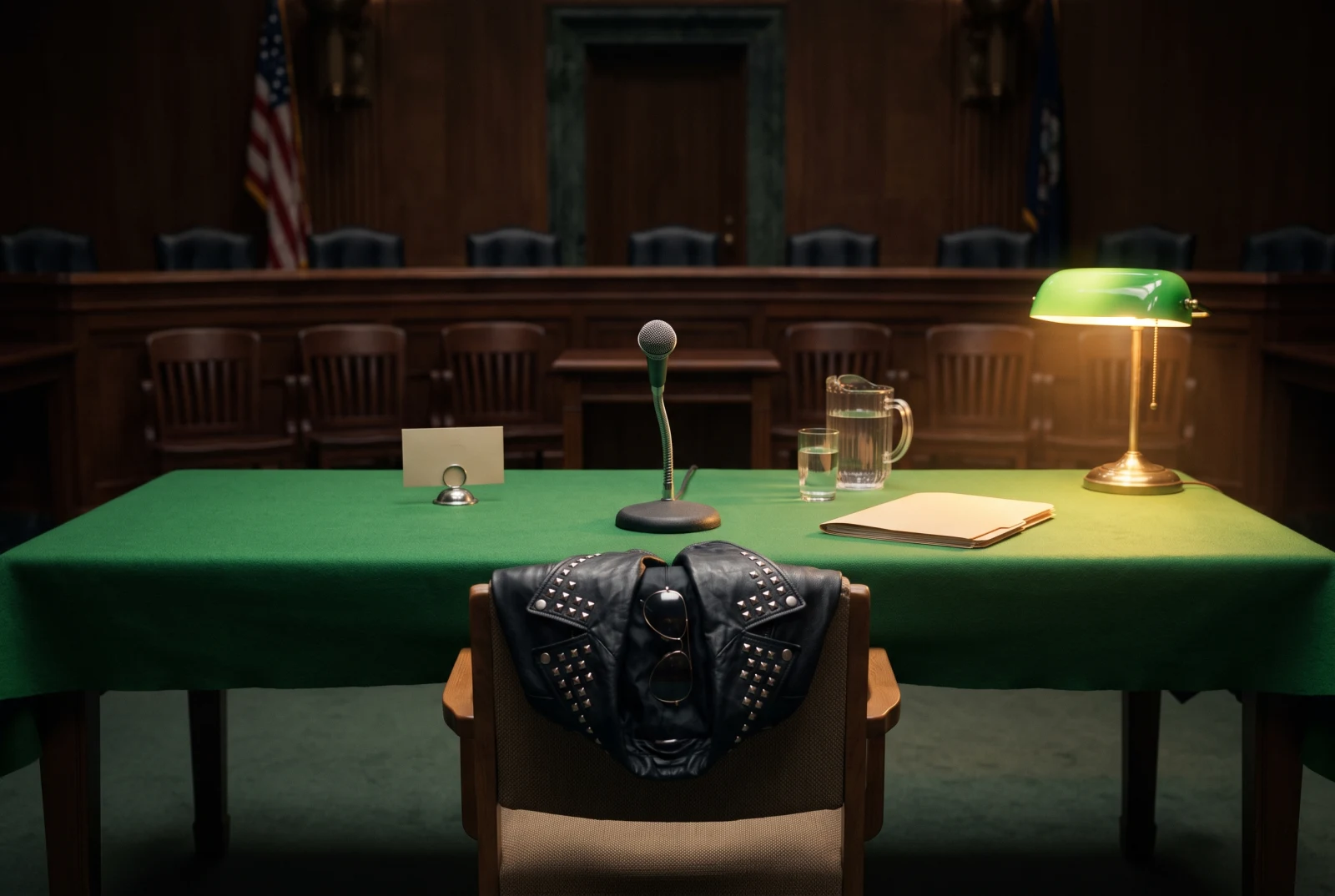
Ilustración: Rebobinados
The PMRC's blacklist had fifteen songs on it and is known as the "Filthy Fifteen". One of them was "We're Not Gonna Take It", by Twisted Sister, marked with a "V" for violence. It is worth pausing there for a second: the committee that said it wanted to protect minors from music pointed the finger, precisely, at the anthem that today gets sung on marches, in stadiums and in television adverts, and that consists basically of refusing to put up with things. That is the irony that tends to get lost when the story of the day Dee Snider went to the Senate is told.
Ho-Ho-Kus, 1972
The band formed in 1972 in Ho-Ho-Kus, New Jersey, and not in the mid-seventies on Long Island, as keeps being repeated. Long Island was something else, equally important: the bar circuit where they made themselves, night after night, for years, with the guitarist Jay Jay French holding the project up when nobody would have bet a penny on it. Dee Snider, who is the face everyone remembers, only joined in 1976.
The explosion came in 1984 with Stay Hungry and two songs that no longer belong to the band. And here is a fact that contradicts intuition: "We're Not Gonna Take It" reached number 21 on the Billboard Hot 100 and "I Wanna Rock" number 68. Neither of Twisted Sister's two generational anthems was a big chart hit. They became enormous afterwards, through use: through the number of people who needed them for something.
19 September 1985
That day it was not only Dee Snider who testified, and the body of this story tends to erase the other two. Before the Senate Committee on Commerce, Science and Transportation, chaired by John Danforth, testimony was also given by Frank Zappa, who called the PMRC's proposal an ill-conceived piece of nonsense, and John Denver, the most inoffensive singer anyone could imagine, who compared the measures to the book burnings of Nazi Germany. The contrast between those three witnesses — the eccentric, the good boy and the monster in make-up — is exactly the reason the hearing became famous. The PMRC, incidentally, was partly funded by Mike Love, of the Beach Boys.
Snider turned up with the usual mane and the usual clothes and read a statement that dismantled the prejudice before anyone had stated it: he was 30, he was married, he had a three-year-old son, he had been born and raised a Christian and still followed those principles, and he did not smoke, did not drink and did not take drugs. Then came the rest. Tipper Gore had cited "Under the Blade" as a song about sadomasochism; Snider explained that it was about the fear of an operation — the throat surgery of Eddie Ojeda, his guitarist — and finished off by saying that the only sadomasochism, bondage and rape in that song was in Mrs Gore's mind.
It was a clean demolition, and it was recorded for posterity. But it worked on the wrong song: Snider took apart Tipper Gore's specific accusation and left intact the list that carried "We're Not Gonna Take It" with its violence label. The man who looked like degeneracy made flesh turned out to be the most sensible person in the room. He also turned out to be the one who won the argument and lost the proceeding.
What the PMRC did get
On 1 November 1985, a month and a half after the hearing, the RIAA agreed with the PMRC on the "Parental Advisory" label. The sticker arrived anyway. What the committee did not get was the other thing it was asking for: a content rating system, lyric by lyric, in the style of the cinema. So the ending is not the rounded triumph usually told. It is an uncomfortable draw, with a rhetorical victory on one side and a black sticker on millions of records on the other.
The band went on its way, with break-ups and comebacks. A.J. Pero, its drummer, died on 20 March 2015, aged 55, of a heart attack, while he was on tour with Adrenaline Mob and not with Twisted Sister, a distinction that press notices still mix up to this day. Snider, over the years, went from threat to the young to respected figure: the same man, the same speech, applauded late.
What to remember
Twisted Sister was never a record-selling machine and never had big chart numbers. What it had was a song people appropriated for everything and a singer who, made to defend it in front of the United States Senate, argued better than his accusers. That the argument came from under a kilo and a half of make-up is what made the scene memorable, and also what makes it useful: hardly anyone walked into that room without a prior idea of who the adult was.
The ending, though, does not round off. Snider won the argument and the PMRC got its label six weeks later. "We're Not Gonna Take It" went on being the song on the blacklist and went on playing every time someone decides not to put up with things any more. Both things happened. Telling only the first is doing exactly what the committee did: keeping the convenient half.
Sources
Twisted Sister formed in 1972 in Ho-Ho-Kus, New Jersey, and developed its live circuit in the bars of Long Island; the guitarist Jay Jay French was a founding and constant figure, and Dee Snider joined as vocalist in 1976, alongside Eddie Ojeda (guitar), Mark Mendoza (bass) and A.J. Pero (drums). Their album "Stay Hungry" (1984) included "We're Not Gonna Take It", which reached number 21 on the Billboard Hot 100, and "I Wanna Rock", which reached 68. "We're Not Gonna Take It" appeared on the list of the "Filthy Fifteen" drawn up by the Parents Music Resource Center, with the "V" label for violence; the PMRC counted Mike Love, of the Beach Boys, among its funders. On 19 September 1985, before the United States Senate Committee on Commerce, Science and Transportation, chaired by John Danforth, Frank Zappa, John Denver and Dee Snider testified. Zappa described the proposal as an ill-conceived piece of nonsense and Denver compared it to the book burnings in Nazi Germany. Snider stated that he was 30, was married, had a three-year-old son, had been raised a Christian and did not smoke, drink or take drugs, and answered Tipper Gore's accusation about "Under the Blade" by pointing out that the song was about the fear of surgery — inspired by the throat operation of the guitarist Eddie Ojeda — and that the sexual content attributed to it was in the mind of the person making the accusation. On 1 November 1985 the RIAA agreed to adopt the "Parental Advisory" label; the PMRC did not, on the other hand, obtain the content rating system it had proposed. A.J. Pero died on 20 March 2015, aged 55, of a heart attack, while he was on tour with the band Adrenaline Mob. Profile compiled for Rebobinados with fact-checking; interpretations of the meaning of the work are offered as the author's reading. No song lyrics are reproduced, for copyright reasons. Information drawn from Billboard, Rolling Stone, the records of the United States Senate, Ultimate Classic Rock, Wikipedia and other coverage.
Keep rewinding
10s
metal
Bring Me the Horizon
Twenty years to get back to the scream
Bring Me the Horizon started in 2006 with a deathcore record and their turn did not happen in 2013: the leap to metalcore was in September 2008 and the synthesisers and clean vocals arrived in October 2010. Jordan Fish, eleven years in the band, was the one who put in the electronics. On 10 July 2026 they re-recorded that first record for its twentieth anniversary, with Oli Sykes back on the guttural scream.
00s
metal
Staind
The sleeve that nearly cost them everything
In October 1997, Fred Durst tried to pull Staind off the bill at the Webster Theatre in Hartford over the sleeve of their home-made record; then he listened to them and signed them. In 2001, Break the Cycle debuted at number one on the Billboard 200 and "It's Been Awhile" spent sixteen weeks at number one on the Modern Rock. Jon Wysocki, founding drummer, died on 18 May 2024.
90s
metal
Marilyn Manson
The lawsuit he withdrew while paying
The triad of Antichrist Superstar, Mechanical Animals and Holy Wood, and a file that is still open: two out-of-court settlements, one sworn retraction, the prosecutor's office that ruled out charges in January 2025 on statute-of-limitations grounds, the defamation suit he withdrew while paying 327,000 dollars and a jury trial set for November 2027.
Rewind with us
Comments · 0
No one has commented yet. Open the conversation.