
U2
Nobody gets left behind
By Rebobinados · Published on September 17, 2026
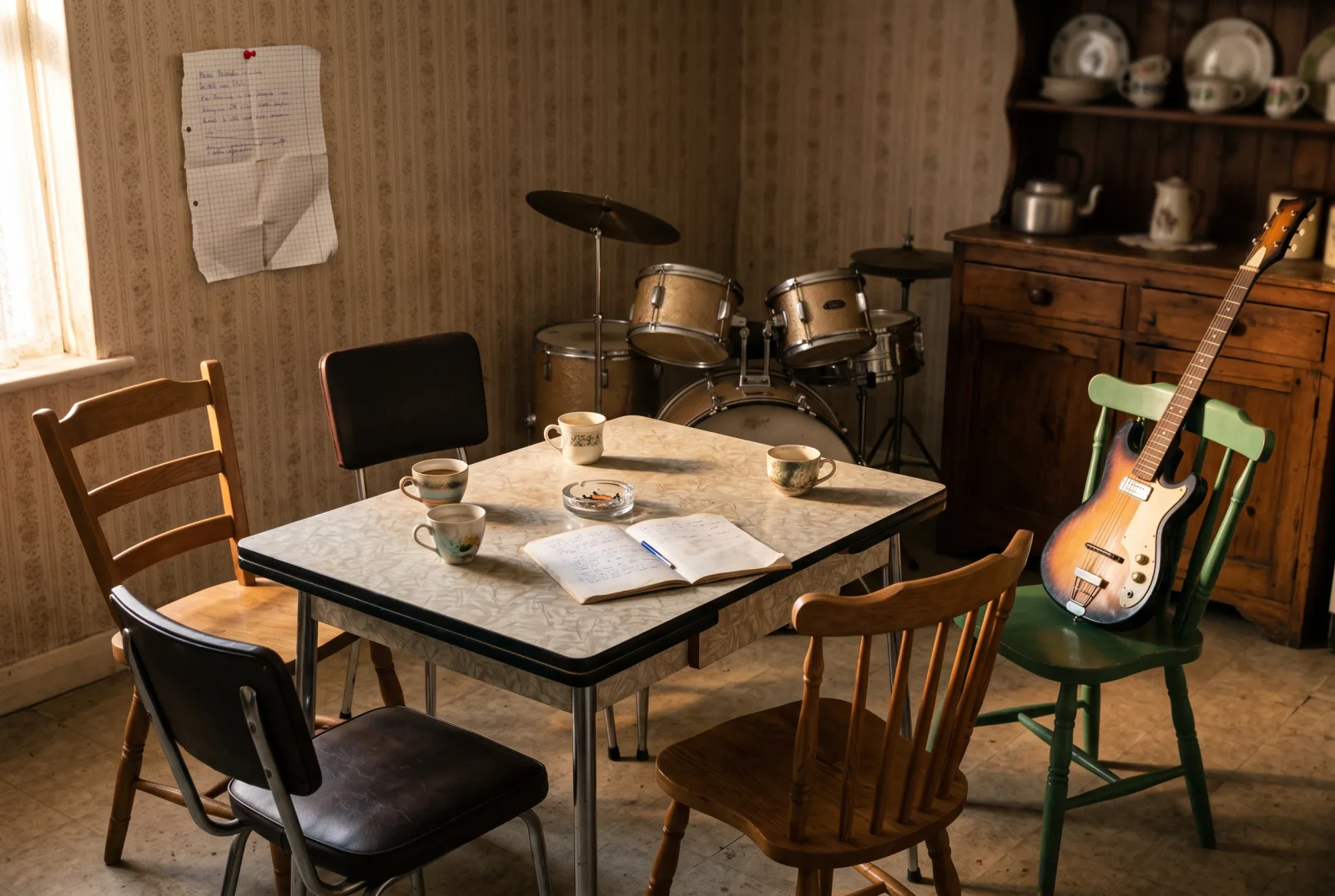
Ilustración: Rebobinados
U2 are one of the biggest bands in the history of rock, and also one of the most singular: the same four blokes since day one, without a single line-up change in almost fifty years.
Their music —those guitars that sound like a cathedral, that voice that reaches the back of the stadium, those anthems that get a hundred thousand people singing— is enormous.
But what holds it up is something more human: four friends who looked after each other. And all four have their story.
A notice on a school board
It all starts with a piece of paper pinned to the notice board of a Dublin school, Mount Temple, in 1976.
It was put up by a fourteen-year-old boy, a drummer, looking for musicians to put a band together. He has said since that the idea for the notice came from his father.
A few classmates answered, and on 25 September that year they met for the first time in the drummer's kitchen. Out of that meeting came U2.
Four teenagers who could barely play, who learned together, who grew up together, and who never split up. It is one of the loveliest origin stories in rock: they did not find each other through talent or a casting call. They met at school and decided not to let go.
Bono: the boy who lost his mother
Out front is Bono —Paul Hewson—, one of the most charismatic and also most divisive frontmen in history.
As a teenager he could hardly play a thing. What he had was an overwhelming conviction, a way of standing up and singing as if his life depended on it.
And there is a wound at the source of that intensity. When Bono was fourteen, his mother, Iris, collapsed at the graveside during the funeral of her own father. She died a few days later, on 10 September 1974, from a ruptured brain aneurysm.
That loss —the home left without a mother, the rage and the grief of that boy— feeds a good part of his work. Many U2 songs are born there.
Over the years Bono also became one of the most influential activists in the world: he fought for debt relief for poor countries, for access to AIDS medication in Africa, and founded global campaigns.
Some see a saint; others, an unbearable stadium preacher. But nobody disputes that he used his fame to fight for real causes, and that the commitment comes, in part, from that boy who lost his mum far too soon.
The Edge: the man who invented a sound
The guitarist is The Edge —David Evans—, and he is one of the most original musicians in rock, though not for playing fast. Almost for the opposite.
His most recognisable device is an echo: a digital delay set to a dotted quaver and synced to the song's tempo, filling the gaps he leaves on purpose. He plays few notes, and the echo completes the pattern. That is why his guitar sounds like bells, like cathedrals, like open sky.
But it would be unfair to reduce him to that trick. The Edge also plays harmonics, open strings, two-note chords, semiquaver strumming, riffs with fuzz. What really defines his playing is not the effect: it is which notes he decides not to play, so the effect has somewhere to go.
He is the band's silent architect. While Bono shouts and leaps, he quietly weaves the web of sound that holds everything up.
Adam Clayton: the one who nearly fell
The bassist, Adam Clayton, has the most human story of the four.
At the start he was, as he jokes himself, the one who could play the least; he got in more for attitude and for the look than for technique.
But with fame came a serious problem: Adam sank into alcohol. It went so far that on 26 November 1993 he failed to turn up for a concert in Sydney, and his bass technician, Stuart Morgan, had to play in his place.
That was rock bottom. Soon afterwards he sought help, and he has been sober since 1996.
And here is the beautiful part: his three friends did not abandon him. In 2017, accepting an award for his work on addiction, Adam described the band's pact: in this band nobody is going to be a casualty, we all come home or none of us comes home, nobody is left behind.
He also said he had three friends who could see what was happening and who loved him enough to carry what he was dropping. And he finished by thanking them for keeping that promise, and for letting him be in their band.
It is one of the most moving friendship stories in rock: three men who did not let the fourth fall.
Larry Mullen Jr.: the one who started it all
And the drummer is Larry Mullen Jr., the boy who pinned that notice up at school. Which means, literally, the man who founded U2.
There is a lovely irony in that: the band began as his, and ended up belonging to the singer, as it always does.
Larry is the most private and the most resistant to the circus of fame. The one who speaks least, who keeps his feet on the ground, the rhythmic engine holding everything up from the back without chasing the spotlight.
He carried his own weight too. His younger sister, Mary, died in an accident in 1973, and his mother, Maureen, died in another road accident in November 1978, when he had just turned seventeen. And over the years he has struggled with physical injuries from decades of wear at the drums.
So much so that something often repeated needs correcting: Sydney was not the only time U2 played without one of the four. It was the only time for thirty years, until Larry sat out the entire residency at the Sphere in Las Vegas —forty concerts between 2023 and 2024— while recovering from surgery, with Bram van den Berg on drums.
He is the band's anchor, the one who shines least and without whom none of it would exist. Because without his notice on that board, U2 would never have been born.
The two at the back
And there is one fact that brings Adam and Larry together, which plenty of people remember without knowing it was them.
The version of the "Mission: Impossible" theme, the one from the 1996 film, was recorded by the two of them alone —U2's bassist and drummer— as a duo, without Bono or The Edge.
They gave the spy classic an electronic, danceable treatment, and it was a huge hit: number seven in both the United States and the United Kingdom, and certified gold.
That a band's rhythm section —the two who usually stay in the shadows behind the singer and the guitarist— could go off on their own and land a worldwide hit says a lot about how good they are. U2's foundation, the one that holds everything up while nobody looks at it, turned out to have a light of its own.
The music
Together, these four became giants.
In the eighties, with "The Joshua Tree" —"With or Without You", "I Still Haven't Found What I'm Looking For", "Where the Streets Have No Name"— they became one of the biggest bands on the planet, with a rock that was epic, spiritual, open-armed.
And when that sound threatened to turn solemn, they did something brave: they reinvented themselves completely with "Achtung Baby" and the Zoo TV tour, embracing irony, electronics and excess, laughing at their own grandiosity.
That ability to destroy their own formula rather than repeat themselves kept them alive for decades.
And there is one song that sums it all up. "One" was born in Berlin, during the "Achtung Baby" sessions, at the exact moment the band was about to break apart: Adam and Larry wanted the old sound, Bono and The Edge wanted the industrial and the electronic, and Larry came to think that was the end.
The breakthrough came from a few chords The Edge was playing for the bridge of another demo. Suddenly, he says, something very powerful started happening in the room. The song was put together in about fifteen minutes, and Bono said the lyric fell out of the sky, like a gift.
An anthem about unity, born just when they were closest to splitting up.
What to remember
U2 are proof that a band can be, above all else, a friendship, and that such a friendship can hold up almost anything.
Put on "With or Without You", "One", "Where the Streets Have No Name" or "Beautiful Day", and you will hear stadium rock at its biggest and most emotional: The Edge's cathedral guitar, Bono's voice giving everything, the firm foundation of Adam and Larry, and that sense of open sky only they manage.
Like them more or less —and they divide people, as everything big does—, the story underneath is beautiful: four schoolmates from Dublin who found each other through a notice on a board, learned to play together, became the biggest band in the world, and looked after each other along the way.
They agreed that nobody would be left behind. They kept their word. And that is why, half a century later, they are still the same four.
Sources
U2, Irish rock band formed in Dublin in 1976, made up without interruption of Bono (Paul David Hewson; vocals), The Edge (David Howell Evans; guitar, keyboards), Adam Clayton (bass) and Larry Mullen Jr. (drums). It began when Larry Mullen Jr., aged 14, put a notice on the board at Mount Temple Comprehensive School looking for musicians —an idea that, as he has said himself, was suggested by his father—; the first rehearsal was on 25 September 1976 in his kitchen. Iris Hewson, Bono's mother, collapsed during the funeral of her own father and died on 10 September 1974 from a ruptured brain aneurysm, when Bono was 14; at the time the family spoke of a stroke. Bono is also a prominent activist (debt relief, the fight against AIDS in Africa, the ONE and RED campaigns). The Edge's most characteristic device is a digital delay set to a dotted quaver and synced to the tempo, audible in "Where the Streets Have No Name" and "I Still Haven't Found What I'm Looking For", although his style is not reducible to that effect. Adam Clayton faced an alcohol addiction: on 26 November 1993 he missed a concert at the Sydney Football Stadium and his bass technician, Stuart Morgan, took his place; he has been sober since 1996. In June 2017, receiving the Stevie Ray Vaughan Award at the MusiCares MAP Fund Benefit, Clayton described the band's commitment: "In our band, no one will be a casualty. We all come home, or none of us come home. No one will be left behind", and gave thanks: "Thank you for honoring that promise, and letting me be in your band". Larry Mullen Jr.'s younger sister, Mary, died in an accident in 1973, and his mother, Maureen, in a road accident in November 1978. The Sydney concert was the only occasion on which U2 played without one of its members until 2023-2024, when Mullen did not take part in the 40 concerts of the "U2:UV Achtung Baby Live at Sphere" residency in Las Vegas, with Bram van den Berg on drums. In 1996, Adam Clayton and Larry Mullen Jr. recorded as a duo, without Bono or The Edge, a version of the "Theme from Mission: Impossible" for the film's soundtrack: it reached number 7 on both the Billboard Hot 100 and the British chart, and was certified gold by the RIAA. Among their key albums: "The Joshua Tree" (1987) and "Achtung Baby" (1991). "One" emerged during the sessions for the latter at Hansa Studios in Berlin, at a moment of tension that came close to breaking up the group, out of a chord progression The Edge was playing as the bridge of another demo; it was written in about fifteen minutes. The usual estimates put their sales at between 170 and 175 million records —claimed figures, not certified—, of which some 52 million units are certified by the RIAA in the United States. Externally authored text, edited and verified for Rebobinados. Interpretations of the meaning of their work are offered as the author's reading. No song lyrics are reproduced, for copyright reasons. Information drawn from Wikipedia, The Irish Times, Rolling Stone, CBS News, u2gigs.com and other press coverage.
Keep rewinding
90s
indie
Portishead
A short film got them the record deal
Before the record they shot *To Kill a Dead Man*, eleven minutes of film noir written by the three of them: Geoff Barrow plays a sniper and Beth Gibbons a widow. That soundtrack got them the record deal, and the cover of *Dummy* is a still from the short. The rest is told wrong too: *Dummy* sold 3,600,000 copies and won the 1995 Mercury ahead of Oasis, Tricky and PJ Harvey. Three records in fourteen years, and eighteen without a fourth.
00s
indie
Peter Bjorn and John
The whistle was provisional
Björn Yttling whistled the melody of "Young Folks" as a placeholder, only so as not to forget it, and they decided to keep it. The single came out on 7 August 2006, with Victoria Bergsman as guest, and it was not no. 1 anywhere: no. 13 in the United Kingdom, no. 9 in Finland. Live it is whistled by Peter Morén, and the trio never broke up: nine albums.
00s
indie
Florence + the Machine
The catharsis had a name
The band formed in London in 2007 and "the Machine" comes from the keyboard player Isabella Summers. Florence Welch has said that she stopped eating at seventeen and that she stopped drinking around 2014: the catharsis in her music has a concrete content. She has five British number ones, the last with Everybody Scream (31 October 2025), nominated for the 2026 Mercury.
Rewind with us
Comments · 0
No one has commented yet. Open the conversation.