
a-ha
Bigger than yourself
By Rebobinados · Published on September 16, 2026
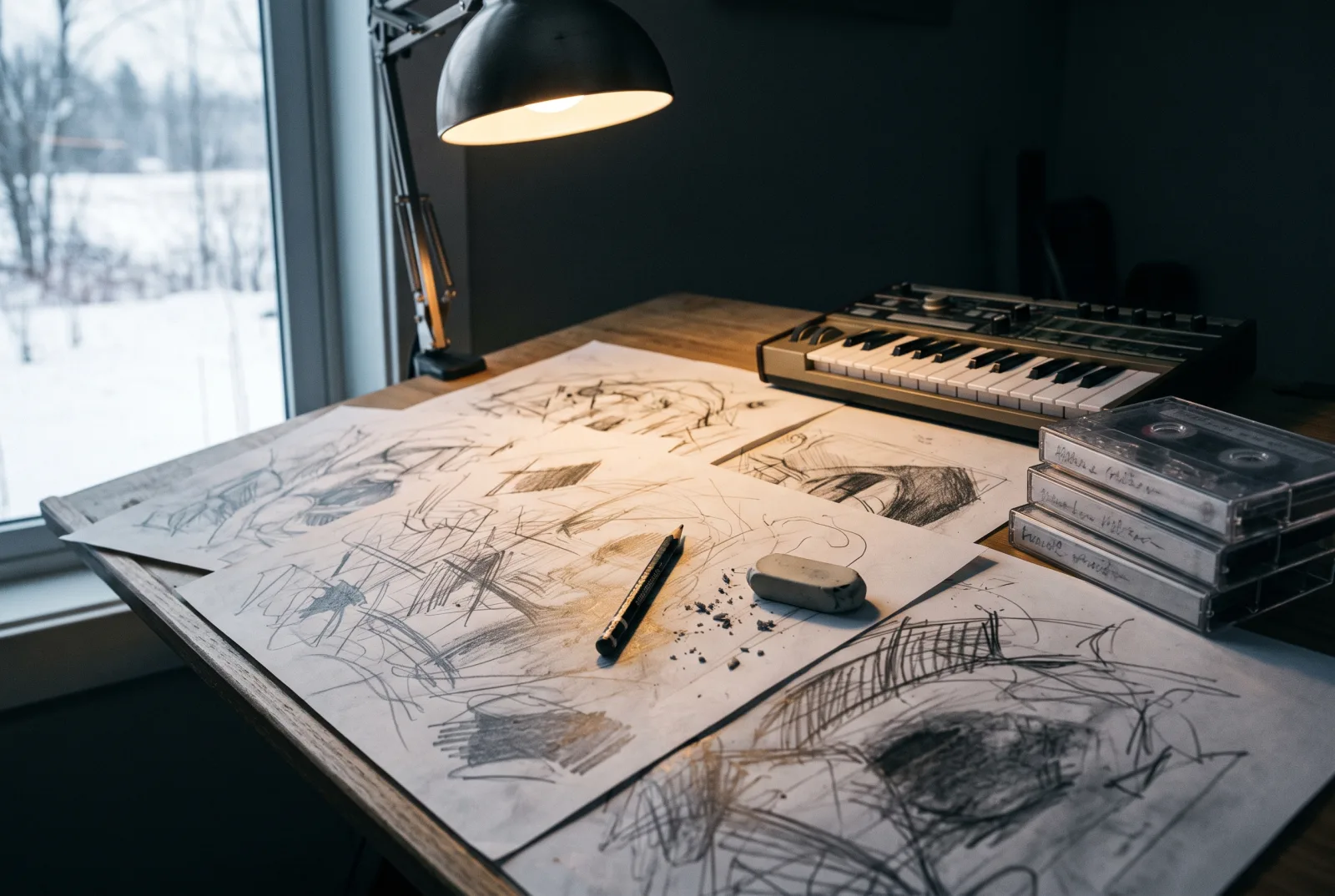
Ilustración: Rebobinados
"Take On Me" flopped twice before it was a hit.
They released it and nothing happened. They released it again and nothing happened either. Only on the third attempt, with a new mix and a video of pencil drawings, did it explode: it sold a million and a half copies in a week, went to number one in dozens of countries and made a-ha the first Norwegian band to top the charts in the United States.
It was not luck. It was insisting three times with the same song.
Three from Oslo
a-ha formed in Oslo in 1982: Morten Harket, a singer with a falsetto that climbed to the heavens; Magne Furuholmen on keyboards; and Paul Waaktaar-Savoy on guitar, the engine of the songwriting.
Magne and Paul had known each other since childhood. The immortal riff of "Take On Me" was written by Magne when he was a teenager of fourteen or fifteen.
The three of them left Norway for London to make their way, with a short, odd name: "a-ha", an exclamation of recognition that sounds the same in almost every language.
The video, with that technique blending pencil animation and live action, won six MTV awards in 1986, competing on equal terms with Dire Straits' "Money for Nothing". It changed what a video could be.
The career nobody looks at
And here is what almost nobody knows: a-ha were not a one-hit band who fizzled out. They were a band with one famous hit and a long, respected career.
They released record after record, with that signature of warm synthesisers and melancholy melodies. "The Sun Always Shines on T.V." was number one in the United Kingdom, and in 1987 they recorded the theme for a James Bond film, "The Living Daylights".
There is a record of theirs that few people know about. In January 1991, at Rock in Rio, in the Maracanã — the same festival that six years earlier had opened up the map of rock in South America — a-ha played to some one hundred and ninety-eight thousand people: the largest paying attendance at a concert in history. That same night, Prince and George Michael were drawing around sixty thousand each.
The three Norwegians, who in the United States were "the ones with the hit", filled stadiums across the rest of the planet as few others did.
Forty years of a difficult marriage
Their internal story is the story of so many great bands: friendship, tension, splits and returns.
They broke up and came back — a 1998 reunion, at the Nobel Peace Prize ceremony, which was meant to be a one-off and went so well that they decided to carry on — did a farewell tour, and came back again.
In 2025, Morten Harket revealed with dignity that he had been diagnosed with Parkinson's disease. His fans all over the world stood by him.
Making peace with a song
There is a line of Morten's that sums up the whole story. Of "Take On Me" he said you have to make peace with that song, "because in a way it's bigger than yourself".
There you have the blessing and the curse of having written an immortal song: it defines you for ever, it feeds you for life and, at the same time, it hides everything else you ever did. a-ha made peace with that, and carried on.
The other ones
They are worth going to look for.
"Crying in the Rain", from 1990, is a version of the Everly Brothers song that a-ha made so thoroughly their own that it stands as a classic of theirs. "Stay on These Roads", with those keyboards that seem to be made of glass. "Hunting High and Low", pure pop drama. "Summer Moved On", with that note Morten holds for almost twenty seconds, one of the longest ever recorded in a pop song.
All by the same band you think only ever made one song.
So if you know "Take On Me" — and you do, we all do — go a little further. You will find three musicians from a country with no pop tradition who gave the world a perfect song, and several more you never took the time to listen to.
Sometimes a single song is a whole inheritance. And sometimes it is barely the front door to something much bigger.
Sources
a-ha, a Norwegian synth-pop band formed in Oslo in 1982, made up of Morten Harket (vocals), Magne Furuholmen (keyboards) and Paul Waaktaar-Savoy (guitar and songwriting). The riff of "Take On Me" was written by Furuholmen in his teens; the single failed on its first releases and succeeded after a new mix in 1985, selling around 1.5 million copies in a week and reaching number one in dozens of countries, making a-ha the first Norwegian band to top the American chart. Its video, using rotoscoping, won six prizes at the 1986 MTV Video Music Awards, an edition in which the band took eight awards in total and competed against, among others, Dire Straits' "Money for Nothing". Their debut album, "Hunting High and Low" (1985), included "The Sun Always Shines on T.V."; in 1987 they recorded "The Living Daylights", the theme from the James Bond film of the same name. On 26 January 1991, at Rock in Rio II (Maracanã stadium), they drew close to 198,000 people, a figure regarded as the largest paying attendance at a concert. Among their best-known songs are also "Hunting High and Low", "Stay on These Roads", "Cry Wolf", "Summer Moved On" — famous for a sustained vocal note of great length — and their version of "Crying in the Rain" (1990), a song by Carole King and Howard Greenfield originally recorded by the Everly Brothers. After several breaks and returns, including a reunion at the 1998 Nobel Peace Prize ceremony, the band remains active. In 2025, Morten Harket publicly revealed his diagnosis of Parkinson's disease. The quotation about "making peace" with the song comes from his interviews. Externally authored text, edited and verified for Rebobinados. Interpretations of the meaning of their work are offered as the author's reading. No song lyrics are reproduced, for copyright reasons. Information drawn from Wikipedia, Songfacts, Variety and other press coverage.
Keep rewinding

10s
pop
Bruno Mars
Eleven names in the credits
"Uptown Funk" came out on 10 November 2014 with six writers and today it has eleven. In February 2015 The Gap Band's publisher filed a claim over "Oops Up Side Your Head" in YouTube's copyright system —there was never a lawsuit— and on 28 April five names were added, with 17 % of the publishing. It happened weeks after the "Blurred Lines" verdict, and the song had been fourteen weeks at number one.

00s
pop
André Rieu
It was not from the jazz suite
The waltz with which André Rieu reached half the world is not from Shostakovich's Suite for Jazz Orchestra No. 2: it is from the Suite for Variety Orchestra, which the composer did not assemble, and it was born in 1956 as music for a Soviet film about settlers in Kazakhstan. The error comes from a misprint in volume 10 of the complete works (Muzyka, Moscow, 1984), corrected only in 2001. And the title "The Second Waltz" was invented by his wife, because the real one did not sell.

90s
pop
Daniela Mercury
She took the neighbourhood out of the song
"O Canto da Cidade" was written by Tote Gira, a composer from Nordeste de Amaralina who recorded the demo on a borrowed cassette, marking the beat on the door of a refrigerator; Mercury's team almost threw the tape away. She shares the credit because she deleted the references to the Pelourinho so that the song would serve all of Brazil. The album, from 20 September 1992, sold more than 2 million copies and nationalised axé. But she did not invent it: the name was a journalist's insult in 1987.
Rewind with us
Comments · 0
No one has commented yet. Open the conversation.