
Amy Winehouse
The whole truth
By Rebobinados · Published on September 16, 2026
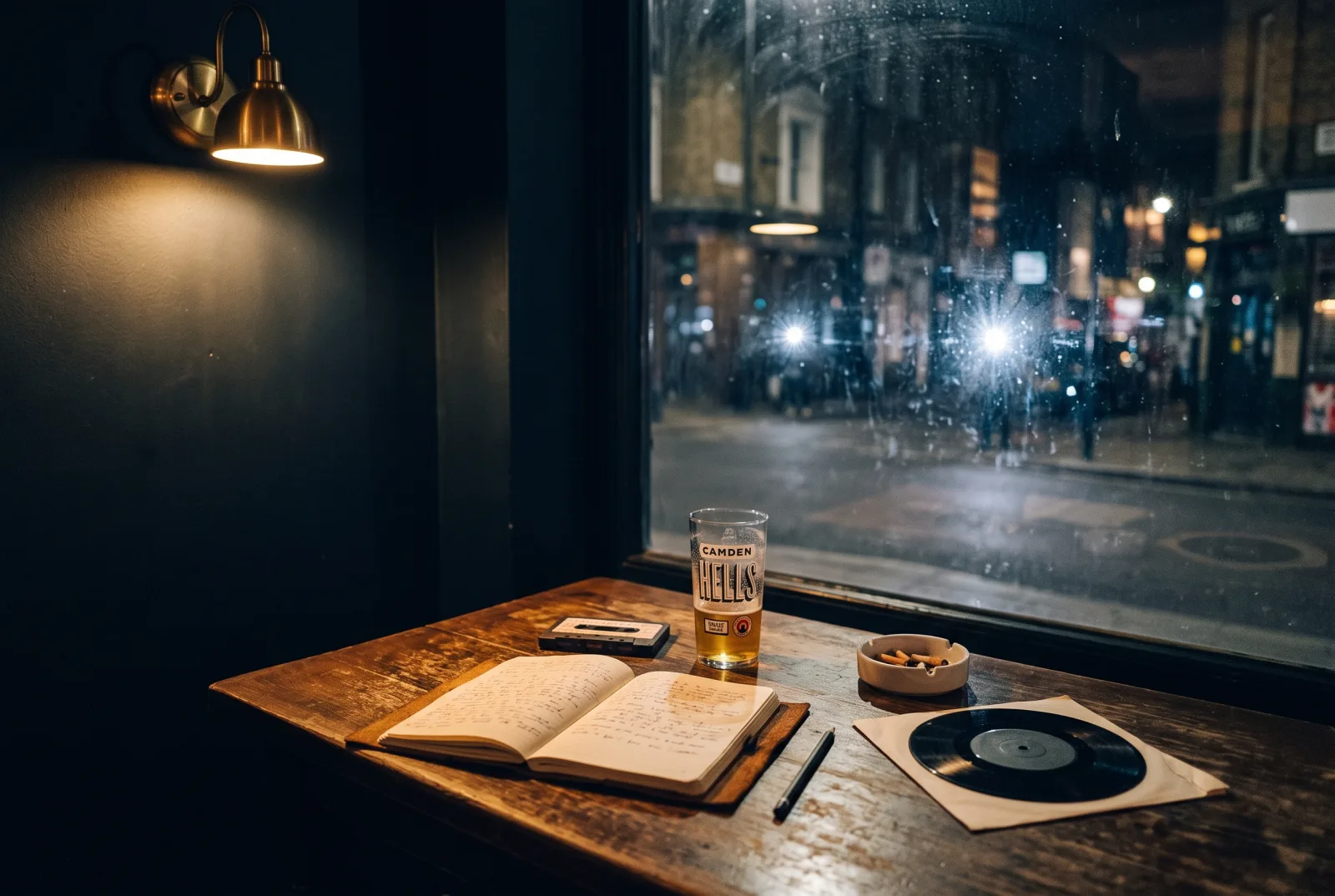
Ilustración: Rebobinados
Amy Winehouse had one of those voices that come along once a generation: deep, hoarse, suddenly old, as though a girl of twenty-three carried inside her every soul and jazz singer of the nineteen-sixties.
She sang pain without dressing it up and wrote about her own life — heartbreak, betrayal, self-destruction — with a raw frankness.
People loved her for that, for telling the whole truth. And then, when that truth became hard to look at, the same world turned her into a spectacle and watched her go under.
Camden
She was born in London in 1983, into a Jewish family in love with jazz; her father was a taxi driver, her mother a pharmacist. She was a Camden girl, that neighbourhood of pubs, music and nightlife.
Her first record, "Frank", from 2003, already showed a singer unlike anything else. But it was "Back to Black", in 2006, that made her a global star.
Working with the producers Mark Ronson and Salaam Remi, Amy took the sound of Motown and of the sixties girl groups and wrapped it in a brutally modern honesty. That record won five Grammy awards in a single night.
"Rehab", "You Know I'm No Good", "Back to Black", her version of "Valerie": songs that sounded old and new at once, and that revived British soul for a whole generation.
Everybody watched
Hers is also one of the saddest stories music ever produced, and it is easy to tell it badly.
Her relationship with Blake Fielder-Civil coincided with a descent into drugs and drink from which she never came back. She also suffered from an eating disorder. And "Rehab" — a witty song in which she refused to go into rehabilitation — became, over the years, a sinister prophecy.
The British tabloid press hounded her, photographed her staggering, laughed at her falls, turned a private illness into public theatre. Every stumble of hers was entertainment. A whole country consumed her agony in slow motion, as though it were a programme.
And almost nobody, in the middle of that circus, did the one thing that needed doing: help her.
Twenty-seven
Amy Winehouse died on 23 July 2011, at her home in Camden, of alcohol poisoning. She was twenty-seven.
With that she entered, without wanting to, the cursed club this collection has already visited with Janis Joplin: the club of those who go out at twenty-seven, enormous voices devoured before their time. Like Janis, Amy sang from an open wound; like Janis, the very sensitivity that made her great was where she broke.
Her father, Mitch, said to the people gathered outside her house a sentence that sums her up better than any headline: that Amy was one thing, and that thing was love.
An uncomfortable lesson
She was not the only one that machine hounded to the end. A few years earlier, the same British tabloid culture had harassed Princess Diana up to the day of her death; she died, in fact, fleeing the photographers.
There is something in that press that feeds on its most luminous women, and Amy fell whole into those gears.
What is left, then, is an uncomfortable lesson: that an entire world set about filming someone who was drowning, instead of reaching out a hand. You help people who are going under, you do not watch them. Amy did not have that luck. In her memory there is now a foundation that helps young people with addiction problems, which was, after all, the only thing she needed and almost nobody gave her.
The voice, not the circus
She has to be remembered for what matters.
She was a Camden girl with a voice that told the whole truth, her own, with nothing made up, however much it hurt.
If you put on "Back to Black", or "Valerie", or "Love Is a Losing Game", you are not going to hear a tragedy: you are going to hear one of the most gifted artists of this century, a woman who carried her soul in her voice.
And one allows oneself to imagine — and it is only that, an invented consolation — another life for her: far from those cameras, growing old in peace, still singing at sixty with that voice which would only have improved with the years. It did not happen. But we keep the right to dream her that way, alive and at peace.
This piece discusses addiction and an eating disorder. If you or someone you know is struggling with alcohol or drug use, help is available, and asking for it is an act of strength. In Chile, SENDA's Drugs and Alcohol helpline answers free of charge 24 hours a day on 1412. For an eating disorder, a health professional can advise on the best course to take.
Sources
Amy Jade Winehouse (London, 14 September 1983 – London, 23 July 2011), British singer and songwriter, from a Jewish family with a love of jazz. She released "Frank" (2003) and "Back to Black" (2006), the latter produced with Mark Ronson and Salaam Remi, with the participation of the Dap-Kings; it won five Grammy awards at the 2008 ceremony, including record and song of the year for "Rehab". She fused soul, jazz, rhythm and blues and the sound of the sixties girl groups with autobiographical lyrics, and drove a revival of British soul. She suffered from drug and alcohol addiction and an eating disorder; her decline was exposed and ridiculed by the British tabloid press. She died aged 27 of accidental alcohol poisoning at her home in Camden, and is part of the so-called "27 Club", alongside Janis Joplin and Jimi Hendrix, among others. The Amy Winehouse Foundation was created in her memory, dedicated to supporting young people with addiction problems. Her life is the subject of the documentary "Amy" (Asif Kapadia, 2015) and the film "Back to Black" (2024). The line from her father, Mitch Winehouse, is taken from press coverage. Externally authored text, edited and verified for Rebobinados. Interpretations of the meaning of her work are offered as the author's reading. No song lyrics are reproduced, for copyright reasons. Information drawn from Rolling Stone, Biography, BBC, Wikipedia and other press coverage.
Keep rewinding
00s
soul
Duffy
She told it first
Rockferry (2008) was the best-selling album of the year in the United Kingdom, with 1,685,000 copies, three BRITs in 2009 and the Grammy for Best Pop Vocal Album. In 2020 Duffy told it herself, before anybody else, that she was drugged, held captive and raped. And it is not an epilogue: a new song in 2024, a Disney+ documentary announced in 2025 and a signing with TaP Management in 2026.
80s
soul
Hall & Oates
The craft they called a guilty pleasure
Daryl Hall and John Oates put six songs at number one in the United States, and Billboard named them the most successful duo in Hot 100 history — a measure of chart performance, not of records sold. They met in Philadelphia in 1967 and ended up in a Nashville court in 2023, over the sale of the company that held their name and royalties.
90s
soul
Seal
The song that embarrassed him, and the scars he never hid
The song that won the Grammy for record of the year sat in a drawer for years because its author thought it was bad and was embarrassed to show it: it took a producer who believed in it more than he did. With the scars on his face he did the opposite: he never covered them.
Rewind with us
Comments · 0
No one has commented yet. Open the conversation.