
Aparato Raro
Where the dynasty began
By Rebobinados · Published on October 1, 2026
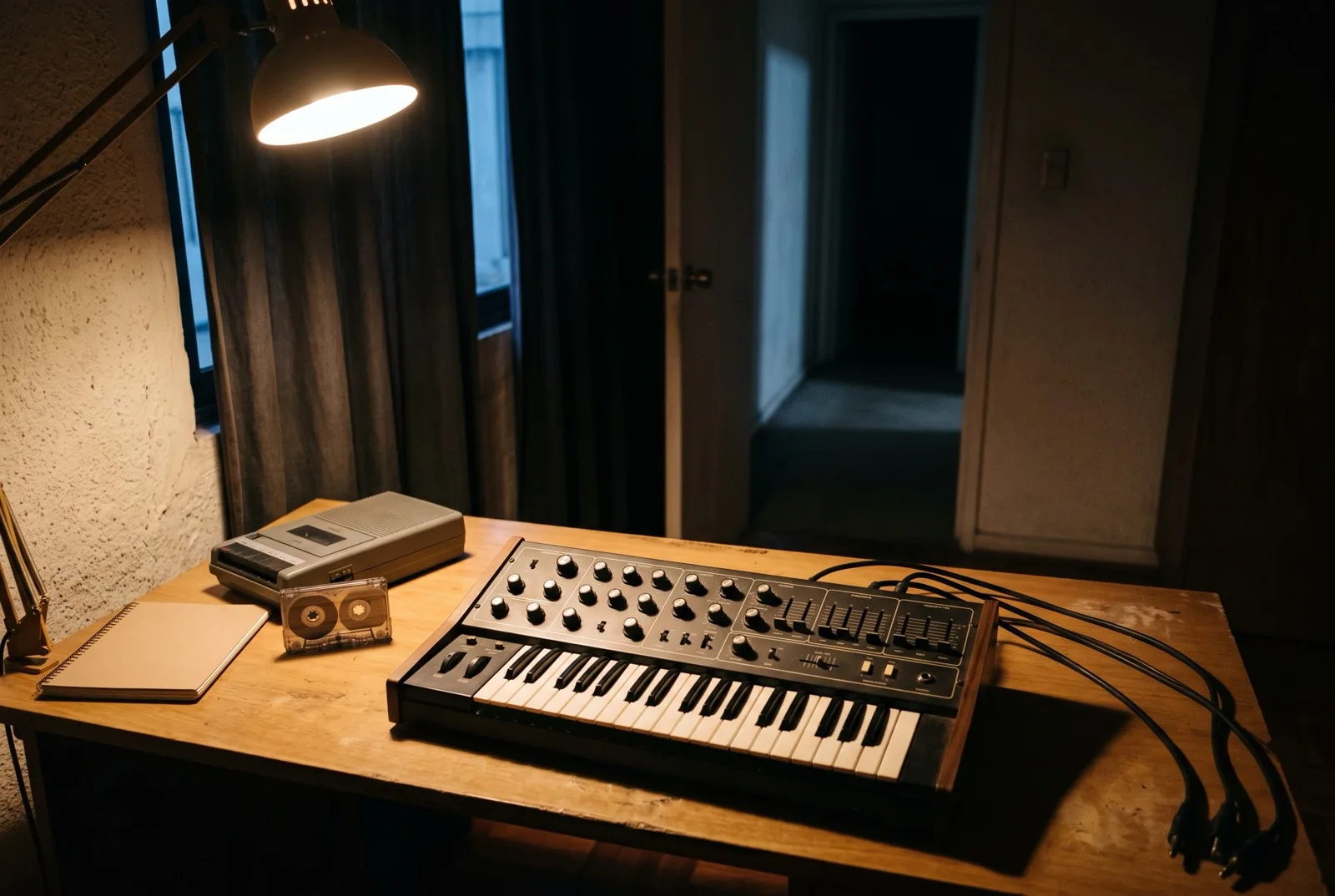
Ilustración: Rebobinados
In mid-eighties Chile, under the dictatorship, with a national rock scene that mostly looked to the guitar and to protest, a band appeared that sounded as if it came from another planet: cold synthesisers, electronic rhythms, a futuristic look, a pop that seemed to have arrived from London or Düsseldorf. They were called Aparato Raro — "Strange Device" — and the name fitted them perfectly. What almost nobody knew back then is that from that cult band would grow, over the years, one of the longest bloodlines in Chilean rock.
From jazz to synthesisers
Aparato Raro formed in Santiago in the mid-eighties, though it came from earlier, under another name and another idea: they had started as a jazz-fusion group called Ojo de Horus, led by drummer Juan Ricardo Weiler. The change came when its members discovered what was happening in the world with electronic music: Depeche Mode, Kraftwerk, Ultravox and, above all, Devo. Those sounds dazzled them and changed their course. They dropped the jazz, picked up the synthesisers and reinvented themselves as a synth pop and new wave band.
The line-up included, among others, Weiler, Igor Rodríguez, Rodrigo "Coti" Aboitiz and Boris Sazunic. The group's first synthesiser was a Yamaha CS-60 brought in by Rodríguez. They were not the only pioneers — Electrodomésticos came together in those same years, and that band is credited with the first systematic use of samplers and tape in Chilean rock — but they were among the first who dared to sound like that in a country that was not yet expecting them.
Calibraciones and the sound of tomorrow
Their great moment came with "Calibraciones", which became one of the most emblematic songs of eighties Chile. With its electronic sound and its futuristic air, the song captured a new sensibility and stayed forever tied to that era. It is on their debut album, from 1985, which was followed by Blanco y Negro, in 1987. Alongside it, songs like "Conexiones Televisivas" and "Emociones Sin Restricciones" completed the portrait of a band doing in Chile what the great new wave acts were doing in the world.
The band broke up around 1988. Two albums, a handful of songs and a place in the memory of a generation: that looked like everything they were going to leave behind.
The meeting that founded a dynasty
It was not, and this is what really makes Aparato Raro an important band, though it is almost never told properly.
In their final stretch, around 1987, the band invited a young musician called Andrés Bobe to play guitar. He was not a founder or a settled member: he was a guest sideman, played few shows and never got to record with them. But there, in the rehearsals of a band that was already winding down, Bobe met Rodrigo Aboitiz.
Out of that meeting came La Ley. It formed in 1987, with Bobe on guitar, Aboitiz on keyboards and singer Shía Arbulú, who also gave the group its name, taken from a song by the Spanish band Radio Futura. In other words: La Ley was not born from the ashes of Aparato Raro, it was born while Aparato Raro still existed, and what Aparato Raro contributed was not a legacy but a rehearsal room where two people crossed paths.
And Aboitiz kept going. He was a founder of La Ley, joined and left it several times, and in 1998 he founded Saiko together with Luciano Rojas. Which means that the thread running through that chain — Aparato Raro, La Ley, Saiko — is not Bobe, who was passing through. It is Aboitiz, who founded all three.
What to remember
Aparato Raro were much more than an eighties cult band. They were among those who brought the electronic sound and the futuristic look to a Chile that was not yet expecting them, and with "Calibraciones" they left an anthem that defines a whole era.
But their greatest legacy is not in their songs, it is in something you cannot plan: they were the place where two musicians met. Out of that came La Ley and, later, Saiko. To be a pioneer is to open a road that others will travel; sometimes it is enough to set down the room where people meet. Aparato Raro set down that room, and that is why, even though many people do not remember them, they stand at the origin of a good part of what we love about our music.
Sources
Aparato Raro is a Chilean synth pop and new wave band formed in Santiago in the mid-1980s — Wikipedia gives 1984, and an Emol interview with its members places the transformation in 1985 — out of the earlier jazz-fusion group Ojo de Horus, led by drummer Juan Ricardo Weiler. They took their new direction under the influence of Depeche Mode, Kraftwerk, Ultravox and especially Devo. Its members included Weiler, Igor Rodríguez, Rodrigo "Coti" Aboitiz and Boris Sazunic; the group's first synthesiser was a Yamaha CS-60 provided by Rodríguez. They released two albums: "Aparato Raro" (1985), which includes "Calibraciones", and "Blanco y Negro" (1987); other notable songs are "Conexiones Televisivas" and "Emociones Sin Restricciones". The band broke up around 1988, though Emol records 1987 as its final performance; it has reunited sporadically since 2007, with a full reunion in 2013. Electrodomésticos, also formed in Santiago in 1984, is credited with the first systematic use of samplers and pre-recorded tape in Chilean rock. Andrés Bobe took part in the final stretch of Aparato Raro, around 1987 and 1988, as an invited support guitarist; he was not a founding or settled member and did not record with the group. It was there that he met Rodrigo Aboitiz. La Ley formed in 1987 with Bobe (guitar), Aboitiz (keyboards) and vocalist Shía Arbulú, who proposed the name, inspired by the song "La ley" by the Spanish group Radio Futura. Aboitiz later founded Saiko together with Luciano Rojas, in 1998; the group's debut album came out in 1999. Profile compiled for Rebobinados with fact-checking; interpretations of the meaning of the work are offered as the author's reading. No song lyrics are reproduced, for copyright reasons. Information drawn from Wikipedia, Emol, La Tercera, Rockaxis and other coverage.
Keep rewinding

10s
pop
Bruno Mars
Eleven names in the credits
"Uptown Funk" came out on 10 November 2014 with six writers and today it has eleven. In February 2015 The Gap Band's publisher filed a claim over "Oops Up Side Your Head" in YouTube's copyright system —there was never a lawsuit— and on 28 April five names were added, with 17 % of the publishing. It happened weeks after the "Blurred Lines" verdict, and the song had been fourteen weeks at number one.

00s
pop
André Rieu
It was not from the jazz suite
The waltz with which André Rieu reached half the world is not from Shostakovich's Suite for Jazz Orchestra No. 2: it is from the Suite for Variety Orchestra, which the composer did not assemble, and it was born in 1956 as music for a Soviet film about settlers in Kazakhstan. The error comes from a misprint in volume 10 of the complete works (Muzyka, Moscow, 1984), corrected only in 2001. And the title "The Second Waltz" was invented by his wife, because the real one did not sell.

90s
pop
Daniela Mercury
She took the neighbourhood out of the song
"O Canto da Cidade" was written by Tote Gira, a composer from Nordeste de Amaralina who recorded the demo on a borrowed cassette, marking the beat on the door of a refrigerator; Mercury's team almost threw the tape away. She shares the credit because she deleted the references to the Pelourinho so that the song would serve all of Brazil. The album, from 20 September 1992, sold more than 2 million copies and nationalised axé. But she did not invent it: the name was a journalist's insult in 1987.
Rewind with us
Comments · 0
No one has commented yet. Open the conversation.