
Arctic Monkeys
The MySpace was made by the fans
By Rebobinados · Published on October 1, 2026
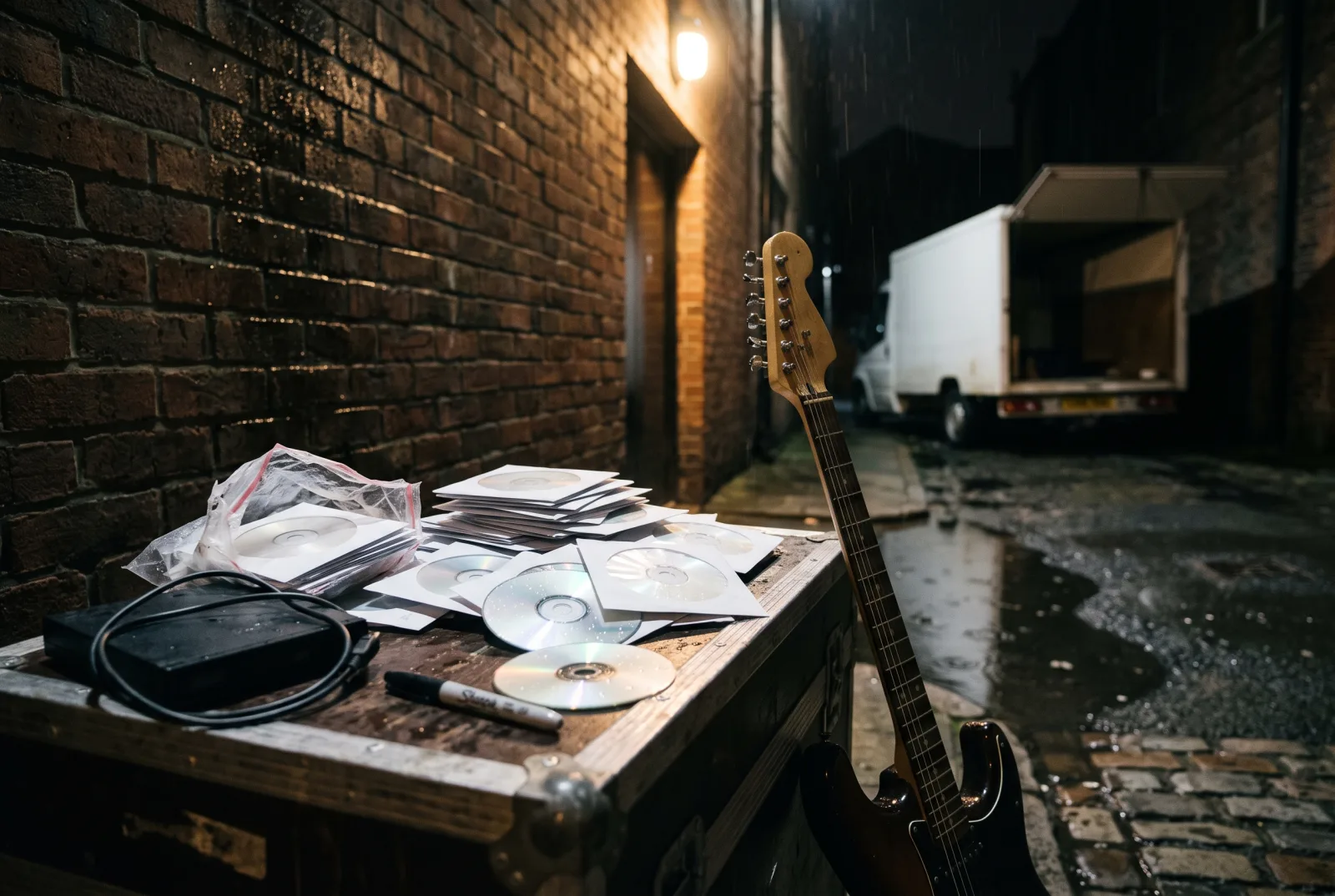
Ilustración: Rebobinados
Arctic Monkeys are the band everyone uses as an example of how the internet changed the music business, and the example is told the wrong way round. They were not pioneers of anything digital: they did not upload their songs anywhere, they did not open any account and, when they were asked about the MySpace profile that was making them famous, they answered that they did not know what MySpace was. Their own followers had created it. What the band did do was record demos in Sheffield and give the discs away at their concerts, charging nothing and asking for nothing; the rest was done by the people who took them home. The real story is better than the myth, because it is not about teenagers who were shrewd with marketing but about teenagers who lost control of how they were being spread and had it work out for them. They arrived late to the wave that The Strokes had opened and took the whole of it, and the rest —the record-breaking debut, the Mercury, the five nominations— came afterwards and also has small print.
High Green and a stack of CD-Rs given away
The band formed in 2002 in High Green, a neighbourhood in the north of Sheffield, with Alex Turner on vocals and guitar, Jamie Cook on the other guitar, Andy Nicholson on bass and Matt Helders on drums. They were schoolmates and they started, literally, with instruments given as Christmas presents.
Between 2003 and 2005 they gathered a handful of demos that became known as Beneath the Boardwalk, after the venue where part of the material was recorded. Those demos were not sold: the band burned CD-Rs and handed them out free at the door of their own concerts. Eighteen songs circulating with no owner and no label.
What happened next was organised by nobody. The people who attended ripped the discs, passed them around by instant messaging and uploaded them to file-sharing networks; a group of followers set up the MySpace profile that the press would cite for years as proof of the group's digital instinct. The band found out late and said so without embellishment. By the time they signed with Domino, in 2005, there were already venues where the audience sang songs that had never been released, and that is not a campaign: it is a leak that went public in its authors' favour.
The record that stopped being true
Whatever People Say I Am, That's What I'm Not came out on 23 January 2006 and sold 363,735 copies in its first week in the United Kingdom. It was preceded by two number one singles, "I Bet You Look Good on the Dancefloor" and "When the Sun Goes Down", with the portraits of the English night —the taxi, the queue at the bar, the Saturday fight— that turned Turner into a chronicler at nineteen.
For three years it was said to be the fastest-selling debut in British history, and it was. It stopped being so in November 2009, when I Dreamed a Dream, by Susan Boyle, did 411,820 copies in seven days. The claim keeps being repeated in reviews and profiles as though nothing had happened.
The category that does still stand is narrower and is registered that way by Guinness: the best-selling debut in one week in the United Kingdom by a group. It is not the same thing and it is worth saying it in full, because the rounded version falls apart with a thirty-second search and the true one needs no exaggeration.
The bassist on the debut is not the one who gets named
Almost every profile of the band credits the bass on the debut to Nick O'Malley. It is not his. The bassist on Whatever People Say I Am, That's What I'm Not was Andy Nicholson, a founding member, and it is he who plays every note on the best-selling record in the recent history of British indie.
Nicholson left the group in mid-2006, with the album already out and the band in the middle of an international tour; O'Malley came in as a replacement and stayed for good. It is a small and much-repeated error, the kind that erases somebody from their own work: the record that defines Arctic Monkeys was recorded by a line-up that no longer existed by the time the record became a phenomenon.
Mercury, hair gel and a hotel with a casino
In 2006 the debut won the Mercury Prize, the award for the best British or Irish album of the year. They were nominated again in 2007, 2013, 2018 and 2023: five nominations in total, the same number accumulated by Radiohead, the band of Thom Yorke. Few groups of the century have a record like that with the most unpredictable jury in English music.
What set them apart from much of their generation —the one that grew up in the shadow of Oasis— was refusing to repeat themselves. AM, from 2013, traded speed for weight: slow grooves, falsettos, borrowings from hip hop and soul, and Turner turned into a sort of heart-throb with hair gel. It was the record that made them enormous outside England, Latin America included.
And when they had the formula worked out, they threw it away. Tranquility Base Hotel & Casino, from 2018, abandoned the guitars for piano, vintage keyboards and a retro science-fiction story set in a lunar hotel; it disconcerted a good part of their audience and earned them another Mercury nomination. The Car, from 2022, carried on along the same path, with string arrangements and auditorium tempos. Neither of the two tries to resemble the debut, and that is deliberate.
What to remember
Arctic Monkeys did not invent internet promotion: they suffered it first and benefited from it afterwards. They gave away eighteen demos at the door of their concerts, the fans did the rest —including the MySpace they did not know existed— and in January 2006 a record made by four kids from High Green sold 363,735 copies in a week, with Andy Nicholson on bass and the Mercury waiting for them at the end of the year.
The merit lies in what came afterwards, and it is harder than a record. They went from chronicling the Sheffield night to the slow weight of AM and from there to a piano record about a hotel on the Moon, losing listeners at every bend and winning them back. It is the catalogue of a band that decided the only way not to age badly was not to repeat themselves, and they have been keeping to it for more than twenty years.
Sources
Arctic Monkeys is a British band formed in 2002 in High Green, Sheffield, originally made up of Alex Turner (vocals and guitar), Jamie Cook (guitar), Andy Nicholson (bass) and Matt Helders (drums). Between 2003 and 2005 the group gathered a set of demos known as "Beneath the Boardwalk", which it distributed free of charge on CD-R discs at its concerts; those recordings were digitised and spread by its followers, and the MySpace profile associated with the band was created by fans, not by the group, which stated that it was unaware of the platform. They signed with the Domino label in 2005. The singles "I Bet You Look Good on the Dancefloor" (2005) and "When the Sun Goes Down" (2006) reached number one on the British chart. The debut album "Whatever People Say I Am, That's What I'm Not" was released on 23 January 2006 and sold 363,735 copies in its first week in the United Kingdom. That record was surpassed in November 2009 by "I Dreamed a Dream", by Susan Boyle, with 411,820 copies in the first week; the standing category recognised by Guinness World Records corresponds to the best-selling debut album in one week in the United Kingdom by a group. The bass on the debut album was recorded by Andy Nicholson, a founding member, who left the band in mid-2006 and was replaced by Nick O'Malley. The debut won the 2006 Mercury Prize, the award for the best album of the year in the United Kingdom and Ireland; the band added nominations in 2007, 2013, 2018 and 2023, five in total, equalling the all-time maximum held by Radiohead. "AM" (2013) incorporated slow-tempo grooves and elements of hip hop and soul; "Tranquility Base Hotel & Casino" (2018) was built on piano and keyboards with a science-fiction narrative, and "The Car" (2022) incorporated orchestral arrangements. Profile compiled for Rebobinados with fact-checking; interpretations of the meaning of the work are offered as the author's reading. No song lyrics are reproduced, for copyright reasons. Information drawn from Wikipedia, the Official Charts Company, Guinness World Records, the BBC and other coverage.
Keep rewinding
90s
indie
Portishead
A short film got them the record deal
Before the record they shot *To Kill a Dead Man*, eleven minutes of film noir written by the three of them: Geoff Barrow plays a sniper and Beth Gibbons a widow. That soundtrack got them the record deal, and the cover of *Dummy* is a still from the short. The rest is told wrong too: *Dummy* sold 3,600,000 copies and won the 1995 Mercury ahead of Oasis, Tricky and PJ Harvey. Three records in fourteen years, and eighteen without a fourth.
00s
indie
Peter Bjorn and John
The whistle was provisional
Björn Yttling whistled the melody of "Young Folks" as a placeholder, only so as not to forget it, and they decided to keep it. The single came out on 7 August 2006, with Victoria Bergsman as guest, and it was not no. 1 anywhere: no. 13 in the United Kingdom, no. 9 in Finland. Live it is whistled by Peter Morén, and the trio never broke up: nine albums.
00s
indie
Florence + the Machine
The catharsis had a name
The band formed in London in 2007 and "the Machine" comes from the keyboard player Isabella Summers. Florence Welch has said that she stopped eating at seventeen and that she stopped drinking around 2014: the catharsis in her music has a concrete content. She has five British number ones, the last with Everybody Scream (31 October 2025), nominated for the 2026 Mercury.
Rewind with us
Comments · 0
No one has commented yet. Open the conversation.