
What's the Difference Between Rap and Hip-Hop?
By Rebobinados · Published on August 9, 2026
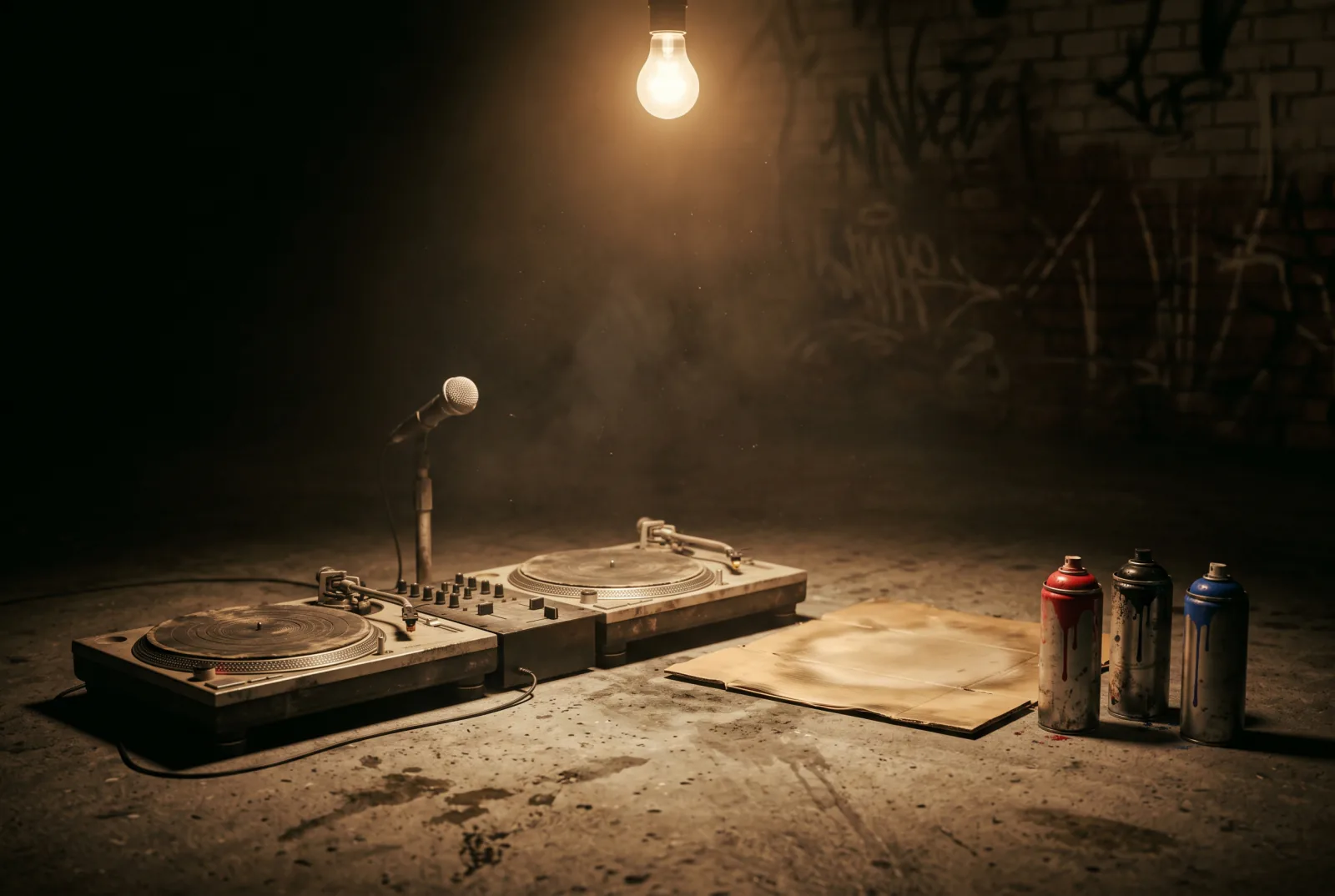
Ilustración: Rebobinados
It's one of those questions that seem silly until you try to answer them. Rap and hip-hop: most people use the two words as if they were synonyms, interchangeable, two names for the same thing. And they aren't. There is a real, precise difference, one that the people who live this culture defend passionately — and understanding it isn't a purist's whim but the key to hearing one of the most important cultural currents of the last half-century with new ears.
The confusion is so widespread that even the Grammys lump rap and hip-hop into a single category. But once you understand the distinction, you start to see something that was hiding in plain sight: that what we call "rap" is only the visible tip of an enormous cultural iceberg. This article explains the difference as clearly as possible, and why it matters.
The answer in one sentence
There's a line that settles the question better than any long explanation, and it came from someone with the authority to say it: the rapper and hip-hop philosopher KRS-One. His definition is so precise that it has become canonical, repeated for thirty years, and it's the best place to start:
"Rap is something you do. Hip-hop is something you live."
It's all there, compressed. Rap is an activity, a technique, something you perform — speaking rhythmically over a beat. Hip-hop is a culture, a way of being in the world, an entire way of life of which rap is only one part. One is done; the other is inhabited. And everything else follows from that distinction.
Put another way, with a formula that helps fix it: all rap is hip-hop, but not all hip-hop is rap. Rap sits inside hip-hop, it's one of its components. But hip-hop is far bigger than rap. A DJ scratching a record is doing hip-hop without rapping a single word. A breakdancer on a piece of cardboard is doing hip-hop without opening their mouth. A graffiti writer painting a train car is doing hip-hop without music. All of them are hip-hop, and none of them is rapping.
The four elements
To understand what hip-hop is as a culture, you have to know its founding elements. Hip-hop historians usually point to four pillars, born together in the same cultural broth, which together form the complete culture:
MCing (or rapping). The vocal part, what we now call rap: speaking, singing or reciting rhythmically over a beat, usually in rhyme. The MC — "master of ceremonies" — began as the voice that hyped the crowd and introduced the DJ, and over time became the one who tells stories, throws rhymes and carries the song's voice. This is the element that became world-famous, the one most people mistake for the whole.
DJing. The art of manipulating records and sound: isolating and extending the "breaks" (the percussive passages of funk and soul songs), scratching, mixing, creating new rhythms out of existing music. The DJ was, historically, the origin of everything — before rap, there was the DJ.
Breakdancing (or breaking). The dance. The b-boys and b-girls who dance over the breakbeat the DJ loops: power moves, footwork, freezes. The body as the culture's visible language.
Graffiti. The visual element. The writers who paint their tags, their signatures and their full pieces on walls, trains and any public surface. The art that makes hip-hop visible in the urban landscape.
To these four, many add a fifth and more philosophical element: knowledge — self-awareness, an understanding of one's own history and culture. And others add sampling, beatboxing and even fashion as aspects that helped shape the culture. But the four classic pillars are MC, DJ, break and graffiti. Four distinct arts — one vocal, one sonic, one bodily, one visual — that together form a single culture. Rap is only one of the four.
The origin: a party in the Bronx
For the distinction to make full sense, you have to go back to the beginning, because hip-hop has a surprisingly precise birth date and birthplace. Many point to 11 August 1973, in the Bronx, New York.
That night, a young and brilliant Jamaican-American DJ named DJ Kool Herc was working a party — a "Back-to-School Jam" organised by his sister — in the community room of a building at 1520 Sedgwick Avenue. And there Herc did something that would change music forever: instead of letting the songs play through, he isolated and extended the "break" — that purely percussive passage, a few bars long, where the song reduces to rhythm. Using two turntables, he alternated between two copies of the same record to prolong that break indefinitely, keeping people dancing through the hottest part of the song. That technique — the "breakbeat" — became the founding sound of hip-hop.
And from there everything else sprang, in a chain. Over those extended breaks danced the b-boys and b-girls: breakdancing was born. Herc, borrowing the Jamaican technique of "toasting" — speaking or chanting rhythmically over a rhythm, something he brought from his native Jamaica — began throwing shouts and hype at the crowd over the music: from that sprang MCing, rap. Graffiti was already flourishing on the streets and trains of the New York of those years, and it fused with this new culture. Within a few years, the musician Afrika Bambaataa and his Zulu Nation would name and organise these elements as a unified culture: hip-hop. The term itself is credited to Keith "Cowboy" Wiggins, of the group Grandmaster Flash and the Furious Five, who according to the most widely told story played with the syllables "hip, hop, hip, hop" imitating the sound of a military march.
Notice the order, because it's revealing: first came the DJ, then the dance, then the MC (rap). Rap wasn't the beginning of hip-hop — it was a consequence. It was born as an accessory to the party, the voice that hyped what the DJ was playing. That it later became the most famous face of the whole culture is one of those ironies of history: the element that came to dominate world perception wasn't the founder but one of the children.
Why rap swallowed hip-hop (in perception)
If hip-hop is four elements, why did the world end up calling all of it "rap" and using the two words interchangeably? The answer lies in how the industry and the media work.
Of the four elements, rap is the easiest to sell. It's recorded, put on the radio, broadcast, monetised. DJing is harder to package as a product; breakdancing is a bodily practice that doesn't sell on a record; graffiti is, literally, street art and often illegal. Rap, by contrast, fits perfectly into the machinery of the music industry: it's a song, a known format, something you can buy. So the industry amplified rap and left the other three elements in the shade. Over time, the other elements stopped appearing with their former prominence, and it became easy to mistake the part for the whole — to call "rap" what was in fact a four-faced culture.
That's why, for many of those who lived and live the culture, insisting on the distinction is an act of justice and of memory. When you say "hip-hop" instead of "rap", you're remembering the DJ, the dancer, the graffiti writer — the other three quarters of the culture the industry forgot because it didn't know how to sell them. You're honouring the whole culture, not just its most commercial product.
Rap as technique, hip-hop as belonging
There's a deeper layer to KRS-One's distinction, and it's worth unfolding, because it goes beyond "one is an activity and the other a culture".
When he says "rap is something you do", he's pointing out that rapping is a skill, a technique anyone can learn and which today appears in genres with nothing to do with hip-hop — there's rap in K-pop, in pop, in rock, in country music. Rapping doesn't make you part of hip-hop, just as playing guitar doesn't make you part of flamenco. It's a portable technique, one that travels.
When he says "hip-hop is something you live", he's pointing at something else: a belonging, an identity, a commitment to a culture, its history and its values. Living hip-hop means knowing and honouring the foundation others laid before you, understanding where it comes from, doing quality work that converses with that tradition. That's why, within the culture, a distinction is drawn between someone who is an "MC" — who honours the culture, who contributes, who belongs — and someone who "just raps" — who strings rhymes together and applies a formula to get rich quick, with no connection to what hip-hop means. The difference isn't vocal talent: it's belonging and respect.
For the Black, Caribbean and Latino youth of the nineteen-seventies Bronx, hip-hop wasn't a musical genre they consumed: it was a language they invented to express themselves, to tell their stories, to exist and compete creatively in an environment that offered them few ways out. It was identity, community and voice for those who had none. That's what "living it" means. A beat and some rhymes can be manufactured in any studio in the world; that belonging, that history, that meaning, cannot.
Why the difference matters
You might wonder whether all this precision isn't a bit pedantic. What difference does it make whether we say rap or hip-hop, if we understand each other anyway? But it matters, and for a reason that goes beyond music.
It matters because mistaking the part for the whole is a form of forgetting. Calling the whole culture "rap" reduces a four-dimensional artistic movement — vocal, sonic, bodily, visual — to its most commercial fragment. It's like calling all of opera "singing", forgetting the orchestra, the staging, the drama. The word we use determines what we remember, and "hip-hop" remembers more, honours more, sees more.
And it matters because a valuable idea about any culture is at stake in that distinction: that there's a difference between executing a technique and belonging to a tradition. Between doing something and living it. Between applying a formula to succeed and honouring a history that precedes you. That distinction — doing versus living, technique versus belonging — doesn't only hold for hip-hop. It holds for almost everything humans do seriously and with love. You can play rock without living rock, write without being a writer, cook without being a cook. Hip-hop, with its distinction between the rap you do and the culture you live, left us one of the clearest formulations of that old truth.
So the next time someone uses "rap" and "hip-hop" as if they were the same thing, you know the difference. Rap is the voice. Hip-hop is the whole body — the DJ, the dancer, the graffiti writer, the history, the community, the belonging. Rap is something you do. Hip-hop, as the man who knew put it, is something you live. And that difference, between doing and living, may be the most important one there is.
Keep rewinding
90s
hip hop
Coolio
The number one that was really a lament
The biggest rap hit of 1995 was, deep down, a funeral: over the funereal strings of Stevie Wonder's "Pastime Paradise", a young man looks at his short, dead-end life. It won the Grammy and half the world sang it without listening closely to the words.
90s
hip hop
The Notorious B.I.G.
The greatest storyteller rap ever produced, silenced at 24
He could fit an entire life into a verse: rap lost its finest narrator at twenty-four, in a drive-by shooting nobody ever solved. He left two albums, and the second came out two weeks after the funeral with a title he had chosen beforehand.

10s
hip hop
Macklemore & Ryan Lewis
They reached number one with no label, and they used that number one for something
A song about buying used clothes in second-hand stores went to the very top of the American chart with no major record company behind it. And at the peak of that fame, the Seattle duo chose to spend it on "Same Love", while their state was voting on marriage equality.
Rewind with us
Comments · 0
No one has commented yet. Open the conversation.