
Decade 70s · Rhythm progresivo
Electric Light Orchestra
The chosen disciple
By Rebobinados · Published on September 7, 2026
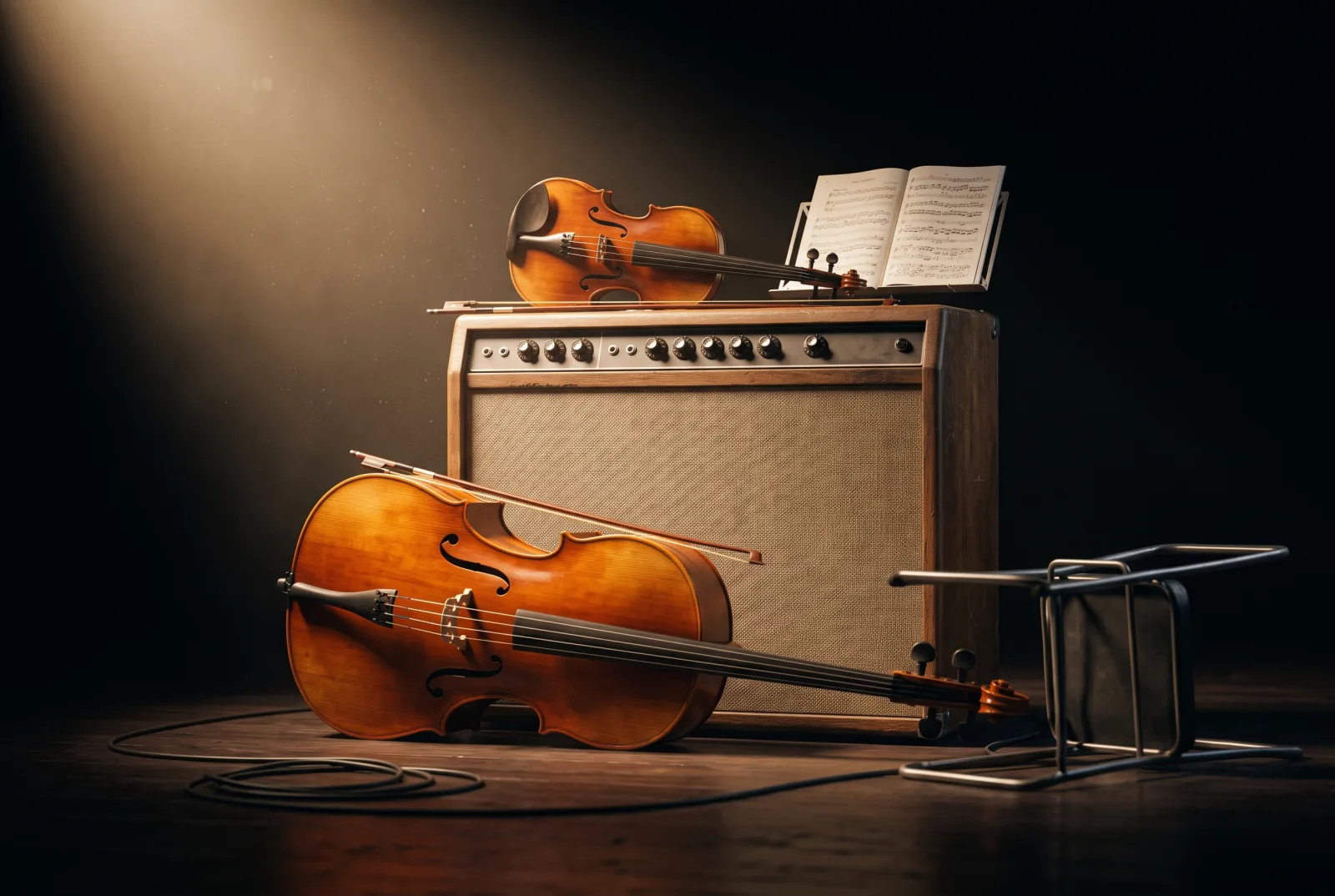
Ilustración: Rebobinados
When the surviving Beatles decided, in the nineties, to finish some unreleased John Lennon recordings and put them out as new songs, they needed a producer.
George Martin, the man who had always done it, declined.
They called Jeff Lynne.
The boy who founded a band to sound like them
Lynne produced "Free as a Bird", released on 4 December 1995, and "Real Love", on 4 March 1996. The demos were Lennon's; Yoko Ono had handed the tapes to McCartney.
The man chosen to touch John Lennon's voice from beyond the grave was the one who had put together an entire band with the ambition of continuing what the Beatles had left half-done.
It was not a prize for devotion. By then Lynne was one of the most respected producers in the world: he had produced records by George Harrison — "Cloud Nine", from 1987, and "Brainwashed", from 2002 — and the two had become close friends. In 1988 he was part of the Traveling Wilburys, alongside Harrison, Bob Dylan, Roy Orbison and Tom Petty.
A necessary correction about the founding quote
There is a line repeated all over the ELO literature: that they wanted to "pick up where the Beatles left off with 'I Am the Walrus'".
It is usually attributed to Jeff Lynne. It is not his.
It was said by Roy Wood, the other founder, and Lynne has denied it with some irritation: he said that was never his thing, that Wood said it, that Wood left the band two months later and stuck him with the quote.
And the chronology backs him up: the original idea behind ELO — rock with strings, brass and woodwind — was Wood's, and Lynne only became the leader when Wood walked out, in 1972.
It is a distinction that matters, because the band people remember — "Mr. Blue Sky", "Livin' Thing", "Telephone Line" — is Lynne's, and his ambition was somewhat different: not to continue the Beatles, but to get away from what every other band was doing.
What they did with a plugged-in orchestra
They formed in Birmingham in 1970, with Lynne, Wood and Bev Bevan.
The idea was simple to state and very hard to pull off: that a pop song could have the richness of an orchestral piece without ceasing to be a pop song. Cellos and violins playing in a rock band, not as decoration but as part of the engine.
In 1973 they did something that sums up the whole project. They covered "Roll Over Beethoven", by Chuck Berry — the original is from 1956 — and crossed it, literally, with fragments of Beethoven's Fifth Symphony.
The father of rock and roll and the giant of classical music, on the same track. It is a joke and it is a manifesto.
The end
ELO retired. The farewell tour, "Over and Out", ran through 2024 and 2025, and ended badly: the final concert in Hyde Park, set for 13 July 2025, was cancelled because of an infection Lynne had picked up, as were the last British dates, which were never rescheduled.
Richard Tandy, the band's long-standing keyboard player, had died in May 2024.
Lynne is still alive. The band is not.
What to remember
ELO is the proof that an idea that looks ridiculous on paper can work perfectly in practice.
Put on "Mr. Blue Sky", "Livin' Thing" or "Telephone Line" and you will hear something that ought not to stand up: conservatory strings pushing radio choruses, with production so dense that every listen turns up something new.
And remember the end of the story, one of the neatest in all of music: the boy from Birmingham who put a group together to get closer to the Beatles ended up being the man the Beatles trusted.
Remember them this way: not as the imitators who got away with it, but as the band that proved an orchestra can rock too.
Sources
Electric Light Orchestra, a band formed in Birmingham, England, in 1970 by Jeff Lynne, Roy Wood and Bev Bevan. A much-repeated attribution should be corrected: the line about "picking up where the Beatles left off with 'I Am the Walrus'" belongs to Roy Wood and not to Jeff Lynne, who has explicitly denied it, pointing out that Wood said it and left the band two months later; the original conception of the band was Wood's, and Lynne took over the leadership after Wood's departure in 1972. The version of "Roll Over Beethoven" belongs to the album "ELO 2" (1973) and incorporates fragments of Beethoven's Fifth Symphony; the Chuck Berry original is from 1956. Jeff Lynne produced George Harrison's albums "Cloud Nine" (1987) and "Brainwashed" (2002), and was a member of the Traveling Wilburys in 1988 alongside Harrison, Bob Dylan, Roy Orbison and Tom Petty. He also produced "Free as a Bird" (released on 4 December 1995) and "Real Love" (4 March 1996), the two unreleased John Lennon recordings completed by the surviving Beatles, a commission he accepted after George Martin declined; the original tapes were handed by Yoko Ono to Paul McCartney. Of the members of the Traveling Wilburys, George Harrison and Roy Orbison have profiles of their own in this series; Bob Dylan and Tom Petty do not. The band was inducted into the Rock and Roll Hall of Fame in 2017. The keyboard player Richard Tandy died in May 2024. The farewell tour "Over and Out" ran between 2024 and 2025; the final concert scheduled at Hyde Park for 13 July 2025 was cancelled because of an infection Lynne had contracted, as were the last British dates, which were not rescheduled. Externally authored text, edited and verified for Rebobinados. Interpretations of the meaning of their work are offered as the author's reading. No song lyrics are reproduced, for copyright reasons. Information drawn from Wikipedia, Far Out Magazine, AllMusic and other coverage.
Keep rewinding
70s
progresivo
Jean-Michel Jarre
Twenty-five times in his whole life
His father was Maurice Jarre, three Oscars for "Lawrence of Arabia", "Doctor Zhivago" and "A Passage to India", and he left home when the son was 5: "we saw each other twenty or twenty-five times in our whole lives". *Oxygène* came out in December 1976, recorded in the former kitchen of his flat with a broken Mellotron, and sold some 18 million. Of his father's inheritance he received nothing: the European Court of Human Rights dismissed the case on 15 February 2024.
70s
progresivo
Roger Hodgson
The two wrists and the broken pact
"Dreamer" and "Breakfast in America" are his, written at nineteen, even though they are attributed to Rick Davies. In 1983 he left Supertramp with a verbal pact that Davies broke five years later, and in 1987 he fell from a loft and broke both wrists: he was told he would never play again. Davies died on 6 September 2025, at the age of 81.
70s
progresivo
Yes
The cathedrals and the borrowed name
The only American number one credited to Yes, "Owner of a Lonely Heart", was strictly speaking recorded by a different band: Chris Squire, Alan White, Tony Kaye and guitarist Trevor Rabin had put together a group called Cinema, and in June 1983 Atlantic executives suggested they call it Yes. Jon Anderson joined once the album was well under way.
Rewind with us
Comments · 0
No one has commented yet. Open the conversation.