
George Harrison
The one who waited his turn
By Rebobinados · Published on September 22, 2026
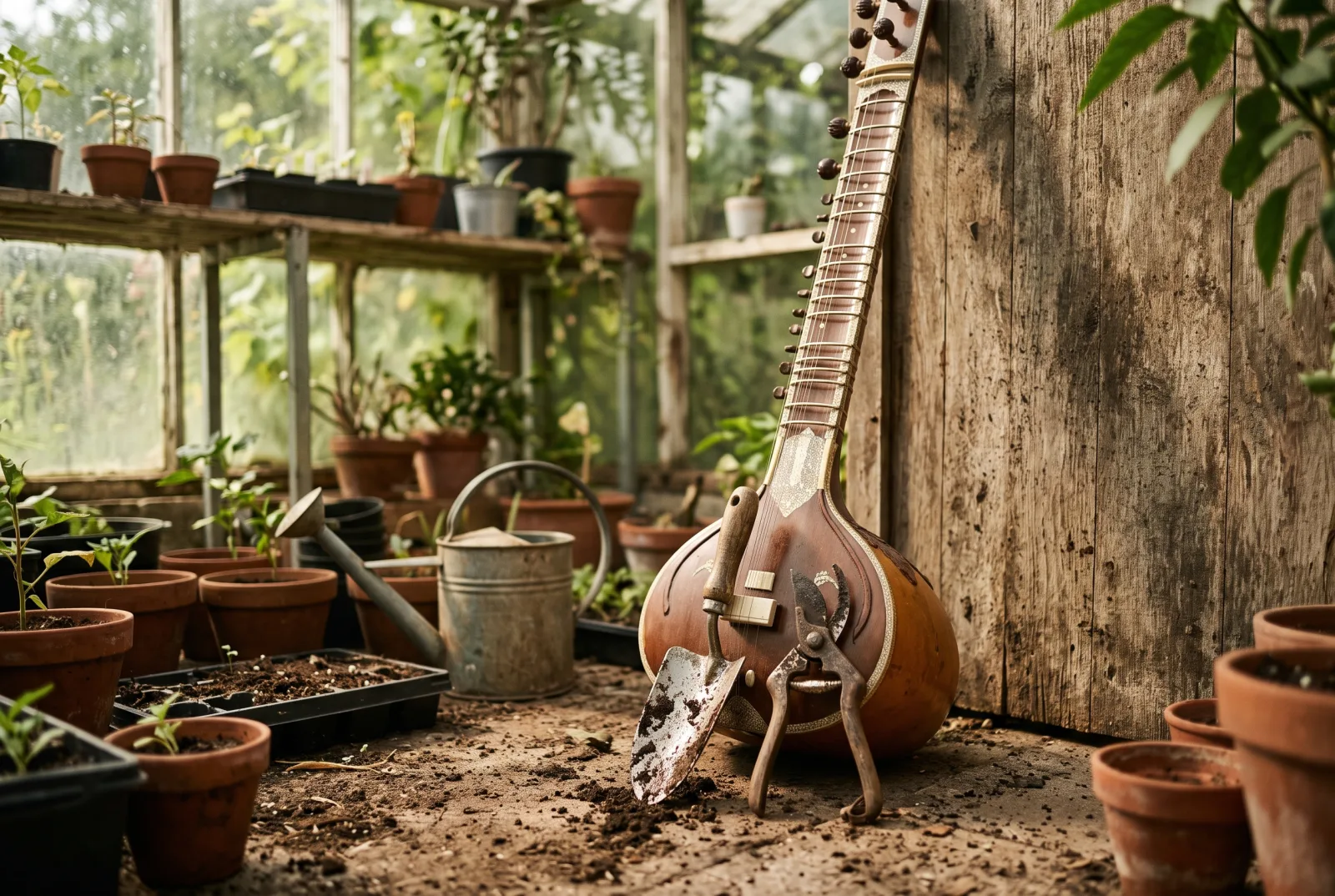
Ilustración: Rebobinados
George Harrison was called "the quiet Beatle" because he spoke little and stayed, almost always, in the shadow of Lennon and McCartney.
But that nickname is misleading.
Behind the one who talked least there was a guitarist with an unmistakable touch—clean, elegant notes, never one too many—and a songwriter who, when they finally let him, wrote some of the most beautiful songs the Beatles ever had: "Something", "Here Comes the Sun", "While My Guitar Gently Weeps".
He was not quiet because he had nothing to say. He was the quiet one who was waiting his turn.
The song that won Sinatra over
Frank Sinatra hated the Beatles. Until he heard "Something".
He recorded it in October 1970 and recorded it again ten years later, and for the rest of his life he introduced it onstage calling it the greatest love song of the last fifty years. On another occasion he spelled out why he thought it was so good: that it never says "I love you" in the whole song, and still says it completely.
There is a detail that gets repeated a lot and is worth telling properly: for years Sinatra introduced it as a Lennon and McCartney song. The mistake was real, but it had an expiry date: by the mid-seventies he was already crediting Harrison correctly.
And there is a lovely bonus. Sinatra used to change a line in the bridge for a quip of his own, and Harrison took a liking to it: at his own concerts in the nineties, George sang that Sinatra variant.
By 1972, "Something" had already been recorded by more than a hundred and fifty artists. It is the second most covered Beatles song in history, behind only "Yesterday".
The guitar that weeps was played by somebody else
"While My Guitar Gently Weeps" is one of the peaks of the Beatles, and it keeps a secret.
When George brought it into the studio, the band was in a moment of disunity and tension, and his bandmates received it half-heartedly, with no appetite for working on it.
George, hurt, made a shrewd move: he invited a friend to record the solo, knowing that with an outside guest the Beatles would pull themselves together. He told it that way himself: that the presence of that friend made everybody try a little harder and be on their best behaviour.
That friend was Eric Clapton. He recruited him, as George recalled, in the car on the way to London, asking him out of nowhere why he did not come and play on the track.
Clapton recorded the weeping solo that gives the song its title on 5 and 6 September 1968, and he did not appear in the album credits—which, strictly speaking, did not credit musicians at all.
So one of the most famous solos by the Beatles was played by someone who was not a Beatle. And he is, strictly speaking, the only musician from outside the group who played on one of their studio recordings.
The man who brought India in
George's greatest contribution to music was to open a door that did not exist.
In 1965, during the shooting of "Help!", he came across some Indian instruments and was fascinated by one of them: the sitar, that long guitar with the hypnotic sound.
He learned to play it and put it into "Norwegian Wood". It was the first released pop song with a sitar genuinely played on the recording, and it opened the floodgates: all of a sudden rock filled up with sounds, scales and spirituality from the East.
George became a friend and a disciple of the great master of the sitar, Ravi Shankar, threw himself into meditation and Hindu philosophy, and dragged the other Beatles off to India.
That spiritual search—rare in a rock star—was the centre of his whole life. He did not collect cars or excesses: he tended his garden, literally, and looked for God.
The plagiarism he committed without noticing
When the Beatles split up, George let out everything he had been keeping back on an enormous triple album, "All Things Must Pass", with his big hit: "My Sweet Lord".
And then came a famous problem, which is almost always told by halves.
He was sued for plagiarism: the melody was very close to "He's So Fine", by The Chiffons, from 1963. The lawsuit arrived in 1971, the trial only in 1976, and the ruling was extraordinary and went into legal history: the judge Richard Owen—a classical musician and opera composer, a delicious detail—ruled that Harrison had copied subconsciously. He wrote that "My Sweet Lord" was the very same song as "He's So Fine" with different words, and that this amounted to copyright infringement even if it had been committed unintentionally.
He was ordered to pay almost one million six hundred thousand dollars in damages.
But the ending is better. While the case dragged on, Allen Klein—Harrison's own former manager—bought the rights to "He's So Fine" through his company and then tried to sell them back to George.
In 1981 the court found that Klein had breached his fiduciary duty, reduced Harrison's payment to what Klein had spent on the copyright, and handed Harrison the rights to "He's So Fine".
That is: George ended up owning the song that had sunk him.
The blueprint for the benefit concert
In 1971, Ravi Shankar told him about the hunger and the war in Bangladesh, and George decided to do something.
He put on two shows on the same day, 1 August, at Madison Square Garden, bringing together Bob Dylan, Eric Clapton, Ringo Starr, Billy Preston, Leon Russell and Badfinger. Shankar himself opened the show, with Ali Akbar Khan and Alla Rakha.
It is worth being fair about the fact, because it tends to get exaggerated: it was not the first benefit concert in history. Back in January 1970, at that same Madison Square Garden, there had been a festival for peace in Vietnam with Blood Sweat & Tears, Judy Collins and Harry Belafonte, among others.
What George invented was something else: the scale. It was the first benefit concert of that magnitude, with an album and a film behind it, and the blueprint that Live Aid and all the rest would later copy. The box office took in some two hundred and fifty thousand dollars, and the whole operation ended up approaching forty-five million.
What to remember
George Harrison died on 29 November 2001, of lung cancer, at fifty-eight, at peace with his faith.
Put on "Here Comes the Sun", "Something" or "My Sweet Lord", and you will hear the Beatle who made the least noise and reached the deepest.
The one who brought the East into rock. The one who gave the benefit concert its scale. The one who spent his life looking for something bigger than fame.
The quiet one, it turned out, had the most important things to say.
Sources
George Harrison (Liverpool, 25 February 1943 – Los Angeles, 29 November 2001), guitarist and singer-songwriter, member of The Beatles. He wrote "Something", "Here Comes the Sun" and "While My Guitar Gently Weeps" for the band, among others. Frank Sinatra recorded "Something" in October 1970 and again in 1980 for "Trilogy", and used to introduce it onstage as "the greatest love song of the past fifty years"; for years he wrongly attributed it to Lennon and McCartney, although by the mid-seventies he was crediting Harrison. It was not the only Beatles song he recorded: he also cut "Yesterday", on the album "My Way" (1969). By 1972 "Something" had been covered by more than 150 artists, which makes it the second most covered Beatles song, after "Yesterday". On "While My Guitar Gently Weeps", the solo was played by Eric Clapton on 5 and 6 September 1968, without appearing in the album credits, which did not credit musicians; Harrison said, as recorded by Mark Lewisohn, that Clapton's presence made the others "be on their best behaviour". Clapton is the only musician from outside the group who took part in a Beatles studio recording. Harrison discovered the sitar in 1965 during the shooting of "Help!" and brought it into "Norwegian Wood", the first released pop song that includes a sitar genuinely played on the recording; the instrument's absolute primacy in Western pop is a matter of debate, with precedents such as "Goodness Gracious Me" (1960) and a discarded session by The Yardbirds for "Heart Full of Soul" (1965). He was a disciple of Ravi Shankar. After the Beatles split up he released "All Things Must Pass" (1970), with "My Sweet Lord", over which Bright Tunes Music Corp. sued him on 10 February 1971 for plagiarising "He's So Fine" (The Chiffons, 1963, by Ronnie Mack). The trial was held in February 1976 and judge Richard Owen ruled in September of that year that Harrison had committed subconscious plagiarism, setting damages at 1,599,987 dollars. Allen Klein, Harrison's former manager, acquired the rights to "He's So Fine" through ABKCO during the litigation; on 19 February 1981 the court ruled that Klein had breached his fiduciary duty, reduced Harrison's payment to 587,000 dollars and handed him the rights to the song. The case was not definitively closed until March 1998. The Concert for Bangladesh was held in two shows on 1 August 1971 at Madison Square Garden, with Harrison, Ravi Shankar, Ali Akbar Khan, Alla Rakha, Bob Dylan, Eric Clapton, Ringo Starr, Billy Preston, Leon Russell and Badfinger, among others. It was the first benefit concert of that magnitude and the model for those that followed, but not the first in history: the Winter Festival for Peace had been held at the same venue on 28 January 1970, and the Festival for Peace at Shea Stadium on 6 August of that year. It took in some 250,000 dollars at the box office and, adding the album and the film, a figure estimated at around 45 million. Harrison died of metastatic non-small-cell lung cancer. Externally authored text, edited and verified for Rebobinados. Interpretations of the meaning of his work are offered as the author's reading. No song lyrics are reproduced, for copyright reasons. Information drawn from Wikipedia, Beatles Bible, Britannica, Guitar World and other press coverage.
Keep rewinding

10s
pop
Bruno Mars
Eleven names in the credits
"Uptown Funk" came out on 10 November 2014 with six writers and today it has eleven. In February 2015 The Gap Band's publisher filed a claim over "Oops Up Side Your Head" in YouTube's copyright system —there was never a lawsuit— and on 28 April five names were added, with 17 % of the publishing. It happened weeks after the "Blurred Lines" verdict, and the song had been fourteen weeks at number one.

00s
pop
André Rieu
It was not from the jazz suite
The waltz with which André Rieu reached half the world is not from Shostakovich's Suite for Jazz Orchestra No. 2: it is from the Suite for Variety Orchestra, which the composer did not assemble, and it was born in 1956 as music for a Soviet film about settlers in Kazakhstan. The error comes from a misprint in volume 10 of the complete works (Muzyka, Moscow, 1984), corrected only in 2001. And the title "The Second Waltz" was invented by his wife, because the real one did not sell.

90s
pop
Daniela Mercury
She took the neighbourhood out of the song
"O Canto da Cidade" was written by Tote Gira, a composer from Nordeste de Amaralina who recorded the demo on a borrowed cassette, marking the beat on the door of a refrigerator; Mercury's team almost threw the tape away. She shares the credit because she deleted the references to the Pelourinho so that the song would serve all of Brazil. The album, from 20 September 1992, sold more than 2 million copies and nationalised axé. But she did not invent it: the name was a journalist's insult in 1987.
Rewind with us
Comments · 0
No one has commented yet. Open the conversation.