
Franz Ferdinand
The stall was the only deliberate part
By Rebobinados · Published on September 16, 2026
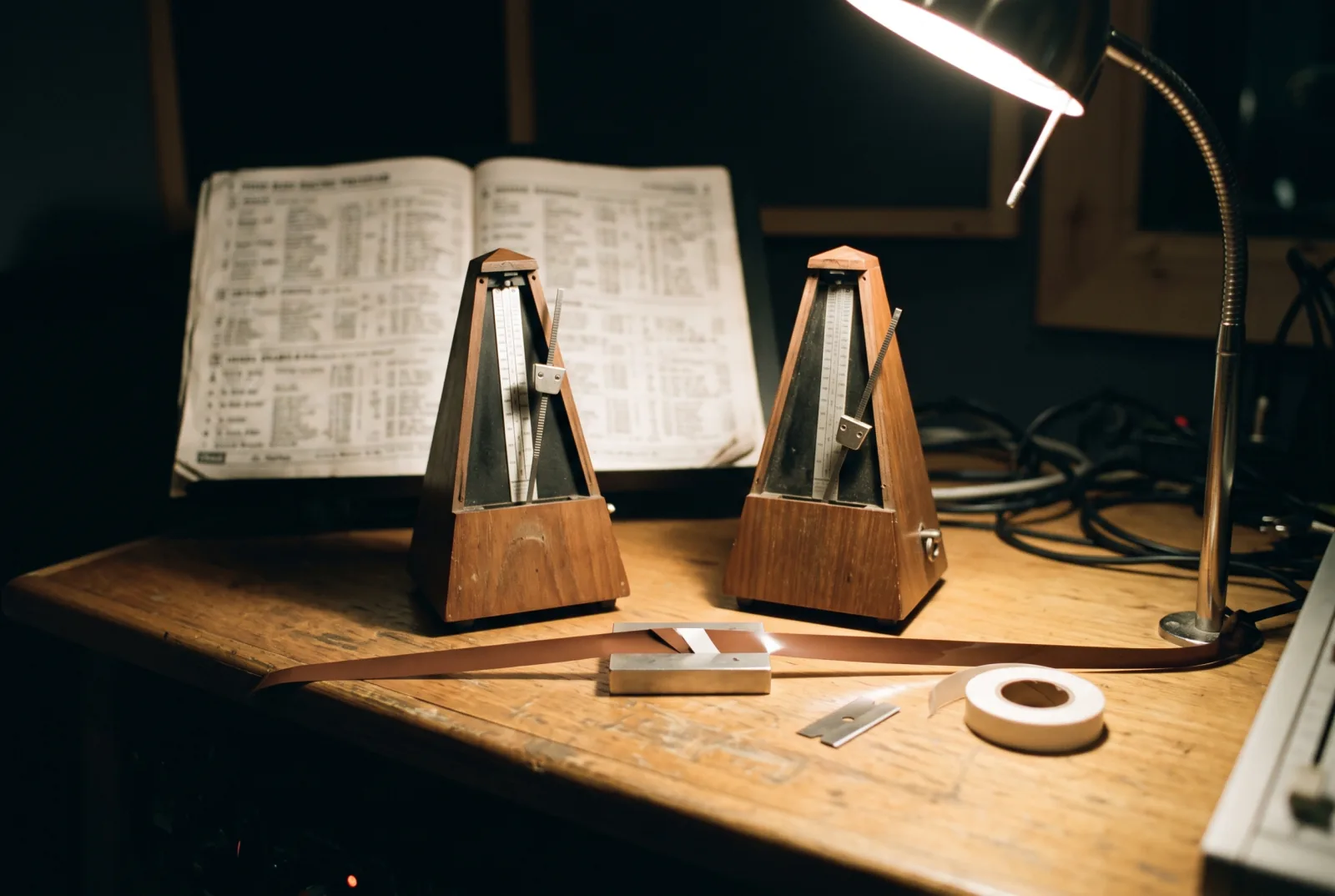
Ilustración: Rebobinados
Fifty seconds in, "Take Me Out" slams on the brakes and turns into another song. That handbrake turn is the most recognisable gesture in the rock of 2004 and the reason the track is still playing twenty-two years later. And it holds the whole lesson about what kind of band Franz Ferdinand are: one that took the thing anybody else would have hidden and put it right in the middle, lit up, with no apology.
It is worth telling how it happened, because the real story beats the myth.
It is not two songs: it is one, deliberately badly built
Everyone thinks "Take Me Out" is two songs stuck together. Alex Kapranos, who wrote it, says no: it was one. The problem was that the verses wanted a fast tempo and the choruses wanted another, slower one. What any song does is alternate, going back and forth between the two speeds. Not them. They stacked all the verses at the beginning and all the choruses afterwards. First the fast part in full, the brakes, and then the slow part in full. In Kapranos's own words, that is more or less the wrong way to do it.
And here is what turns an odd arrangement into a big idea. A tempo change like that can be tidied up: you slip in a transition, smooth it out, disguise the seam so the listener does not feel the bump. They did the opposite. Instead of apologising for the brakes, they decided to own them, to make them huge and shameless. They turned the join into the hook. The part that sounds like a mistake is the only part that was completely thought through.
That is artistic confidence, and it is very rare. Most musicians spend their careers hiding the seams. Franz Ferdinand made a seam the chorus.
Fathered by heavy metal and war films
The best bit is where they got it all from. Kapranos has told the story: the engine of the song came out of "Run to the Hills", by Iron Maiden, and a track by UFO. And the idea behind the lyrics — a courtship that sounds like a duel, flirting like someone taking aim with a rifle — came from the sniper scene in a film about the battle of Stalingrad.
Think about that. The most famous indie dance song of the decade, the one that played on every student party compilation, was fathered by British heavy metal and by war cinema. Nothing on the surface gives it away. That is the mark of a great band: digesting things that have nothing to do with each other and giving back something that sounds inevitable.
The other things they got right
"Take Me Out" came out in January 2004 and reached number three in the United Kingdom; the album, the same spot. That year they won the Mercury Prize, and not against nobodies: ahead of Amy Winehouse. Two Brit Awards the following year. And proof that good songs are in no hurry: twenty years after its release, in December 2024, the American industry certified "Take Me Out" four times platinum. A song that at the time, in the United States, had stalled at a modest number sixty-six. It took two decades to collect what it was worth.
When they said no
There is a recent episode that shows the band still has principles it will defend. In March 2026, the Israeli armed forces used "Take Me Out" in a propaganda video, without permission. The band responded publicly and undiplomatically, condemning the use of their music. It is not the first time a song of theirs has ended up somewhere it was not wanted; it is the first time they have answered that firmly. A band is also defined by where it refuses to be heard.
The detail that closes the circle
And one fact that puts everything else in order: on 25 September 2026 The Yummy Fur released their first record in twenty-eight years, the Glasgow band that two of the Franz Ferdinand came out of before Franz Ferdinand existed. Music scenes work like that: a small, half-forgotten Glasgow group turns out to be the seed of one of a generation's anthems. Nothing comes from nowhere.
What to remember
Franz Ferdinand made a song that looks like two and is one. A handbrake turn that looks like a stumble and is the hook, the only part of the track worked out to the millimetre. They had it fathered by heavy metal and a war film without it showing. They won the Mercury ahead of Winehouse, and waited twenty years for the United States to hand them the platinum they had deserved from the start.
Remember it this way: the best thing about "Take Me Out" is the part that sounds like a mistake, and it is precisely the part that was not one. The whole band is right there: the nerve to show the seam instead of hiding it.
Sources
Franz Ferdinand, a British band formed in Glasgow in the early two-thousands, whose original line-up was Alex Kapranos (vocals and guitar), Nick McCarthy (guitar), Bob Hardy (bass) and Paul Thomson (drums); the musicians who have passed through the group are alive. "Take Me Out", released on 12 January 2004 by Domino, reached number three on the UK Singles Chart and number 66 on the Billboard Hot 100, and was certified four times platinum by the RIAA on 3 December 2024. Alex Kapranos has explained that the track is a single composition whose verses and choruses called for different tempos, and that the solution was to group all the verses at the start and all the choruses afterwards, with a tempo change deliberately left undisguised; he has cited "Run to the Hills" by Iron Maiden and a track by UFO as references, and has pointed to the sniper duel in the film "Enemy at the Gates" as the origin of the idea behind the lyrics. The self-titled debut album (9 February 2004) reached number three in the United Kingdom and number 32 on the Billboard 200, won the Mercury Prize on 7 September 2004 and took two Brit Awards in 2005; the group has five Grammy nominations and no wins. The line about making music for girls to dance to has been repeatedly attributed to them in the British press from 2003 onwards, with no original publication on record; the explanation of the name via the racehorse Archduke Ferdinand, winner of the Northumberland Plate in 2001, circulates without the backing of any statement by the group, which has said that the choice came down to the sound and the alliteration of the name. In March 2026 the band publicly condemned the use of "Take Me Out" in a propaganda video by the Israeli armed forces. On 25 September 2026 the first album in twenty-eight years by The Yummy Fur was released, a Glasgow group that Kapranos and Thomson belonged to before forming Franz Ferdinand. Iron Maiden have their own profile in this series. A Rebobinados rewrite of previously verified research; interpretations are offered as the author's reading. No song lyrics are reproduced, for copyright reasons. Information drawn from Wikipedia, Song Exploder, American Songwriter, Billboard, RIAA, Official Charts, NME, The Guardian, Consequence and other coverage.
Keep rewinding
90s
indie
Portishead
A short film got them the record deal
Before the record they shot *To Kill a Dead Man*, eleven minutes of film noir written by the three of them: Geoff Barrow plays a sniper and Beth Gibbons a widow. That soundtrack got them the record deal, and the cover of *Dummy* is a still from the short. The rest is told wrong too: *Dummy* sold 3,600,000 copies and won the 1995 Mercury ahead of Oasis, Tricky and PJ Harvey. Three records in fourteen years, and eighteen without a fourth.
00s
indie
Peter Bjorn and John
The whistle was provisional
Björn Yttling whistled the melody of "Young Folks" as a placeholder, only so as not to forget it, and they decided to keep it. The single came out on 7 August 2006, with Victoria Bergsman as guest, and it was not no. 1 anywhere: no. 13 in the United Kingdom, no. 9 in Finland. Live it is whistled by Peter Morén, and the trio never broke up: nine albums.
00s
indie
Florence + the Machine
The catharsis had a name
The band formed in London in 2007 and "the Machine" comes from the keyboard player Isabella Summers. Florence Welch has said that she stopped eating at seventeen and that she stopped drinking around 2014: the catharsis in her music has a concrete content. She has five British number ones, the last with Everybody Scream (31 October 2025), nominated for the 2026 Mercury.
Rewind with us
Comments · 0
No one has commented yet. Open the conversation.