
Iron Maiden
The show a bishop stopped
By Rebobinados · Published on September 12, 2026
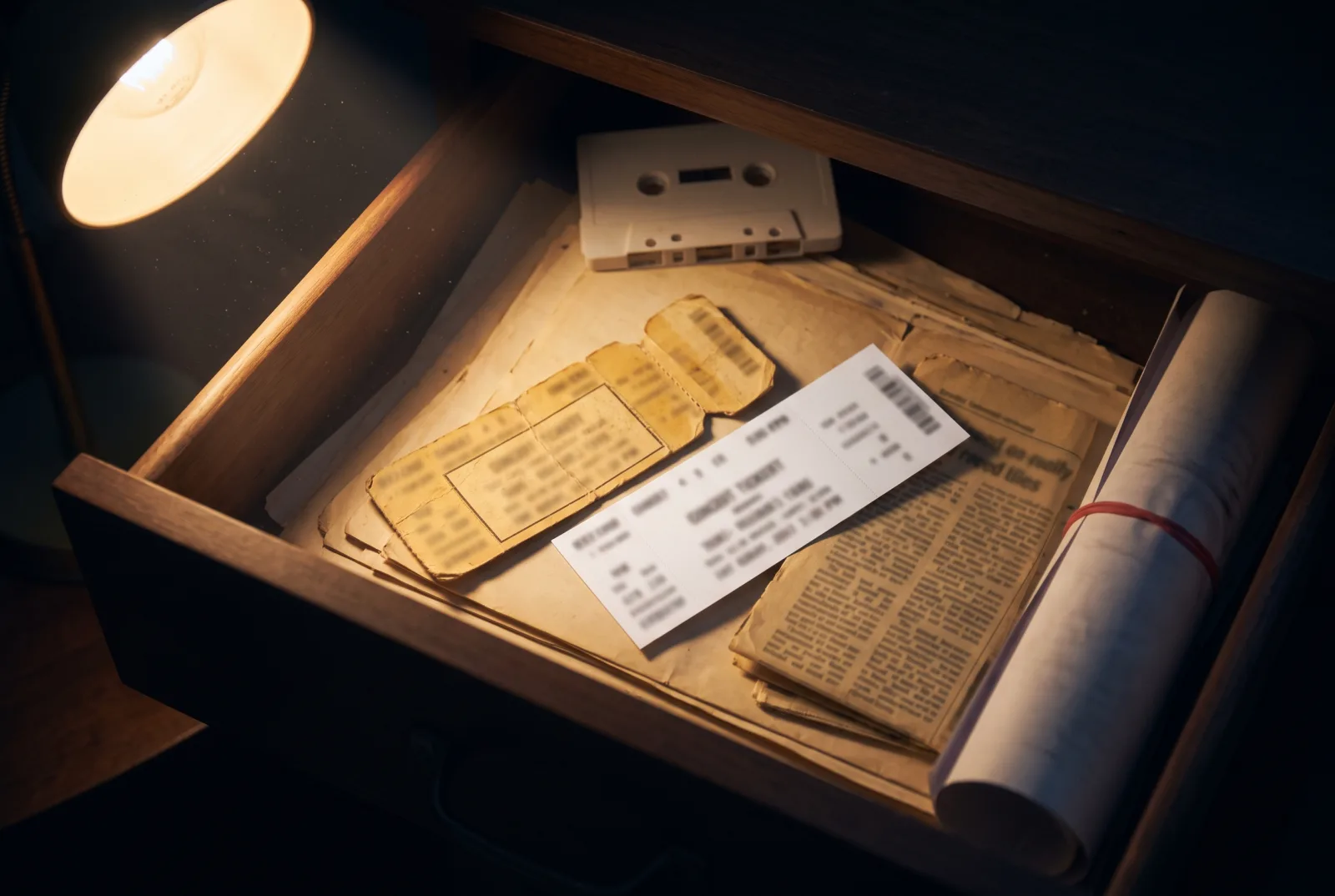
Ilustración: Rebobinados
On 28 June 1992, on the main news bulletin of Televisión Nacional, an auxiliary bishop of Valparaíso spoke about the crisis of the family and the danger of sects, and called Iron Maiden a satanic group.
Nineteen days later, on Friday 17 July, the promoter of the concert cancelled it at a press conference. He spoke of complex situations.
The show was scheduled for 23 July at the Estación Mapocho. It would have been one of the first big metal concerts in Chile after the dictatorship. It did not happen.
What happened four years later
They came back on Thursday 29 August 1996, and not to a stadium: to the Teatro Monumental, today the Caupolicán. The band were on the way down and had dropped from stadiums to halls.
Dickinson was not there. He had left in 1993 and the singer was Blaze Bayley.
They spat at him. For eighteen songs. And the episode did not end the way it is usually told: it ended with Bayley and Steve Harris facing down the group that was spitting and offering to fight them.
It was not a night of love between band and audience. It was fairly ugly.
And even so
Thirty years later, Iron Maiden is the international band with the largest accumulated audience in the history of concerts in Chile: more than three hundred and sixty thousand spectators across ten appearances since that one in 1996.
At the Estadio Nacional they have drawn sixty thousand people in a single night. In 2011 they recorded a live album here.
And they are back in five weeks: on 31 October and 1 November 2026, two dates at the Estadio Nacional, as part of their fiftieth-anniversary tour.
Dickinson has said many times that Santiago is always among the first on his list, and what he repeats most is not the volume but the age of the audience: that they are not nostalgics, that they are young.
The plane, in the past tense
There is a line that turns up in every profile of the band and that today is false: that when Iron Maiden go on tour they fly in their own plane and the singer pilots it.
Dickinson is a commercial pilot with a real licence; that is true and it is no small thing.
But the plane was never the band's: it was chartered. The one in 2016 was a Boeing 747 from an Icelandic airline, and the earlier ones were two planes from the company where he flew as a professional pilot until it went bust, in 2011.
And it was only used on three tours: 2008, 2009 and 2016. On this one there is no Ed Force One and no Dickinson in the cockpit.
The fencing is also worth taking off its pedestal. He was not "almost Olympic": in 1989 he represented Great Britain in a European cup with his club and reached seventh in the British foil rankings. That is a great deal for someone whose job is something else. There is no need to inflate it.
What is missing, and it is the hardest part of his biography, is that in December 2014 he was found to have tongue cancer at a routine check-up. He went through seven weeks of chemotherapy and radiotherapy and in May 2015 he was declared free of the disease. Then he went back to singing.
The ones who are gone
Paul Di'Anno, the first singer, the one on the first two albums, died on 21 October 2024, at sixty-six.
And Nicko McBrain, who spent forty-two years on the drums, had a stroke in January 2023 and retired from touring in December 2024. His last concert was in São Paulo. He remains a member of the band for the studio.
The one playing live now is Simon Dawson. It is the first tour in more than four decades without McBrain behind them.
Metal with a library
What always set Iron Maiden apart from the rest of the genre is what they sing about.
"The Trooper" is the Charge of the Light Brigade, in the Crimean War, taken from Tennyson's poem. "Rime of the Ancient Mariner" lasts thirteen minutes and is Coleridge's poem, undisguised.
There are songs about the Second World War, about mythology, about novels. They treated their audience as people who could take an interest in that, and they were right.
Eddie, the skeleton on the covers, did not appear on his own either: he was created and painted by the British artist Derek Riggs, who did the covers until around 1990.
The band formed in Leyton, in east London, in 1975. That is fifty-one years, not forty, and it is precisely the reason for the tour they are bringing now.
What is worth remembering
Iron Maiden are the proof that banning something is the most effective way of making it important.
Put on "The Trooper", "Fear of the Dark", "Run to the Hills" or the thirteen minutes of "Rime of the Ancient Mariner" and you will hear twin guitars galloping and a voice that sings as if it were in an opera, over nineteenth-century poems.
And keep the whole line in Chile in mind. A bishop on television, a show cancelled in 1992, a theatre with the audience spitting at the singer in 1996, and thirty years later sixty thousand people at the Estadio Nacional.
Alongside Metallica and Ozzy Osbourne, they are the metal that reached everywhere.
Remember them like this: the plane is gone, so is the drummer, and the Chilean audience keeps getting younger.
Sources
Iron Maiden, a British heavy metal band formed in Leyton, east London, in 1975 by the bassist Steve Harris, a central figure of the new wave of British heavy metal. Their concert scheduled for 23 July 1992 at the Estación Mapocho Cultural Centre in Santiago was cancelled by the promoter Luis Venegas on 17 July, after the auxiliary bishop of Valparaíso Javier Prado Aránguiz called the group satanic on the main news bulletin of Televisión Nacional on 28 June that year. The band finally made their Chilean debut on 29 August 1996 at the Teatro Monumental — today the Teatro Caupolicán — on The X Factour, with Blaze Bayley as singer; part of the audience booed and spat at him during the concert, which ended with Bayley and Steve Harris confronting that section from the stage. Iron Maiden is the international band with the largest accumulated audience in the history of concerts in Chile, with more than 360,000 attendees across ten appearances, including dates of some 60,000 people at the Estadio Nacional; the live album "En Vivo!" was recorded in Santiago in 2011. The band has two dates scheduled at the Estadio Nacional on 31 October and 1 November 2026, on the Run For Your Lives tour for their fiftieth anniversary. Bruce Dickinson, singer between 1981 and 1993 and from 1999 onwards, is a licensed commercial pilot: the tour plane, nicknamed "Ed Force One", was in every case a chartered aircraft — a Boeing 747 from Air Atlanta Icelandic in 2016 and two Boeing 757s from Astraeus in 2008 and 2009, the airline where Dickinson flew professionally until it went bankrupt in 2011 — and it was used only on those three tours. In fencing, Dickinson represented Great Britain in a European club cup in 1989 and reached seventh place in the British men's foil rankings. In December 2014 he was diagnosed with tongue cancer, treated with seven weeks of chemotherapy and radiotherapy; in May 2015 he was declared free of the disease. Paul Di'Anno, singer between 1978 and 1981, died on 21 October 2024, aged 66. The drummer Nicko McBrain had a stroke in January 2023 and retired from touring in December 2024, remaining a member of the group for recordings; live he is replaced by Simon Dawson. The mascot Eddie was created by the British illustrator Derek Riggs, author of the group's covers until the early nineties. Metallica and Ozzy Osbourne have profiles of their own in this series. Externally authored text, edited and verified for Rebobinados. Interpretations of the meaning of their work are offered as the author's reading. No song lyrics are reproduced, for copyright reasons. Information drawn from BioBioChile, La Tercera, The Clinic, Billboard, Louder, FlightGlobal, Wikipedia and other coverage.
Keep rewinding

10s
metal
Bring Me the Horizon
Twenty years to get back to the scream
Bring Me the Horizon started in 2006 with a deathcore record and their turn did not happen in 2013: the leap to metalcore was in September 2008 and the synthesisers and clean vocals arrived in October 2010. Jordan Fish, eleven years in the band, was the one who put in the electronics. On 10 July 2026 they re-recorded that first record for its twentieth anniversary, with Oli Sykes back on the guttural scream.
00s
metal
Staind
The sleeve that nearly cost them everything
In October 1997, Fred Durst tried to pull Staind off the bill at the Webster Theatre in Hartford over the sleeve of their home-made record; then he listened to them and signed them. In 2001, Break the Cycle debuted at number one on the Billboard 200 and "It's Been Awhile" spent sixteen weeks at number one on the Modern Rock. Jon Wysocki, founding drummer, died on 18 May 2024.

90s
metal
Marilyn Manson
The lawsuit he withdrew while paying
The triad of Antichrist Superstar, Mechanical Animals and Holy Wood, and a file that is still open: two out-of-court settlements, one sworn retraction, the prosecutor's office that ruled out charges in January 2025 on statute-of-limitations grounds, the defamation suit he withdrew while paying 327,000 dollars and a jury trial set for November 2027.
Rewind with us
Comments · 0
No one has commented yet. Open the conversation.