
Green Day
Nobody reads the titles
By Rebobinados · Published on September 13, 2026
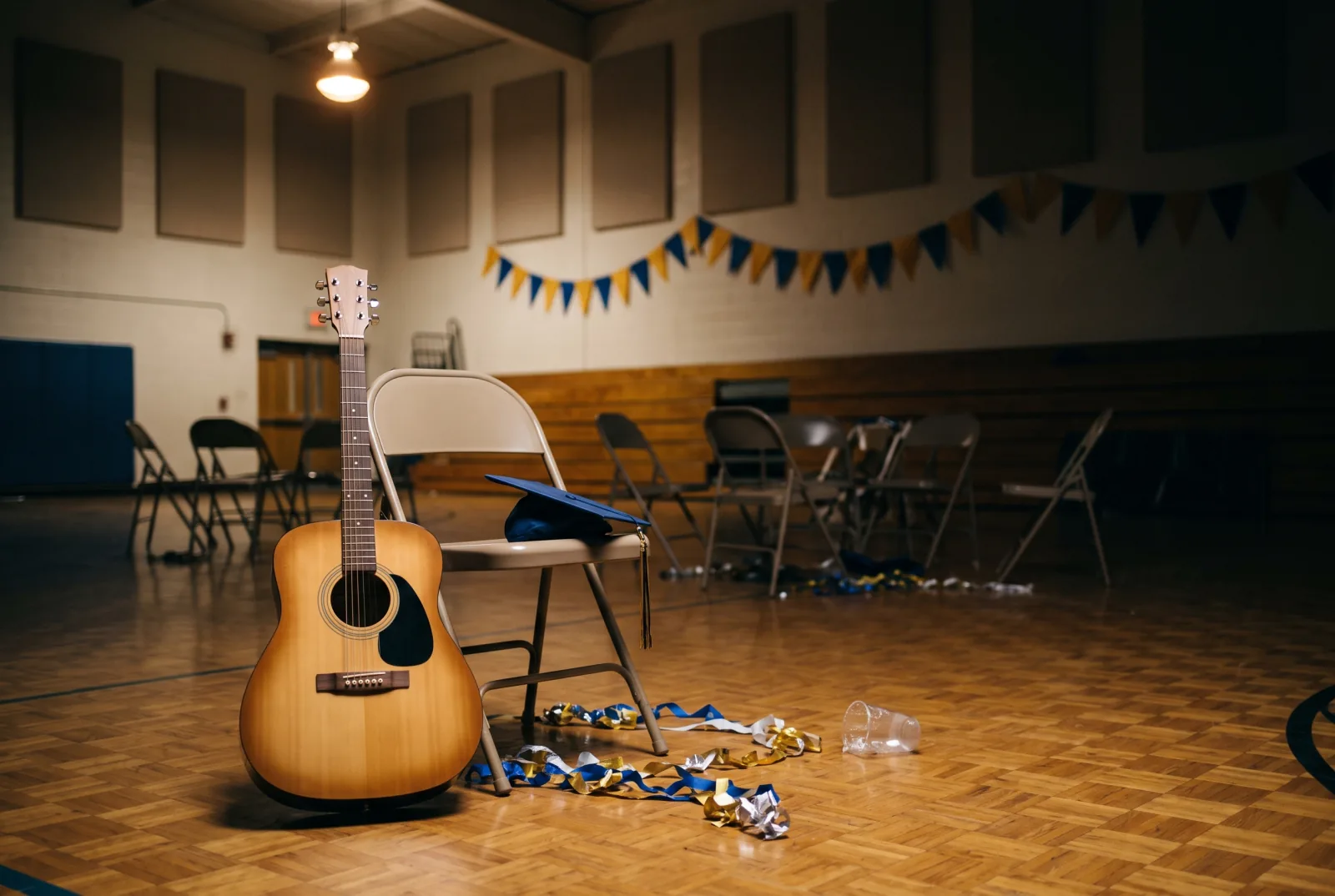
Ilustración: Rebobinados
There is a song that plays at graduations, at weddings, at funerals and in the last episode of TV series. People put it on when somebody leaves and everyone hugs. It is called "Good Riddance". That is the title, in big letters: good riddance, teeth gritted, glad to see the back of you. The friendly title everybody uses, "Time of Your Life", is in brackets. It is the subtitle.
Billie Joe Armstrong put the insult up front, in big letters, and thirty years later nobody has read it. That is where one of the loveliest stories about what happens to a song when it stops belonging to the person who wrote it begins.
Where it came from
He wrote it around 1993, at a party in a house in Berkeley, the kind where the acoustic guitar goes from hand to hand. It was a song about a girlfriend who was leaving for Ecuador to study. He has told it like this: he tried to take it calmly, to be reasonable, to understand that she was going. And he could not. He was furious. Hence the title. It is not fine irony or a wink: it is the song saying exactly what it feels, on the first line of the sleeve, before the music even starts.
There is one line that gets printed in school yearbooks and read out in end-of-year speeches, and that sounds like a metaphor about memory. It is not. Armstrong had tattooed her name on himself; when she left, he had to cover it with more ink. The line describes that, one scar on top of another. The tenderest song in the repertoire was born out of the rawest heartbreak.
Twice it nearly didn't exist
The song that today defines Green Day for millions of people almost does not exist. He played it for the band during the "Dookie" sessions, in 1993, and it was dropped: great, but it doesn't fit here. They tried again in 1995, for another album, and it did not make that one either. It took the producer years to work out what it needed, and the answer was something Green Day had never used: strings. A band that came out of the dirty clubs of Berkeley, from the school of the Ramones, ended up releasing its most famous song with a string quartet on top. It finally came out in 1997 and today it has five platinum discs. What twice looked like a spare part turned out to be the biggest thing they ever made.
How it became something else
In 1998 everything happened at once. The England squad used it as their entrance music at the World Cup. Golf adopted it as the theme of the year. It played on a hospital drama. And it played on "Seinfeld" —although even this gets told wrong: it was not in the finale, but in the clip-show episode broadcast the same night, and in a slightly sped-up version. That is the detail that proves the thesis: the song is so familiar that nobody has ever checked anything about it. Not even the title.
From then on it stopped being his. It became the song for saying goodbye, and the man who wrote it to tell someone to get lost found that people were using it for the exact opposite: to hug each other, to cry nicely, to let go with affection.
The greatness of letting it go
This is where the piece could turn mocking, and it must not, because Armstrong is fine with it. He has said he never imagined a song of his going from grimy clubs to lines in yearbooks. And he told the story of a woman who wrote to him to say she had used it to say goodbye to her dead brother. His reaction was not to correct her or explain the joke in the title. It was to say that, thinking about it, that was beautiful.
That is the real greatness, more than any chart. A song stops belonging to whoever wrote it the moment somebody needs it for something else. Most authors fight against that, they defend "what they meant". Armstrong understood it and let it go before anyone else did. He wrote an insult and let the world turn it into a consolation, and he was fine with it. That is the hardest kind of artistic generosity.
The last step
On 8 February 2026, in a stadium half an hour from where they formed, Green Day played the opening ceremony of the Super Bowl. Before they came on, a group of violinists performed "Good Riddance" while the greatest players in the tournament's history walked onto the field, one by one, to applause. A song written in 1993 by a furious kid because his girlfriend was leaving for Ecuador, to tell her to go already, ended up being the ceremonial march of the greatest names in the NFL. Heartbreak turned into a solemn anthem. Nobody read the title, and it was perfect that way.
What to remember
Green Day sold twenty million copies of "Dookie" in the United States alone, one of the few double diamond albums in history, and they never had a number one on the singles charts. It does not matter. Their best-loved song, the one people put on when something of theirs is ending, has had it written in the title, in big letters, since 1997: get lost.
Remember it like this: nobody reads titles, and sometimes that is a blessing. Green Day wrote a song of rage and the world needed it so badly for love that the rage rubbed itself out. And the man who wrote it, instead of defending his anger, let the tenderness win.
Sources
Green Day, American band formed in 1987 in Rodeo, California, under the name Sweet Children and renamed Green Day in 1989, made up of Billie Joe Armstrong (vocals and guitar), Mike Dirnt (bass) and, since 1990, Tré Cool (drums), replacing John Kiffmeyer; all four are alive. "Good Riddance (Time of Your Life)", written by Billie Joe Armstrong around 1993 during the "Dookie" sessions about his then partner's departure for Ecuador, was dropped from that album and also from "Insomniac" (1995) before being released on 2 December 1997 as the second single from "Nimrod"; producer Rob Cavallo has stated that the song took time to find its arrangement and that it needed string accompaniment. The title alludes to the English expression "good riddance", which expresses relief at someone's departure, and "Time of Your Life" appears as a subtitle in brackets. Armstrong has explained that he tried to take the break-up calmly and that he was in fact furious, and has linked one of its lines to the tattoo of her name, which he later had to cover. The single reached number two on the American Alternative Airplay chart and number eleven on the UK Singles Chart, holds five RIAA platinum discs and won the MTV Video Music Award for best alternative video in 1998. In 1998 it was the England squad's entrance music at the World Cup and the PGA Tour's theme, and it played in "The Chronicle", the "Seinfeld" clip-show episode broadcast on 14 May 1998 —in a slightly sped-up version— immediately before the final episode, with which it is often confused. Armstrong has said that he did not anticipate the song's use at graduations, weddings and funerals and that he finds it valuable that other people have made it their own. On 8 February 2026 the song was performed with strings at the opening ceremony of Super Bowl LX, at Levi's Stadium in Santa Clara, during the entrance of the most valuable players in the tournament's history. "Dookie" (1994) reached number two on the Billboard 200 and was certified double diamond by the RIAA on 16 September 2024, with twenty million units in the United States. The band has never reached number one on the Billboard Hot 100 or the UK Singles Chart: their highest American position is number two with "Boulevard of Broken Dreams", kept off the top by "Candy Shop" by 50 Cent; Noel Gallagher stated publicly in late 2004 that its arrangement matched that of "Wonderwall". Ramones and Oasis have their own profiles in this series. A Rebobinados rewrite of previously verified research; interpretations are offered as the author's reading. No song lyrics are reproduced, for copyright reasons. Information drawn from Wikipedia, Billboard, Official Charts, Rolling Stone, Variety, Songfacts, Louder, Ultimate Classic Rock, KQED and other coverage.
Keep rewinding
80s
punk
Billy Idol
His two anthems failed when they came out
"Rebel Yell" came out on 12 January 1984 and reached no. 46 on the Hot 100 and no. 62 in the United Kingdom; "White Wedding" got no further than no. 36 and did not chart in the United Kingdom in 1982. The two of them only reached no. 6 in Britain in the 1985 reissues, and "Dancing with Myself" never entered the Hot 100. His only no. 1 was a live "Mony Mony" from 1987 that knocked off Tiffany, whose hit was another Tommy James cover.
90s
punk
Fiskales Ad-Hok
The world tour started with them
On 13 September 1992 the Ramones made their debut in Chile, at the Velódromo, the cycling arena inside the Estadio Nacional grounds, and that date was not just another stop: it was the first night of the Mondo Bizarro world tour. It was opened by Fiskales Ad-Hok, a band from the Santiago underground born in 1986 and still without a record. Then came their own label C.F.A. in 1997, "Fiesta" (November 1998) at number 42 in Rolling Stone Chile, and the indefinite hiatus of February 2025.
00s
punk
Avril Lavigne
Six years with no album
Between her 2013 album and Head Above Water, of 15 February 2019, Avril Lavigne released no records because she was seriously ill with Lyme disease: diagnosed in December 2014, she told it on the cover of People in April 2015. The comeback album is about that, and Love Sux (2022) returned her to pop-punk on Travis Barker's label.
Rewind with us
Comments · 0
No one has commented yet. Open the conversation.