
Depeche Mode: The Machine That Became Soul
By Rebobinados · Published on July 30, 2026
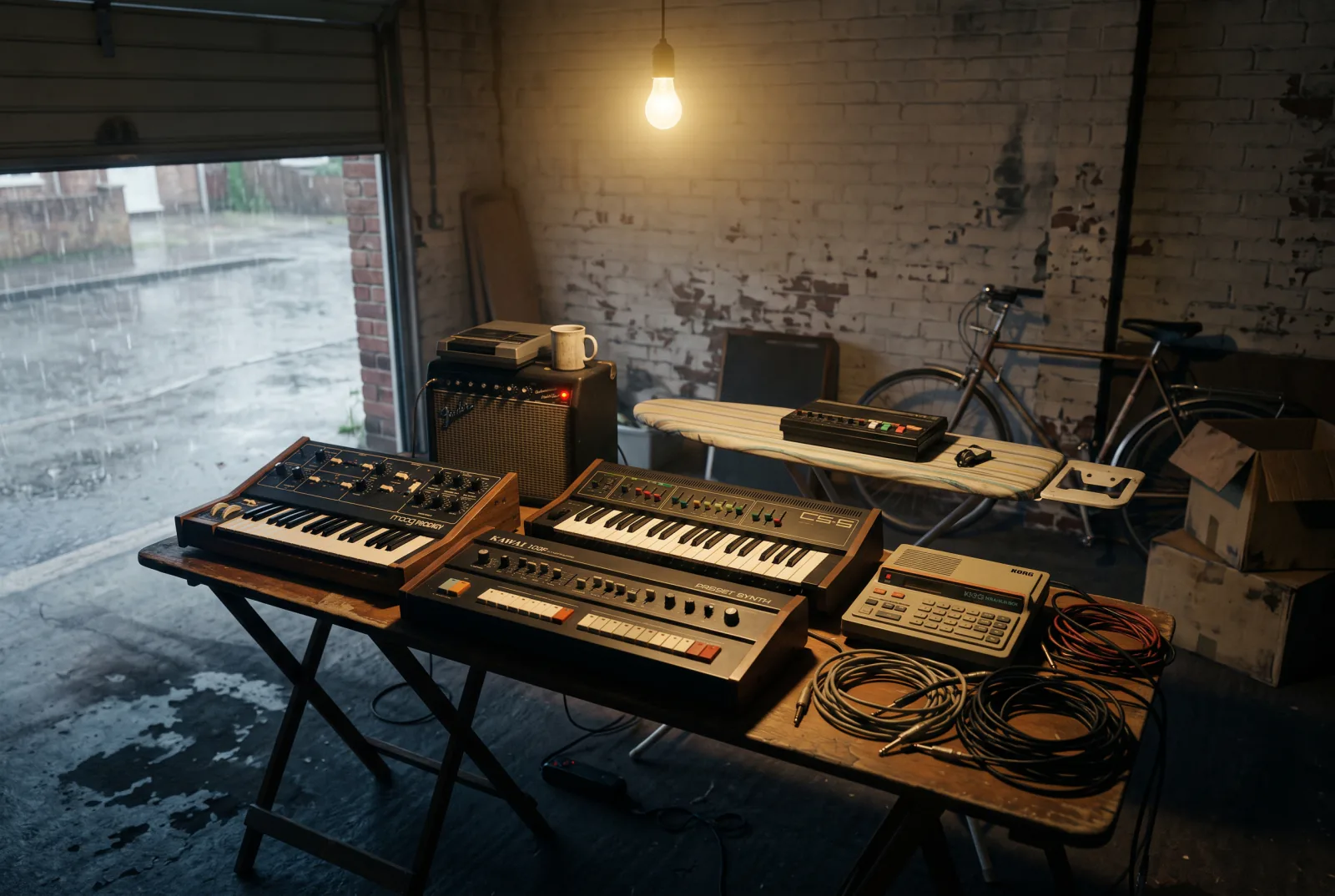
Ilustración: Rebobinados
There is a paradox at the heart of Depeche Mode that explains why, more than four decades after their first album, they still fill stadiums on three continents. It is this: they made the coldest music in the world — synthesizers, drum machines, machines — and with it they touched the hottest feelings there are: desire, faith, guilt, death, devotion. They took the instrument that seemed to dehumanise music and used it to make the most deeply human music of their generation.
Nobody was betting on them. When they appeared in the early eighties they were four kids from Basildon — a grey town on the outskirts of London — with keyboards they could barely afford, making a bouncy electronic pop the critics treated as a passing teenage fad. The idea that these boys would end up being, in Q magazine's words, "the most popular electronic band the world has ever known" would have seemed absurd. But that is exactly what happened, with more than a hundred million records sold to prove it. The story of how it happened — from "Just Can't Get Enough" to "Enjoy the Silence", from toy pop to black cathedrals — is one of the great reinvention stories in rock.
This is that story, album by album, with the band's current state and a map of who picked up the baton.
The origins: Basildon, 1980
It started with some school friends. Vince Clarke and Andy Fletcher had played together in a band called No Romance in China. Martin Gore joined them, and the three formed Composition of Sound. In 1980 a singer with a deep baritone came aboard, Dave Gahan, and with him the group changed its name to Depeche Mode — taken from a French fashion magazine, a detail that already announced their taste for European style and elegance.
The original line-up had a curious detail that would prove decisive: the main songwriter was none of the names we associate with the band today. It was Vince Clarke. And he wrote the hits on the debut. But Clarke would leave almost immediately, and that departure — which looked like a blow — was in fact the birth of the real Depeche Mode.
The fifteen albums: the map of a transformation
Speak & Spell (1981) — Toy pop
The debut is pure eighties electronic joy: bright, bouncy, carefree. Its big hit, "Just Can't Get Enough", is still one of the catchiest pop anthems of the decade. It's a fun, uncomplicated synth-pop record dominated by Vince Clarke's writing. But it is also the least representative album of everything Depeche Mode would become: it makes more sense as Clarke's springboard into his later career — he would found Yazoo and then Erasure — than as the band's true beginning. Listening today, it's hard to believe this is the same group that would record "Black Celebration".
A Broken Frame (1982) — The awkward transition
With Clarke gone, Martin Gore took over the songwriting: the founding moment of the band we know. But the change was abrupt, and it shows. "A Broken Frame" is a transitional record, the sound of a group searching for itself after losing its main author. Gore hadn't quite found his dark voice yet. Recorded as a trio, it is the necessary but hesitant link between what they were and what they would be. The man who would complete the picture was already arriving: Alan Wilder joined in January 1982, first as a touring keyboardist and soon as a full member, and would define the band's sound for thirteen years.
Construction Time Again (1983) — The birth of the industrial
This is where the real Depeche Mode starts. With Wilder bringing technological sophistication and Gore gaining confidence, the sound turns denser, more metallic, more political. They began using samples of industrial sounds — metal strikes, factory noise — woven into the songs, and the lyrics opened up to social criticism. "Everything Counts", with its indictment of corporate greed, marks the turn. The toy band was growing an edge.
Some Great Reward (1984) — The first great leap
The album of their artistic and commercial coming-of-age. Gore's dark, provocative obsessions surface: spiritual doubt in "Blasphemous Rumours", psychosexual manipulation in "Master and Servant". Both paid a price — several radio stations refused to play the latter, and the former was condemned by Britain's broadcasting authority and by the tabloid The Sun, to the point that the label released it as a double A-side out of fear of the backlash. Meanwhile the single "People Are People", a plea against intolerance, became their first big hit on both sides of the Atlantic. Depeche Mode had found its subject: the tension between the sacred and the profane, between faith and desire.
Black Celebration (1986) — The black cathedral
For many fans, the album where Depeche Mode became fully Depeche Mode. "Black Celebration" is dark, atmospheric, melancholy to the marrow, and is often described as the definitive gothic electronic record. It almost entirely abandons pop's cheerfulness to sink into a sombre, nocturnal beauty. Songs like "Stripped" and "A Question of Time" show a band that has learned to make the synthesizer an instrument of deep emotion rather than light dancing. It is the sound of the soul's midnight, and it is magnificent.
Music for the Masses (1987) — The conquest of America
The title was ironic — "music for the masses" from a band considered a cult act — but it turned out to be prophetic. This record, more accessible without losing its depth, was the one that broke the American market. "Strangelove" and "Never Let Me Down Again" resonated with a global audience that kept growing. The tour peaked on 18 June 1988 at the Rose Bowl in Pasadena: 60,453 paid attendance, the biggest concert that stadium had ever held, and the 101st show of the tour — hence the name of the documentary D. A. Pennebaker filmed of it all. A band that had started out playing English pubs was now filling American stadiums.
Violator (1990) — The masterpiece
If you must choose a single Depeche Mode album, this is it. "Violator" is the absolute summit, the point where everything — the darkness, the pop hook, the electronic sophistication, the emotional depth — lines up perfectly. It contains two of the most important songs of their career and of all synth-pop: "Personal Jesus", with its almost bluesy riff and its magnificent blasphemy, and "Enjoy the Silence", perhaps the band's perfect song, where a celestial melody wraps a lyric about the pain of words. "Violator" is one of the peaks of electronic pop and alternative rock, an album that balanced accessibility and innovation like no other. It is the moment Depeche Mode stopped being a great band and became an immortal one.
Songs of Faith and Devotion (1993) — The guitar explosion
And then, at the summit, they reinvented themselves again, risking everything. Influenced by the grunge and alternative rock dominating the United States, they brought in distorted electric guitars, live drums, real strings, bagpipes and gospel choirs. The result, led by the single "I Feel You", was a raw, intense, almost rock record — and the band's first to debut at number one in the UK and the United States at once, a rare feat. But the process nearly destroyed them. Internal tensions, addiction and the chaos of the Devotional tour led to Alan Wilder's departure in 1995 and took Dave Gahan to the edge of death. Success and the abyss, at the same time.
Ultra (1997) — The resurrection
Reduced to Gahan, Gore and Fletcher, with Gahan recovering from an overdose that nearly killed him, many gave the band up for finished. "Ultra" was the survival record: more introspective, with industrial touches, the sound of a group that had looked at the end up close and chose to go on. That it exists at all is a small victory in itself.
The 2000s: Exciter, Playing the Angel and Sounds of the Universe
The band entered a fertile maturity. "Exciter" (2001) was their most minimal and digital record, delicate and experimental. "Playing the Angel" (2005) marked a return to the warmth of analogue synthesizers and to force, with Gahan starting to contribute his own songs. "Sounds of the Universe" (2009) went deeper into that reunion with the old synths, mixing the synth-pop of their origins with the darkness of their maturity. Three albums from an already legendary band that refused to repeat itself.
Delta Machine (2013) and Spirit (2017) — The last stretch with Fletcher
"Delta Machine" (2013) pushed their sound into territory that was bluesier and more electronic at once, dark and textured. "Spirit" (2017) was an openly political record, full of rage at the state of the world. It would be, though nobody knew it then, the last Depeche Mode album with founding member Andy Fletcher.
2020: the Hall of Fame and the last picture of the three
In November 2020, with the ceremony turned into a television special because of the pandemic, Depeche Mode entered the Rock and Roll Hall of Fame. Charlize Theron introduced them, and speaking about them were Coldplay's Chris Martin — "sonically, they were and are about throwing away all the rulebooks", he said, and also that "Depeche Mode can make lost souls feel more found" — along with Arcade Fire's Win Butler, Chvrches' Lauren Mayberry and ZZ Top's Billy Gibbons. Gahan, Gore and Fletcher accepted the honour together, each from home, on a screen split in three. It was the last great ceremony of the three of them. Eighteen months later there were two.
The blow: Fletcher's death
On 26 May 2022, Andy "Fletch" Fletcher died suddenly at sixty. The cause, revealed weeks later at his family's request, was an aortic dissection. Of the three long-standing members Fletcher was the least visible musically — he joked about it himself in "101": "Martin's the songwriter, Alan's the good musician, Dave's the vocalist, and I bum around". But that modesty hid his real role: he was the band's human glue, the mediator, the one who held it together across forty years of tension. His loss left Depeche Mode reduced, for the first time, to a duo.
Memento Mori (2023) — Looking death in the face
Faced with the loss, Gahan and Gore made a decision: carry on. Gahan had thought the band was over; Gore said the songs they already had in hand were precisely what kept them together — "when Andy died it cemented the idea that we had to carry on with these songs and the title". Because that is the chilling detail: the album about mortality already existed before Fletcher's death. It had been born of the pandemic, and life gave it afterwards a resonance nobody was looking for.
"Memento Mori" (2023) is the fifteenth studio album and the first recorded as a duo. James Ford produced it, and Richard Butler of the Psychedelic Furs co-wrote four of its songs, among them the single "Ghosts Again". It went to number one in Germany, France, Italy, Switzerland, Austria and Sweden, and number two in the UK. The tour that followed played 112 concerts between March 2023 and April 2024. Three of those nights, at the Foro Sol in Mexico City — where, as in few places on earth, the band is worshipped — were captured in the film "Depeche Mode: M", directed by Fernando Frías de la Parra and released in cinemas in late 2025, alongside the double live album "Memento Mori: Mexico City". Grief turned into communion, which is, at bottom, what Depeche Mode always knew how to do.
Why they matter: the machine with a soul
What makes Depeche Mode great is not just the longevity or the sales figures. It is what they managed to do with technology. At a time when the synthesizer was associated with the cold, the artificial, the dehumanised, they proved the opposite: that a machine, in the right hands, could express longing, faith, guilt and desire more powerfully than any guitar. They were synth-pop pioneers, yes, but they also opened the road for entire genres — darkwave, industrial, electronic EBM — and their use of samplers and digital production changed how music is made.
But their deepest lesson is sustained reinvention. Few bands transformed so many times without betraying themselves: from toy pop to the gothic cathedral, from the cathedral to grunge guitars, from the guitars to electronic maturity, and from all of it to looking death in the face in old age. Every decade, a new skin. And through all of them, the same recognisable soul: that unique mix of darkness and beauty, of the sacred and the profane, that ability to turn alienation into mass communion which Dave Gahan embodies every night by turning a whole stadium into a single devout congregation.
Who picked up the baton
Depeche Mode's influence is so vast that it cuts across genres that seem to have nothing to do with one another. Their DNA is recognisable in four great lineages of heirs.
The industrial and the dark. Nine Inch Nails is perhaps their most direct heir in intensity: Trent Reznor took Depeche Mode's fusion of electronics and raw emotion to its most abrasive extreme. In the same family are Marilyn Manson and, from Germany, the titans Rammstein, who inherited the theatrical, sombre weight and put it on record in 1998, when they chose to cover "Stripped" for the tribute album "For the Masses". And Crosses, the project of Chino Moreno (of Deftones), was born from a Depeche Mode tape his sister left in his Christmas stocking: from then on, he has said, his whole concept of music changed.
The stadium kings. The Killers owe Depeche Mode their insatiable love of the electropop hook. Brandon Flowers has told how he bought "Songs of Faith and Devotion" for $4.99 from a bucket of cassettes at a truck stop, and what that record meant to a teenager in Nephi, Utah: it "brought a sense of danger and excitement into my adolescence — Nephi had neither". Muse know the comparison well — Matt Bellamy explains it by way of what interests him too: "they're a band that never really fitted in exactly with the music of their time" — and Coldplay put their debt into words the day Chris Martin spoke at the Hall of Fame induction.
The indie and alternative. Arcade Fire confess their devotion without hedging: Win Butler described "The Suburbs" as "a mix of Depeche Mode and Neil Young", and he was one of those who spoke at that 2020 ceremony. And a long line of melodramatic synth-pop bands, like Britain's Hurts, exist practically as a direct continuation of the formula: electronics, darkness and drama.
The family lineage. There is a beautiful irony in Vince Clarke, the founder who left after the first album, going on to form Yazoo and Erasure — two pillars of synth-pop — from the other end of the spectrum: the bright and danceable one, the exact reverse of the darkness Depeche Mode specialised in. Two branches of the same original tree, growing in opposite directions.
The list goes on, and reaches unlikely places: the trace of Depeche Mode shows up anywhere someone has tried to make a machine feel. That, in the end, is their real legacy. Not a sound, but a possibility: that the electronic could have a soul. They proved it first, and proved it best. Everything that came after walks on that discovery.
And as long as Gahan and Gore keep climbing onto a stage to turn darkness into shared light, the story isn't finished being written.
Keep rewinding

10s
pop
Bruno Mars
Eleven names in the credits
"Uptown Funk" came out on 10 November 2014 with six writers and today it has eleven. In February 2015 The Gap Band's publisher filed a claim over "Oops Up Side Your Head" in YouTube's copyright system —there was never a lawsuit— and on 28 April five names were added, with 17 % of the publishing. It happened weeks after the "Blurred Lines" verdict, and the song had been fourteen weeks at number one.

00s
pop
André Rieu
It was not from the jazz suite
The waltz with which André Rieu reached half the world is not from Shostakovich's Suite for Jazz Orchestra No. 2: it is from the Suite for Variety Orchestra, which the composer did not assemble, and it was born in 1956 as music for a Soviet film about settlers in Kazakhstan. The error comes from a misprint in volume 10 of the complete works (Muzyka, Moscow, 1984), corrected only in 2001. And the title "The Second Waltz" was invented by his wife, because the real one did not sell.

90s
pop
Daniela Mercury
She took the neighbourhood out of the song
"O Canto da Cidade" was written by Tote Gira, a composer from Nordeste de Amaralina who recorded the demo on a borrowed cassette, marking the beat on the door of a refrigerator; Mercury's team almost threw the tape away. She shares the credit because she deleted the references to the Pelourinho so that the song would serve all of Brazil. The album, from 20 September 1992, sold more than 2 million copies and nationalised axé. But she did not invent it: the name was a journalist's insult in 1987.
Rewind with us
Comments · 0
No one has commented yet. Open the conversation.