
Series
A History of Chilean Rock · Chapter 16: Music Loses Its Weight
By Rebobinados · Published on August 30, 2026
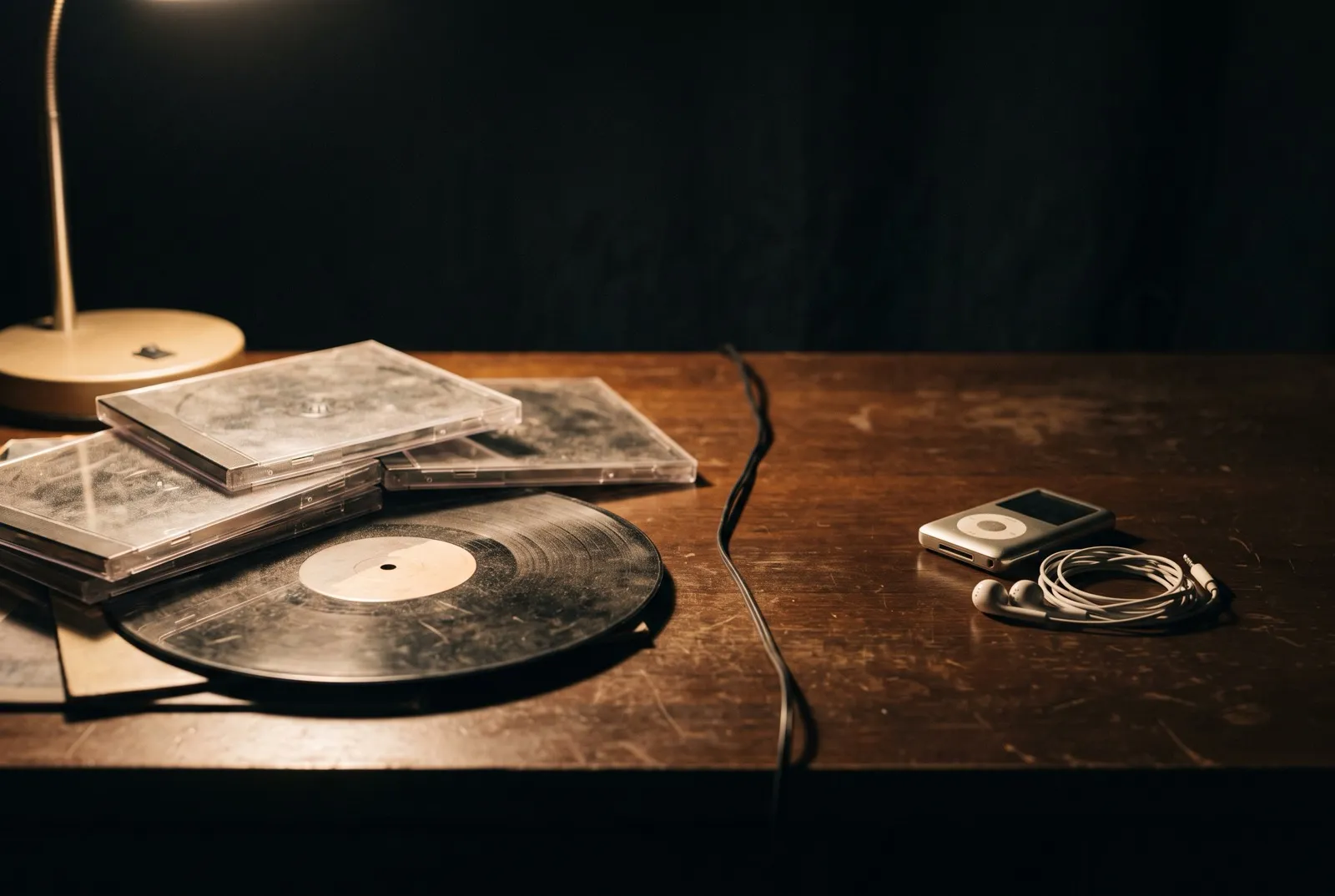
Ilustración: Rebobinados
In the early 2000s, a program appeared that changed everything without asking permission. It was called Napster, and overnight music became free: any song, instantly, copied and shared between strangers for nothing. The mp3 arrived, the file. And the record industry, which had just had the best year in its history, began to collapse almost at once; Metallica took Napster to court, the CD started to die, and music stopped being a thing you buy and keep and became something else: a file, weightless, everywhere at once. And at that very moment, down here, what this series had been chasing since its first page finally happened: distance stopped mattering.
A hundred years of weight
To understand the scale of that, you have to see what music had been until then. For a hundred years it was a physical object: a wax cylinder, a vinyl record, a cassette, a compact disc. It weighed something, it took up space, it had to be manufactured, shipped, sold in a shop. And above all, it had to travel. That is why, for sixty years — this whole history — the world's music arrived in Chile late, with an echo: the record crossed the ocean and turned up months later. The mp3 ended that at the root. Music became information, weightless, and information crosses the planet at the speed of light, arriving everywhere in the same instant. What had defined Chilean music for six decades — the distance, the delay, the echo — was abolished, and not by culture but by physics: you cannot arrive late to something that arrives instantly.
The mp3's trick
And for the curious, the mp3's trick is cleverer than it looks. It did not compress the music: it compressed the ear. It rests on psychoacoustics, the study of how we actually hear, and throws away everything a human cannot notice. It discards what falls outside our range — sounds too high or too low for us to hear — and, above all, it uses an effect called masking: when something loud plays, the ear is covered for the faint sounds that occur right beside it or right after, and the mp3 works out those details a louder sound stops you hearing, and deletes them, because you were not going to make them out anyway. It does not remove what you hear; it removes what something else prevents you from hearing. That way a file drops to a tenth of its size and sounds, to almost everyone, almost the same. Almost, because what was thrown away does not come back: it is lossy compression. The format that took the weight out of music and erased distance was tailored not to the song, but to the limits of the person listening. Today the mp3 is already a thing of the past: if you want full fidelity there are lossless formats that discard nothing, such as FLAC; and if you want efficiency, finer heirs of the same trick, such as AAC or Opus, which sound better at the same size. But the one that broke the world was the mp3.
Distance abolished
And that closes the story we opened in the first chapter. Chile had spent sixty years closing that distance: first copying by ear, then finding its voice, then receiving the world live, then making itself heard, then losing the inhibition. And now distance itself — the ten thousand kilometres, the ocean the record had to cross — simply disappeared. A young person in Santiago heard a new song the same second as a young person in London or Seattle. There was no longer an "out there" arriving "here" late. The echo that gives this series its name had become, at last, physically impossible.
The door opened both ways
But the door opened both ways, and that is the other half, the more important one for us. It was not only that Chile received instantly; now Chile could send instantly, without asking anyone's permission. Before, reaching the world took a label, a radio station, a plane, MTV's screen. Now a kid with a computer could record a song in his bedroom and upload it, and someone in Mexico or Spain would hear it that same night, with no industry in between. That is where indie grew in Chile: not a sound, but a way of doing things. Record alone, distribute alone, skip the entire apparatus the golden age had required. The independent labels, which predated the moment and found their footing in it — Quemasucabeza, founded by the band Congelador in the nineties; Beast, born in Concepción in 2005 — the portals for uploading and downloading music, communities like MySpace where a Chilean song could cross the mountains without anyone authorising it. The people guarding the door were left with no door to guard.
What it gave and what it took
Now, it has to be told whole, because dematerialisation gave and took at the same time. It freed the musician from those who controlled access, yes; and it simultaneously destroyed the economy that let them live off their music. Songs became "free", records stopped paying, and the entire industry that had sustained the golden age fell apart. And abundance brought its own problem: when anyone can upload, everyone uploads, and the signal drowns in the noise. Chilean music multiplied into a thousand currents, a landscape split into compartments, where there was everything and yet it was hard for anything to be heard above the rest. The new freedom came with a new precariousness. The door was left open for everyone, which also meant it was left open for everyone: a crowd where there had once been a stage.
So rewind to that start of the 2000s when music lost its weight. The series began with distance: Chile listening to the world from far away, late, with an echo. And here that distance ended, not because Chile finally caught up with the world, but because the world stopped having a "far away" for music. The song became light, and light things do not arrive late, nor do they ask permission to leave. The echo was over. What came next was a world with no centre and no shore, where a kid in his bedroom, in any city, was as close to everyone as anybody else: a fragmentation that was also, at last, a form of equality. What Chile did with that equality is what the coming chapters are about.
Sources
The file-sharing program Napster launched in June 1999 and peaked between 2000 and 2001; Metallica sued on 13 April 2000 and the original service closed in 2001, following a court order and a settlement with the plaintiffs. All of this triggered a crisis in a record industry that had just reached its commercial high point. Music moved from physical media — vinyl, cassette, CD — to a digital file distributable instantly. The mp3 (MPEG-1/2 Audio Layer III, standardised in 1993) reduces size through perceptual coding based on psychoacoustics: it discards information outside the audible range, roughly 20 Hz to 20 kHz, and above all applies masking, removing faint sounds hidden by louder ones nearby in time or frequency, as well as allocating bits according to the ear's sensitivity. It is lossy compression: the discarded information cannot be recovered. Today there are lossless formats, such as FLAC or ALAC, which preserve the original intact, and more efficient lossy formats, such as AAC and Opus. In Chile, the arrival of internet in homes, digital downloading and communities like MySpace drove a generation of musicians who self-produced their records. The independent labels of that scene were not all born with the mp3: Quemasucabeza was founded by the band Congelador in the second half of the nineties, before Napster, and Beast Discos was created in 2005 in Concepción; alongside them came download portals such as Portaldisc and, later, the IMI Chile association. The musicologist Juan Pablo González has described the effect as a multiplication of currents in a landscape divided into compartments, with self-production and the industry's crisis giving visibility to previously invisible sectors. No song lyrics are reproduced, for copyright reasons. Sourced from Wikipedia, Zona de Obras, MondoSonoro, Chilemúsica and other press coverage.
Keep rewinding
Series
A History of Chilean Rock · Chapter 15: The Golden Age and the End of the Millennium
As the world crosses into the year 2000, Chilean rock reaches its peak and loses its last inhibition: it stops measuring itself against a distant "real thing". Los Tres say goodbye in Concepción just as the new century begins, and in that same city Los Bunkers had already existed for months.
Series
A History of Chilean Rock · Chapter 14: Joy and Rage
While the world surrenders to Britpop, the echo reverses: through MTV Latino, Chilean rock finally goes out to be heard. And Los Tres, from Concepción, conquer the screen not by copying the north but by taking Roberto Parra's cueca. Yet beneath the joy lay real losses and a rage that would not go away.

Series
A History of Chilean Rock · Chapter 13: The Avalanche
While Seattle invents grunge, the whole world pours through the door Rod Stewart opened: Bowie, Clapton, Amnesty International, Guns N' Roses, Michael Jackson. Chile stops listening years late and starts watching live. But the party had a price, and one night in 1992 it was paid.
Rewind with us
Comments · 0
No one has commented yet. Open the conversation.