
Series
A History of Chilean Rock · Chapter 14: Joy and Rage
By Rebobinados · Published on August 28, 2026
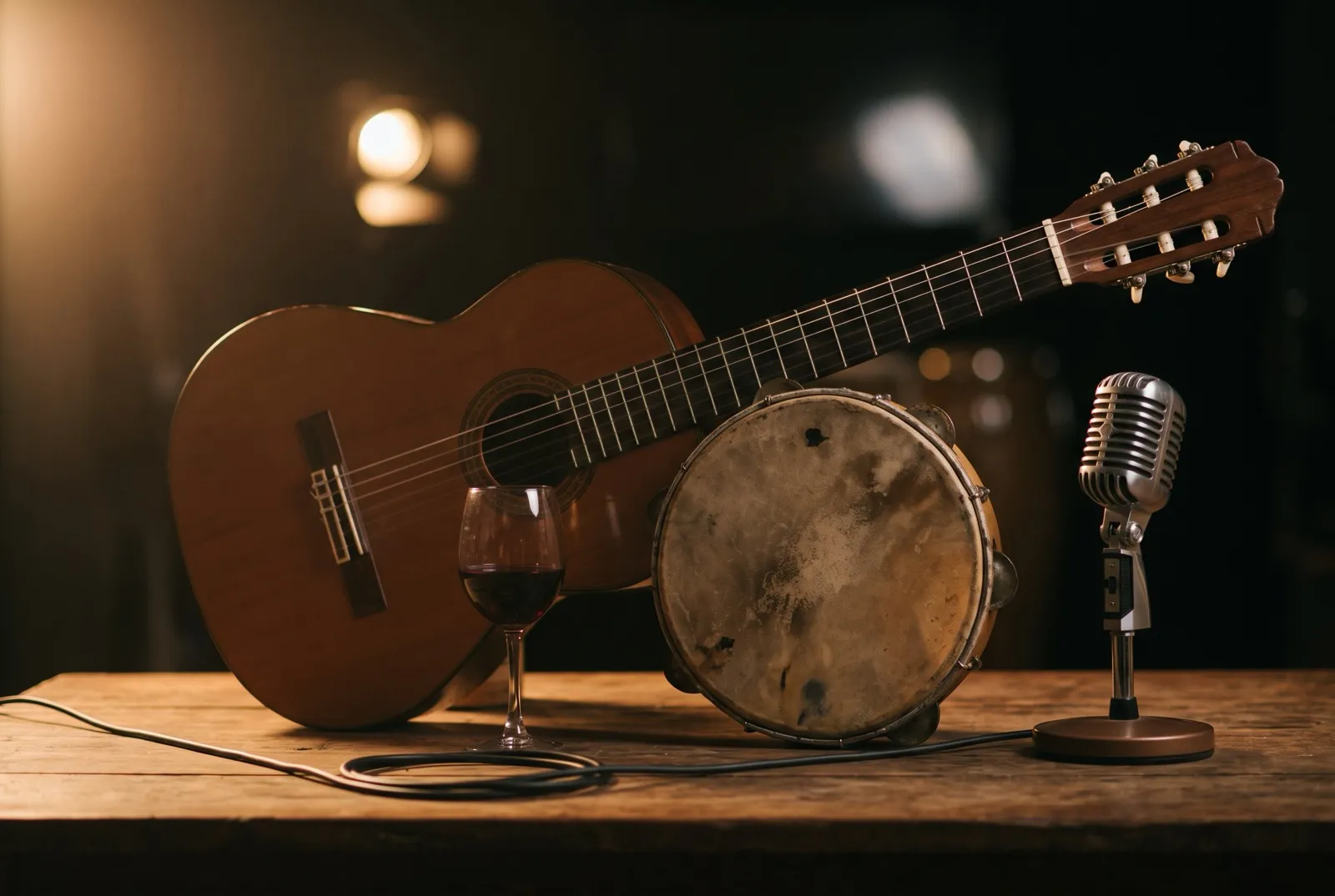
Ilustración: Rebobinados
In the mid-nineties the rock world was looking at England: it was the era of Britpop, of Oasis and Blur fighting over the number one spot, and of an MTV at the peak of its power, able to make anyone who crossed its screen famous. One of its inventions, MTV Unplugged — bands playing acoustic, unplugged — had become a form of anointing: getting there meant entering the map of the world. And onto that map, for the first time, came Chilean rock.
The echo turns around
For thirty years, the echo had travelled in one direction only: Chile received the world's music, late. The avalanche of the early nineties had set the two clocks to the same hour, but the direction was unchanged: from there to here. Until in 1993 MTV Latino launched, a channel that carried Latin American rock across the continent, and through that signal, for the first time, Chilean bands went outward. The echo reversed. It was no longer only Chile listening to the world; it was starting to be the world listening to Chile.
And the way it happened is the best part of the story. The band that opened that door was Los Tres, from Concepción, led by Álvaro Henríquez.
Concepción, the cradle
And it is worth pausing on Concepción, because it is no accident that they came from there. That southern city on the banks of the Biobío river is called the cradle of Chilean rock, and rightly so: out of its streets came Los Tres and, later in this story, Los Bunkers — two of the biggest bands the country has produced — as well as Emociones Clandestinas, Santos Dumont, Machuca and many others. That tradition weighs so heavily that in 2023 UNESCO named Concepción a Creative City of Music. If you ever get the chance, go: every March the city hosts REC, Rock en Conce, the largest free festival in Chile, on the riverbank, and it is a way of touching with your own hand where a good part of this music comes from. Hold on to the name Concepción, because it will come back.
The cueca on MTV
In September 1995 Los Tres recorded, in Miami, the first MTV Unplugged by a Chilean band, released in April 1996. But look at how they did it: they did not conquer the world's screen by copying the sound of the north. They did the opposite. They took onto that international stage the cueca chora and the jazz guachaca, the songs of Roberto Parra — the most Chilean, most rooted, most fonda material they had. The root Violeta had dug up, the one Los Jaivas had electrified, Los Tres sent out, unplugged, across the whole continent. The most ours became what we exported. The album went platinum and was the best-selling record in Chile in 1996. The echo of the first chapter had reversed completely: now the world was hearing from Chile not a copy, but its root.
They were not alone
Alongside Los Tres, La Ley — fronted by Beto Cuevas — took a darker, more polished sound to the continent, and over the years would win a Grammy and record its own Unplugged. Lucybell brought a sombre, elegant alternative rock. Chilean rock was playing on MTV Latino, seen from Mexico to Argentina. For the first time, Chile was not only importing rock: it was exporting it.
The rage underneath
But this chapter is called "joy and rage", and the second word is there for a reason. It was not all celebration. The democracy that had returned was incomplete, with its unsettled accounts, as we saw. And the scene had wounds of its own. In April 1994, La Ley lost Andrés Bobe, its founder and guitarist, in a motorcycle accident, just as they were on the way up. It was the same week the world lost Cobain: five days separate one death from the other. The joy of opening up and being heard carried, underneath, real losses and a rage that would not go away. These bands were not going out simply to celebrate: many still carried the edge, the anger of a generation that had grown up under dictatorship and inherited a democracy with the small print unresolved. They smiled outward and kept the harshness inside. Joy and rage, both at once.
So rewind, to see the picture across time. The series began with Chile singing the world's songs, borrowed and delayed, an echo of what was playing far away. And it reached, in the mid-nineties, the moment when the world began to sing Chile's: a band from Concepción playing the cueca on MTV for an entire continent. The echo had become a voice, and the voice was finally being heard abroad. But that joy came with a rage underneath, because the country that was at last being listened to still had, inside, its own accounts left open. How that voice matured until it lost its last inhibition is what the next chapter is about.
Sources
MTV Latino launched on 1 October 1993, broadcasting Latin American rock across the continent. Los Tres, a band from Concepción led by Álvaro Henríquez, recorded the first MTV Unplugged by a Chilean group on 14 September 1995 at Post Edge Studios, Miami, released on 15 April 1996, following the albums "Los Tres" (1991), "Se remata el siglo" (1993) and "La espada & la pared" (1995); the album included three versions of songs by Roberto Parra, sold 150,000 copies in its first three months and was the best-selling record in Chile in 1996. La Ley, fronted by Beto Cuevas, achieved continental reach; its founder and guitarist Andrés Bobe died in the early hours of 10 April 1994 in a motorcycle accident in La Reina, Santiago, five days after the death of Kurt Cobain. "Invisible" (1995) was the band's first album after that loss; years later "Uno" won a Grammy, and La Ley's MTV Unplugged was recorded in 2001. Lucybell, formed in 1991, contributed a darker strain of alternative rock. Concepción is recognised as "the cradle of Chilean rock", home to Los Tres, Los Bunkers, Emociones Clandestinas, Santos Dumont, Machuca and De Saloon, among others; in 2023 UNESCO designated it a Creative City of Music, and since 2015 the city has hosted the REC festival (Rock en Conce) on the banks of the Biobío, the largest free festival in the country. On the world clock: the rise of Britpop (Oasis, Blur) and the peak of MTV and its Unplugged format. Chile's transition still had unsettled accounts in those years. No song lyrics are reproduced, for copyright reasons. Sourced from Wikipedia, MusicaPopular.cl, BioBioChile, La Tercera, Radio Concierto and other press coverage.
Keep rewinding

Series
A History of Chilean Rock · Chapter 16: Music Loses Its Weight
Napster and the mp3 strip music of its weight, and with it goes the distance this series opened with: you cannot arrive late to something that arrives instantly. The door opens both ways, but the same freedom that released the musician destroyed the economy that sustained them.
Series
A History of Chilean Rock · Chapter 15: The Golden Age and the End of the Millennium
As the world crosses into the year 2000, Chilean rock reaches its peak and loses its last inhibition: it stops measuring itself against a distant "real thing". Los Tres say goodbye in Concepción just as the new century begins, and in that same city Los Bunkers had already existed for months.

Series
A History of Chilean Rock · Chapter 13: The Avalanche
While Seattle invents grunge, the whole world pours through the door Rod Stewart opened: Bowie, Clapton, Amnesty International, Guns N' Roses, Michael Jackson. Chile stops listening years late and starts watching live. But the party had a price, and one night in 1992 it was paid.
Rewind with us
Comments · 0
No one has commented yet. Open the conversation.