
Series
A History of Chilean Rock · Chapter 3: The Counterculture and the Root
By Rebobinados · Published on August 21, 2026
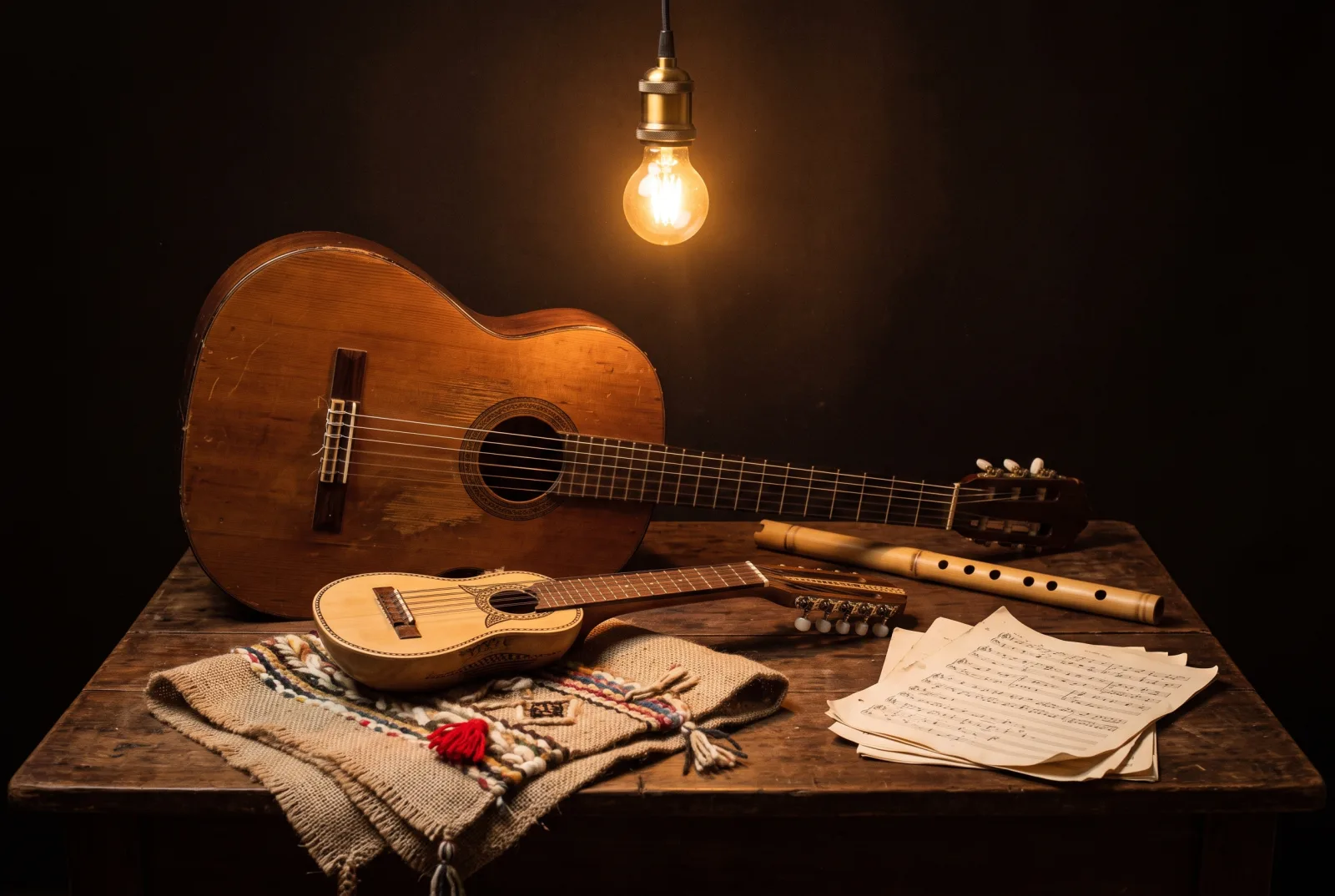
Ilustración: Rebobinados
The sixties were, almost everywhere in the world, the decade when young people let loose. But "letting loose" meant different things depending on where you were standing. In Chile it meant, curiously, the opposite of what it meant up north.
Abroad, above all in the United States and Europe, young people let loose by running forward. Kennedy was assassinated in 1963 and a certainty cracked with him; the Beatles crossed the Atlantic and set off a new kind of hysteria; and towards the end of the decade, in a field at Woodstock, half a million young people gathered to listen to rock in the rain, among drugs, flowers and the promise of another world. That was the counterculture: psychedelia, individual liberation, "turn on, tune in, drop out". A rebellion that pushed outwards, away from the system, towards utopia, sometimes towards escape. The young people of the north broke away from their parents by running forward, towards something that did not yet exist.
Chile ran the other way
In Chile, young people were rebelling too, but they ran in the opposite direction: downwards, towards the root. While the world was inventing the future, Chile went looking for its past. At the height of imported music —rock from the north, the Argentine bands filling the radio, all of it the combed and pressed world that Viña let through— a group of artists began travelling the country, collecting the peasant music that was being lost. At the head of it, a woman: Violeta Parra. Violeta had walked the hills recording the old singers, rescuing cuecas, tonadas and laments that nobody was writing down, and out of that she built a body of work of her own, bottomlessly deep. She copied nothing from abroad: she dug inwards.
A movement was born from that digging. In 1965, in a large old house on Carmen street in Santiago, Violeta's children —Isabel and Ángel Parra— opened the Peña de los Parra, a place where the root was sung and the country was argued over. Víctor Jara, Rolando Alarcón and Patricio Manns all passed through it; there, what would be called the Nueva Canción Chilena took shape. Soon after came the groups that would give it a face: Quilapayún in 1965, Inti-Illimani in 1967, with their ponchos and their quenas, about as far from the aesthetics of rock as it was possible to be. The Nueva Canción wasn't after a psychedelic future; it was after the land, the peasant, the worker, and it sang to a country that was changing.
It wasn't nostalgia: it was a question
Because Chile, in those years, was genuinely changing. It was the time of land reform, of "the land belongs to those who work it", of the countryside being redistributed, of a country seriously asking itself how to share out what was its own. The music of the root was not nostalgia: it was part of that question. When Víctor Jara sang for the peasant, he wasn't making museum folklore; he was pushing, alongside millions, towards a different country. That is why the Nueva Canción was political from the cradle: in that Chile you couldn't sing about the land without also singing about who the land should belong to.
It's worth saying that the world had that other side too. Not everything abroad was psychedelia and escape: there were Bob Dylan and Joan Baez, the protest song, the guitar put at the service of a cause. The Chilean Nueva Canción rhymes with that family, the committed one, more than with the family of Woodstock. But with a difference that makes it unique: the Chilean one sank its roots into the indigenous, the peasant, the cueca and the charango, and it was tied to a concrete project for the country, the one that would lead to 1970. It wasn't imported protest. It was protest with a quena.
Violeta
Before going on, we have to stop at Violeta, because without her none of this exists. She wasn't only the woman who collected the folklore: she was a composer, a poet, a painter and an embroiderer, and the first Latin American artist to have a solo exhibition at the Louvre. Among her hundreds of songs she left one that broke loose from Chile and travelled the world, sung today in many languages: "Gracias a la vida", perhaps the greatest hymn to existence this country has produced. She recorded it on her last album, in 1966, months before she died. Because Violeta, in early 1967, carrying a deep depression and a sense of abandonment, took her own life. It is one of the most heartbreaking contradictions in our music: the woman who taught a continent to give thanks for life could not find a way to go on with her own. She didn't die as a symbol or as a gesture; she died as a person who had given too much. She managed to set the root alight, but not to see the forest that grew from it.
The voice that carried the root across the continent
And there was a voice that made sure that forest was heard far away: Mercedes Sosa's. Argentine, from Tucumán, la Negra was the great disseminator of Chilean song across the continent. In 1969 she recorded a single with Violeta's "Gracias a la vida" on one side and Víctor Jara's "Te recuerdo Amanda" on the other —the two roots of this story on a single record— and in 1971 her album "Homenaje a Violeta Parra" turned those songs into the heritage of all Latin America, to the point that many people still believe "Gracias a la vida" is hers. It isn't, but by lending it her voice so often, she partly made it so. Years later, the Argentine dictatorship censored her and forced her into exile, the same fate as the Chileans she sang about: the persecution did not respect borders. Mercedes Sosa deserves far more than this paragraph, and her work will have a space of its own; for now let it be said that it was she, more than anyone, who carried Chilean song to the world, and that in her voice Violeta's root became a continent.
The half that Chilean rock was missing
And what does all of this have to do with Chilean rock, which is our subject? Everything, and that is what makes this a hinge chapter. Because while the world was letting loose towards rock, Chile was letting loose towards the root, and that root —the one Violeta unearthed, the one the Nueva Canción made bloom— was going to be, very soon, the half that Chilean rock needed in order to stop being an echo. Rock had arrived imported, as we've already seen. The root was growing, deep and its own, in parallel. What was missing was someone to bring the two together: the electric guitar from abroad and the quena from here. When that happened —and it was about to— Chile would stop sounding like the world and start sounding like Chile.
While the north let its hair down and ran towards the future, Chile did something quieter and stranger: it crouched down to look at where it came from. It went looking for its root just when everyone else was looking for their escape. And that search, which seemed to run against the current of the world, was what prepared the ground for this country to have, before long, something of its own to say. You can't have a voice without knowing where you come from. Chile, in the sixties, went to find out.
This piece discusses suicide and depression. If you are going through a difficult time or having thoughts of harming yourself, you are not alone and help is available. In Chile you can call *4141 free of charge, the Ministry of Health's suicide-prevention line, available 24 hours a day.
Sources
Violeta Parra (1917-1967) travelled across Chile collecting cuecas, tonadas and peasant songs, and built from that work a body of her own as a composer, poet, painter and embroiderer; in 1964 she exhibited her arpilleras and oils at the Museum of Decorative Arts in the Palais du Louvre, in Paris, becoming the first Latin American artist to hold a solo show there. "Gracias a la vida" appeared on "Las últimas composiciones" (1966), her last record; Violeta took her own life on 5 February 1967. In 1965 her children Isabel and Ángel Parra opened the Peña de los Parra, at Calle Carmen 340, Santiago, a key space in the gestation of the Nueva Canción Chilena, through which passed Víctor Jara, Rolando Alarcón and Patricio Manns, among others. Quilapayún formed in 1965 and Inti-Illimani in 1967. The period coincided with the Chilean agrarian reform. Mercedes Sosa recorded a 1969 single pairing "Gracias a la vida" and "Te recuerdo Amanda", and in 1971 the album "Homenaje a Violeta Parra", both decisive in spreading Chilean song across the continent; the Argentine dictatorship censored her and in 1979 she went into exile. On the world clock: the assassination of John F. Kennedy in 1963, the Beatles' arrival in the United States in 1964, the Woodstock festival in 1969, and the protest song of Bob Dylan and Joan Baez. Information drawn from Memoria Chilena, MusicaPopular.cl, Wikipedia and press coverage.
Keep rewinding
Series
A History of Chilean Rock · Chapter 16: Music Loses Its Weight
Napster and the mp3 strip music of its weight, and with it goes the distance this series opened with: you cannot arrive late to something that arrives instantly. The door opens both ways, but the same freedom that released the musician destroyed the economy that sustained them.
Series
A History of Chilean Rock · Chapter 15: The Golden Age and the End of the Millennium
As the world crosses into the year 2000, Chilean rock reaches its peak and loses its last inhibition: it stops measuring itself against a distant "real thing". Los Tres say goodbye in Concepción just as the new century begins, and in that same city Los Bunkers had already existed for months.
Series
A History of Chilean Rock · Chapter 14: Joy and Rage
While the world surrenders to Britpop, the echo reverses: through MTV Latino, Chilean rock finally goes out to be heard. And Los Tres, from Concepción, conquer the screen not by copying the north but by taking Roberto Parra's cueca. Yet beneath the joy lay real losses and a rage that would not go away.
Rewind with us
Comments · 0
No one has commented yet. Open the conversation.