
Jimmy Page
The architect
By Rebobinados · Published on September 16, 2026
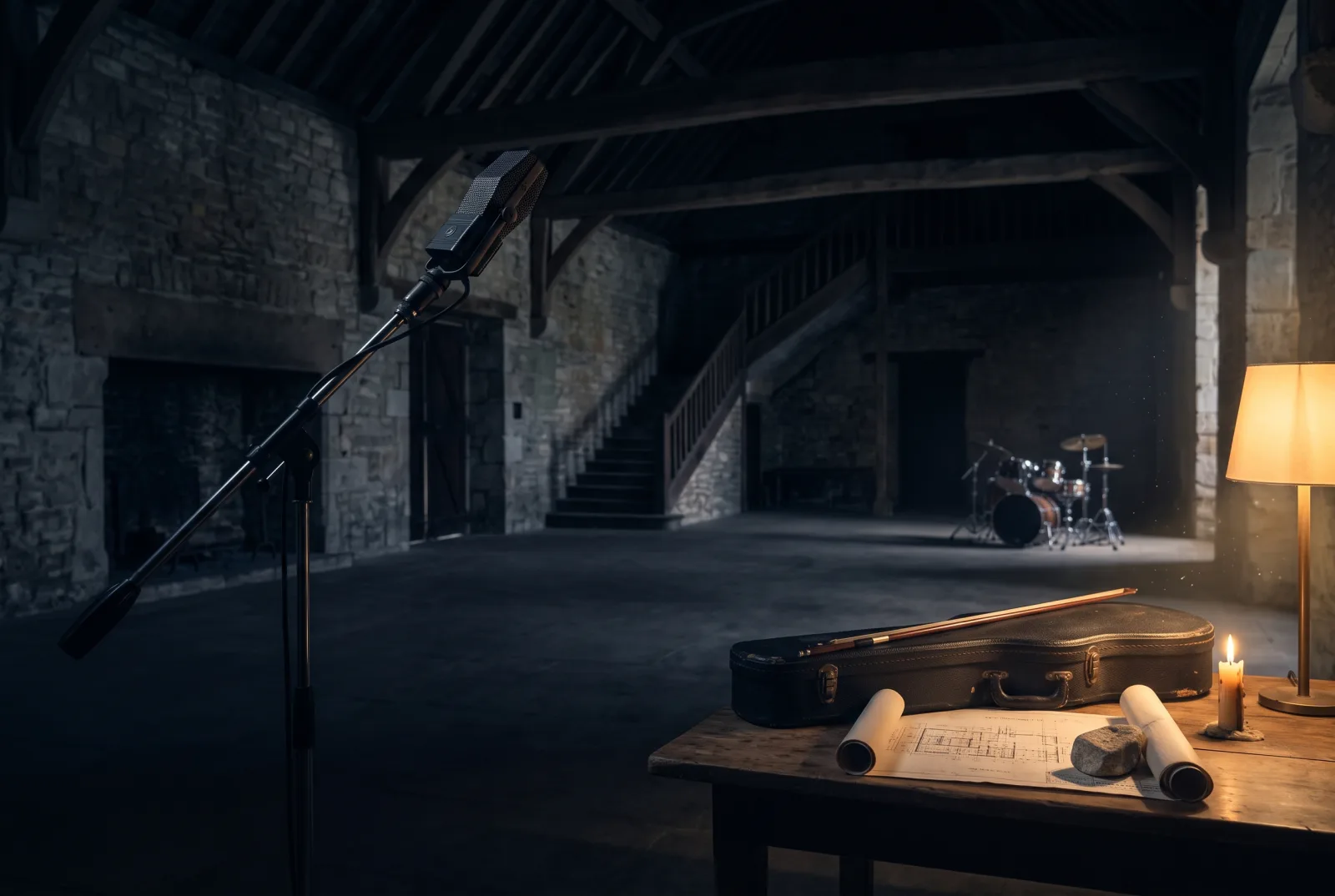
Ilustración: Rebobinados
If Robert Plant was the golden voice of Led Zeppelin, Jimmy Page was the architect who built the entire cathedral around that voice.
And here is what a lot of people do not know. Page was not just the guitarist of the most powerful band in rock: he was its producer, its sound designer, its technical brain.
He did not simply play guitar. He invented a new way for rock to sound.
The secret legend
Before Zeppelin, Page was already a legend almost nobody could name.
A self-taught prodigy, he was playing in public at thirteen, and by the time he was a little past twenty he was one of the most in-demand session guitarists in London: the anonymous musician who recorded, without appearing on the sleeve, on an endless run of British pop and rock records.
He passed through the Yardbirds between 1966 and 1968, and when that band fell apart he put together his own. He recruited an unknown singer, Robert Plant; a brutal drummer, John Bonham; and a brilliant multi-instrumentalist, John Paul Jones.
Led Zeppelin was born, and with it, heavy rock.
The producer
What Page did as a producer is what sets him apart from any other guitarist.
He financed and produced Zeppelin's first album himself, with less than eighteen hundred pounds out of his own pocket and about thirty-six hours of studio time — mixing included — spread across a few weeks in the autumn of 1968. He already had his revolutionary ideas.
The most famous one: instead of sticking the microphone right up against the instrument, he moved it away, to capture the sound of the whole room.
The extreme case is "When the Levee Breaks". Bonham's drums were recorded at the foot of a stairwell, in a country house, with two microphones hanging a floor above — an idea Page worked out with engineer Andy Johns. That is why it sounds like cannon fire, and why producers are still trying to imitate it.
He stacked layer upon layer of guitar until he had what he called an army of guitars. He pioneered backwards echo, phasing, a pile of studio tricks that are everyday business now and that in 1970 nobody else had thought of.
Page did not record songs: he sculpted the space, the weight and the texture of sound.
The riffs
And then there are the riffs, which are immortal.
"Whole Lotta Love", "Kashmir", "Black Dog", "Immigrant Song", and the writing of "Stairway to Heaven". Guitar phrases so perfect and so heavy that they defined what hard rock could be, and that often place him as the greatest guitarist in the history of rock.
His image set a standard too: the Les Paul slung ultra low, the double-neck guitar, the suit with dragons, and above all the violin bow he drew across the guitar strings to pull ghostly sounds out of it, as on "Dazed and Confused".
He drank from Mississippi Delta blues, from British folk and from the scales of the East and North Africa — "Kashmir" is pure that — and fused it all into something new.
The dark streak
There was also in Page a dark, mysterious side that fed the band's aura.
He was fascinated by the occult and by the figure of the British occultist Aleister Crowley. He collected his objects, and in 1970 he bought Boleskine, Crowley's old house on the shores of Loch Ness, which he kept until 1992.
That esoteric side — the four symbols on the fourth album, the mysticism of some of the lyrics — was, in part, his doing.
Over time, drug use caught up with him, affecting his health and his grip on the band.
After the end
The end came with Bonham's death, in 1980, which dissolved Led Zeppelin.
Page shut himself away in grief for almost two years. Then he came back slowly: film soundtracks, projects with other singers, a much celebrated reunion with Plant in the nineties, and Zeppelin's one-off reunion in 2007.
Today, past eighty, he lives a quieter life, dedicated to preserving and remastering his band's work.
The blueprint of the building
He should be remembered for what he was: not one more guitarist, but the architect of a sound.
Half craftsman and half sorcerer, a man who not only played guitar like few others, but who designed, nut by nut, a new way for rock to sound heavy and magical at the same time.
Every hard band that came after works inside a building whose blueprint he drew.
Put on "Kashmir", "Whole Lotta Love" or "When the Levee Breaks", and you will not just hear a great musician: you will hear a great design. The riffs, yes, but also the space, the echo, the weight.
A self-taught kid who, with a violin bow, an obsession with the occult and Mississippi blues, ended up being the greatest architect rock has ever had.
Sources
James Patrick "Jimmy" Page (Heston, England, 9 January 1944), guitarist, songwriter and producer. A self-taught prodigy, he was one of the most in-demand session guitarists in London in the mid-sixties; he was a member of The Yardbirds (1966-1968), initially as bassist, and after their break-up he founded Led Zeppelin in 1968 alongside Robert Plant, John Paul Jones and John Bonham. He produced and financed the debut album, recorded at Olympic Studios between September and October 1968: according to Page himself, it cost about 1,782 pounds and took around 36 hours of studio time including the mix. As a producer he introduced techniques that are standard today: ambient miking — the drums on "When the Levee Breaks" were recorded in the stairwell at Headley Grange, with two Beyerdynamic M160 microphones placed on the upper floor, a solution worked out with engineer Andy Johns —, guitar multitracking ("army of guitars"), backwards echo and phasing effects. Author of classic riffs ("Whole Lotta Love", "Kashmir", "Black Dog", "Immigrant Song") and co-author of "Stairway to Heaven"; he is regularly considered one of the greatest guitarists in history. He used a violin bow on the strings, for example on "Dazed and Confused", and fused blues, folk and Eastern and North African influences. A collector of material relating to the occultist Aleister Crowley, in 1970 he bought Crowley's former house, Boleskine, on the shores of Loch Ness, and sold it in 1992. Drug use affected his health in the band's final years. After Bonham's death (1980) and the dissolution of Led Zeppelin, he developed projects such as The Firm, Coverdale-Page and Page and Plant, as well as the Led Zeppelin reunion in 2007. Externally authored text, edited and verified for Rebobinados. Interpretations of the meaning of his work are offered as the author's reading. No song lyrics are reproduced, for copyright reasons. Data gathered from AllMusic, MusicRadar, American Songwriter, Rolling Stone, Wikipedia and other press coverage.
Keep rewinding
90s
hard rock
Lenny Kravitz
He doesn't play that guitar
The riff of "Are You Gonna Go My Way" (9 March 1993) is not played by him: the guitar is Craig Ross's, the song is co-written with him and the Academy nominated them both for Best Rock Song in 1994. "Always on the Run" was written by Slash for Guns N' Roses. And one of his four straight male rock Grammys, the one of 23 February 2000, he won with "American Woman", by The Guess Who, from which he removed the guitar solo.
60s
hard rock
Steppenwolf
The motorcycle was a Ford Falcon
The century's biker anthem was not written by the band that sings it, and it was not about a motorcycle: Mars Bonfire wrote "Born to Be Wild" as a folk ballad about his battered Ford Falcon, and he had left the group in June 1967, before the name Steppenwolf existed. "The Pusher" is Hoyt Axton's, Easy Rider dropped it in as a temporary track, and the single stalled at no. 2 on the Hot 100 in 1968.
00s
hard rock
Thirty Seconds to Mars
The seven-year law
In August 2008, EMI sued them for thirty million dollars for breaching a 1999 contract they had signed before releasing a single record. They defended themselves with a Californian employment law that voids contracts of more than seven years, closed a settlement on 28 April 2009 and signed with the same label again. The Guinness record they ended up with is not a box-office one: it is three hundred and nine concerts on a single tour.
Rewind with us
Comments · 0
No one has commented yet. Open the conversation.