
Korn
A failed guitar and a brand-new genre
By Rebobinados · Published on September 15, 2026
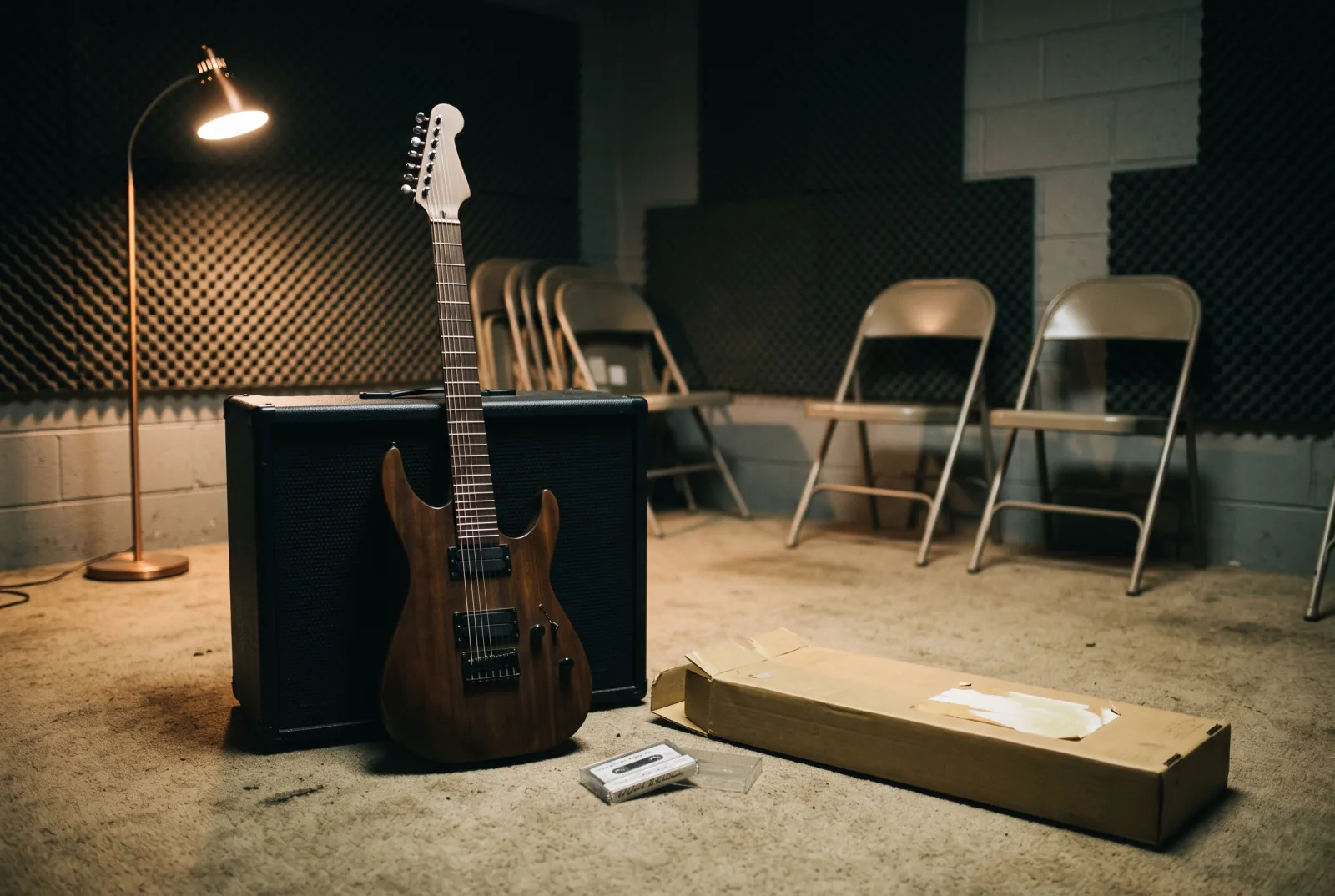
Ilustración: Rebobinados
Korn's first album, from 1994, opens with a guitarist scraping the strings, a voice asking whether you are ready, and a riff that founded an entire genre. Few bands can say they invented a sound; Korn can say they invented one that a whole decade of music hung from, Slipknot downwards. Before them, that low, sick, dragging weight did not exist. After them, it was everywhere. That is the greatness, and everything else is tasty detail around it.
Let us start with the strangest part, which is the guitar.
The instrument they were told was useless
The legend says Korn invented the seven-string guitar. It is not true, and the truth is better. The first mass-produced seven-string was an Ibanez model from 1990, designed for Steve Vai, a virtuoso. It was meant for the opposite of what Korn did with it: for playing higher, faster, further up the neck. It sold so badly that in 1995 Ibanez did not build a single unit. Commercially, it was a flop.
Korn used it backwards. Not to go up, but to go down: they tuned down, almost sunken, and stayed on the low string, the one nobody used. Two lads from Bakersfield had been told that guitar was no good for making riffs. With it, they made the riff that defined a decade. In 1996 Ibanez had to start building it again because suddenly everybody wanted one, and in 2001 the company gave the two guitarists their own model. They turned a virtuoso's failed instrument into the tool of a genre. That is no small thing: it is exactly what people who invent something do.
The success that did not arrive all at once
Something else that gets told wrong: that nu metal exploded overnight. Quite the opposite, and that is what makes it more admirable. The album came out in October 1994 and did not enter the United States album chart until February 1996. Sixteen months. It took more than two years to go platinum. It had no radio single and no video in rotation. The touring sold it, city by city, venue by venue, convincing people one at a time.
Think about it: they built a cultural phenomenon with no help from the radio, purely by climbing onto a stage every night until the whole country caught it. The successes that take time are the ones that stay. This one took its time, and it has not gone away in thirty years.
The song at the door
And yes, the story of "Blind", the track that opens the album, has to be told, because it is true and because telling it properly honours the band. That song came from before Korn. Jonathan Davis, the singer, brought it from SexArt, a local Bakersfield group where it was already played, with that same opening. When three musicians went looking for a singer and took Davis away, the song went with him.
Korn did not copy it: they finished it. They gave it a longer intro, a bass line, an ending, and turned it into the front door of a new genre. At first the original writers were not in the credits, and it took ten years for them to appear in print; today the song is credited to seven people, the five in Korn and the two from SexArt, as it should be. That they were recognised, even late, is what sets it right. The song at the door had two more pairs of hands than the sleeve admitted, and now it admits them.
The rest of the album, mind you, is entirely theirs, and it is the one that changed music. The door was borrowed; the whole house they built themselves.
The name from a toy shop
While we are on legends: the name does not come from any deep darkness. They ruled out "corn", and someone suggested spelling it with a K and a backwards R, copying the logo of the toy shop where several of them had worked as kids. The drummer himself summed it up without mercy: the music makes the name, because Korn is a silly name. He was right. The silly thing turned fearsome because what was playing behind it was enormous.
The one who said goodbye from a pulpit
There is one departure from a band that is like no other, and it ends in redemption. In February 2005, the guitarist Brian Welch left Korn. He did not announce it by press release: he told it himself in front of some ten thousand people, spread across three services at a church in Bakersfield, speaking about his methamphetamine addiction and his conversion. He was baptised in the River Jordan a month later.
The story could have ended there, like so many. But it did not. Welch recovered, came back seven years later, played "Blind" with them at a festival in 2012, officially rejoined in 2013 and is still in the band. He left to save his life and, once he had saved it, he came home. Not every exit in metal ends with the musician back, alive and on stage. This one did.
What to remember
Korn took a guitar they were told was useless and founded a genre with it. They built a phenomenon without radio, on touring alone, through sixteen months of stubbornness. They opened their album with a song that came from another group, and ended up giving its authors the credit they deserved. They are named after a toy shop. And they lost a guitarist who left from a pulpit and came back years later, whole.
None of that takes anything away from them, quite the opposite: the sound was theirs, and a whole decade of music came after it. Remember it like this: the album that founded nu metal starts with a borrowed song, but the genre that door opened was, from beginning to end, their own invention.
This piece mentions drug addiction. If you or someone you know is struggling with alcohol or drug use, in Chile SENDA's Drugs and Alcohol helpline answers free of charge 24 hours a day on 1412.
Sources
Korn, an American band formed in Bakersfield, California, in 1993, made up of Jonathan Davis (vocals), James "Munky" Shaffer and Brian "Head" Welch (guitars), Reginald "Fieldy" Arvizu (bass, 1993-2021) and David Silveria (drums, 1993-2006); since 2007 the drummer has been Ray Luzier and since 2021 the bass has been played by Roberto "Ra" Díaz. All of them are alive. Before Korn, Jonathan Davis sang in SexArt, a Bakersfield group that also featured the guitarist Ryan Shuck and the drummer Dennis Shinn. "Blind", the track that opens the debut album "Korn" (11 October 1994), came from SexArt's repertoire; Shuck and Shinn claimed authorship and the song is credited to seven writers, although that credit did not appear publicly until the compilation "Greatest Hits Vol. 1" (2004). Dennis Shinn is also among the writers of "Daddy", the closing track of the same album. The album did not enter the Billboard 200 until February 1996, sixteen months after its release, reached number 72 and was certified platinum in January 1997 and double platinum in November 1999. The group's name came from the word "corn", with the K and the inverted R taken from the logo of the Toys R Us chain, where several members had worked. The first mass-produced seven-string electric guitar was the Ibanez Universe of 1990, Steve Vai's signature model; its production was halted in 1995 because of low demand and resumed in 1996 after its adoption by Korn and other bands, and in 2001 Ibanez launched the K7 model for Shaffer and Welch. Brian Welch announced his departure from the band on 22 February 2005 before the congregation of the Valley Bible Fellowship in Bakersfield, explaining his methamphetamine addiction and his religious conversion; he was baptised in the River Jordan on 10 March 2005, played with the group again on 5 May 2012 and officially rejoined on 2 May 2013. Korn have won two Grammy awards from eight nominations. Slipknot have their own profile in this series. A Rebobinados rewrite of previously verified research; interpretations are offered as the author's reading. No song lyrics are reproduced, for copyright reasons. Information drawn from Wikipedia, Billboard, RIAA, Songfacts, Loudwire, Blabbermouth, guitar.com, Guitar World and other coverage.
Keep rewinding
10s
metal
Bring Me the Horizon
Twenty years to get back to the scream
Bring Me the Horizon started in 2006 with a deathcore record and their turn did not happen in 2013: the leap to metalcore was in September 2008 and the synthesisers and clean vocals arrived in October 2010. Jordan Fish, eleven years in the band, was the one who put in the electronics. On 10 July 2026 they re-recorded that first record for its twentieth anniversary, with Oli Sykes back on the guttural scream.
00s
metal
Staind
The sleeve that nearly cost them everything
In October 1997, Fred Durst tried to pull Staind off the bill at the Webster Theatre in Hartford over the sleeve of their home-made record; then he listened to them and signed them. In 2001, Break the Cycle debuted at number one on the Billboard 200 and "It's Been Awhile" spent sixteen weeks at number one on the Modern Rock. Jon Wysocki, founding drummer, died on 18 May 2024.

90s
metal
Marilyn Manson
The lawsuit he withdrew while paying
The triad of Antichrist Superstar, Mechanical Animals and Holy Wood, and a file that is still open: two out-of-court settlements, one sworn retraction, the prosecutor's office that ruled out charges in January 2025 on statute-of-limitations grounds, the defamation suit he withdrew while paying 327,000 dollars and a jury trial set for November 2027.
Rewind with us
Comments · 0
No one has commented yet. Open the conversation.