
Lady Gaga
Under the costume, a piano
By Rebobinados · Published on September 2, 2026
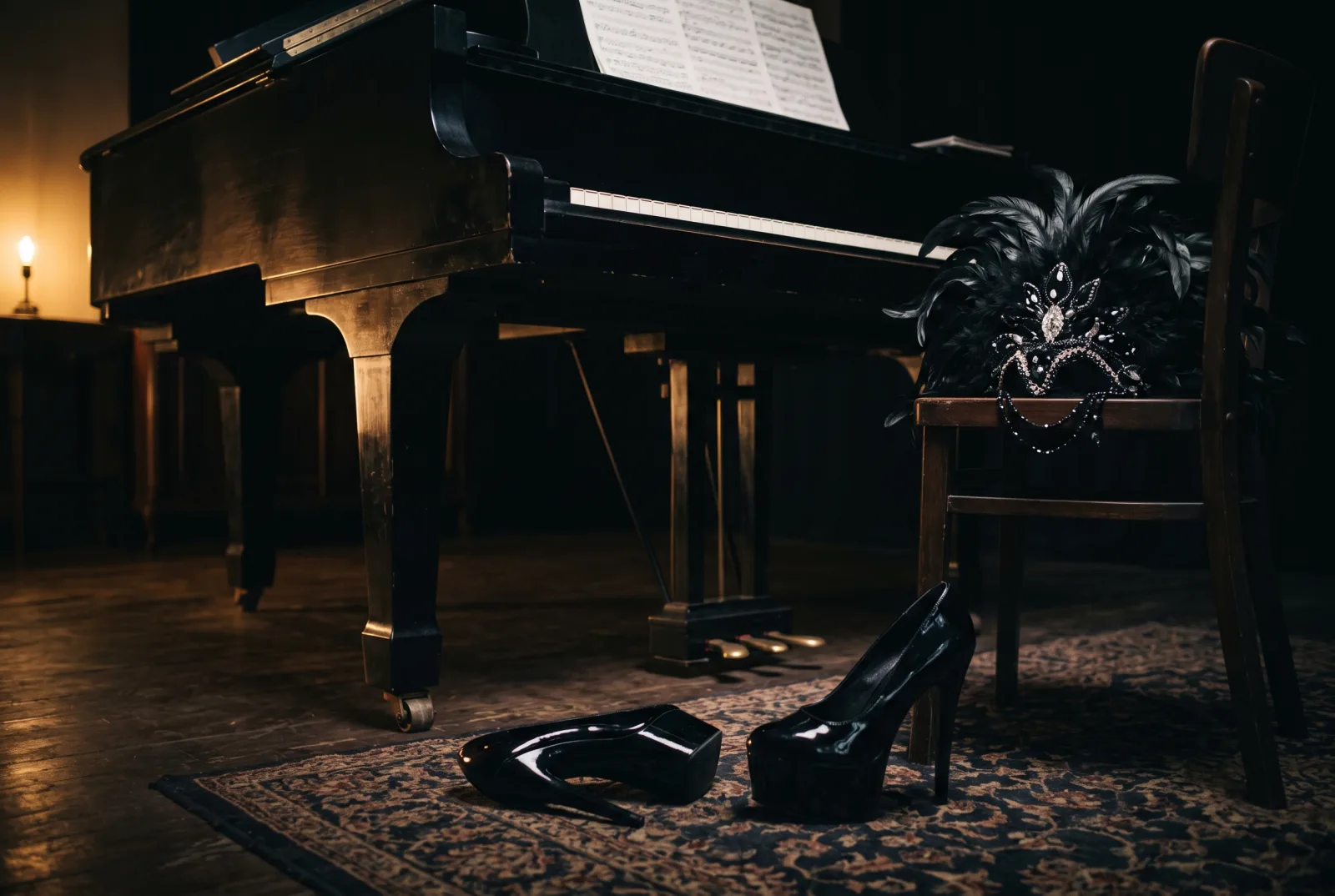
Ilustración: Rebobinados
Lady Gaga appeared at the end of the two thousands like an explosion: impossible outfits, delirious videos, and electronic pop songs that stuck from the first second.
She looked like a provocateur, a shock artist, a machine for extravagance.
That reading misses the most important thing: underneath the costume there was a pianist who had been writing her own songs since she was thirteen.
Piano at four years old
Before she was Lady Gaga she was Stefani Germanotta, a New York girl who started playing the piano at four because her mother wanted her to be, in her words, a cultured young woman. She learned by ear, and always said she preferred it to reading the score.
She was no amateur. She wrote her first piano ballad at thirteen, played bars and open mic nights at fourteen, and in 2003, at seventeen, she entered CAP21, the musical theatre conservatory of New York University's Tisch School of the Arts, through early admission.
She did not finish. She left in 2005, halfway through her second year, with a deal: her father would pay her rent for twelve months and, if nothing came of it in that time, she would go back to class.
Which means that the queen of electronic pop was, at bottom, a trained pianist and songwriter, someone who knew about harmony and melody. Not a manufactured figure.
And the name the world knows her by hides a tribute that explains her: it comes from "Radio Ga Ga", by Queen.
It is worth being precise about how, because it tends to be told wrong. She did not give it to herself: it was given to her by her producer Rob Fusari, who compared her to Freddie Mercury and sang her that song every time he saw her walk into the studio. He also maintains that it was his phone's autocorrect that turned "Radio" into "Lady"; she tells the story without that detail.
And the song is not Mercury's either, even though he sings it. It was written by Roger Taylor, the drummer, after hearing his small son come out with "radio ca-ca" in a car in Los Angeles, about something on the radio he did not like. Mercury rebuilt it as an arranger, but the credit stayed entirely with Taylor.
The real chain is better than the legend: a child mumbling, the drummer of Queen, a phone's autocorrect, and the name of the biggest pop star of her generation.
One way or another, the clue was already there in the name: she came from the tradition of theatrical, ambitious pop-rock, not from disposable pop.
Conquering with the mask
Her rise was meteoric and not without blows. Def Jam signed her in September 2006 and dropped her three months later.
In 2008, with "The Fame" and songs like "Just Dance" and "Poker Face", she exploded worldwide, and with "Bad Romance" she became the biggest pop star on the planet.
What set her apart was the constant reinvention and the visual ambition: every appearance was a spectacle, every video a little film, every outfit a calculated provocation.
She used extravagance with a purpose, not on a whim: to talk about fame, about identity, about the freedom to be different.
And that is where she built her strongest bond. She called her fans "little monsters" and spoke directly to those who felt odd, sidelined, outside the mould, to tell them that this was beautiful. "Born This Way", from 2011, became a banner of pride.
Like Bowie before her, she turned extravagance into a refuge for those who have no place in the normal world.
Taking off the mask
And here is the turn that makes her truly great.
Once she had conquered everything with her character, she began to show what lay underneath.
In September 2014 she released "Cheek to Cheek", a whole album of standards alongside Tony Bennett, who was eighty-eight: Cole Porter, the old American songbook. She proved that voice could hold its own, without tricks, in the most demanding tradition.
Then came the cinema. In 2018 she starred in "A Star Is Born" opposite Bradley Cooper, singing with a rawness stripped of all artifice, and "Shallow" won the Oscar for best original song in 2019.
The woman in the meat dress turned out to be a performer capable of making people cry without a single costume.
That was her deepest message: the extravagance was never there to hide a lack of talent, but quite the opposite. It was the wrapping chosen by someone who had so much she could afford to play with the form.
Back into the costume, with nothing to prove
A third movement was missing, and it arrived years later.
When nobody was asking her for proof any more, she went back to maximum pop, the pop of impossible outfits and giant choruses. "Mayhem", from 2025, entered at number one on the Billboard 200.
At the Grammys of 1 February 2026 she arrived with seven nominations, her personal record, and took Best Pop Vocal Album for "Mayhem" and Best Dance Pop Recording for "Abracadabra".
First she conquered with the costume, then she showed what was underneath, and in the end she put it back on because she felt like it. That last step can only be taken by someone who has nothing left to prove.
What to remember
Lady Gaga is proof that you do not have to choose between being a spectacle and being a real artist.
Put on "Bad Romance", "Poker Face", "Born This Way" or "Shallow", and you will travel across the two faces of the same talent: the boldest, most visual pop queen of her era, and the musician of real craft capable of a jazz standard or a bare ballad that breaks your chest open.
A girl who played the piano at four, who inherited her name from a Queen song, who was rejected and got back up, who embraced all the monsters who did not fit, and who had the wisdom to conquer first with the costume, reveal the depth afterwards, and go back to the costume when she no longer needed to prove anything.
She was not just a provocateur. She was a complete artist who used provocation as one more tool.
Underneath the meat dress, there was always music. And good music.
Sources
Lady Gaga, real name Stefani Joanne Angelina Germanotta (New York, 28 March 1986), American singer, songwriter, producer and actress. She learned the piano from the age of four —her mother wanted her to be "a cultured young woman"—, wrote her first ballad at thirteen, performed in bars and open mic nights at fourteen, and in 2003, aged seventeen, entered the CAP21 programme of New York University's Tisch School of the Arts through early admission. Her stage name comes from "Radio Ga Ga", by Queen; it is worth being precise that she did not give it to herself: it was given to her by her producer Rob Fusari, who compared her to Freddie Mercury and sang her that song when he saw her walk into the studio. Fusari also maintains that his phone's autocorrect turned "Radio" into "Lady", a detail Gaga does not include in her version; in 2010 Fusari sued her for thirty million dollars, also claiming authorship of the name, a suit that was withdrawn that same year. Def Jam signed her in September 2006 and dropped her three months later; she then signed with Interscope and achieved worldwide fame with "The Fame" (2008, with "Just Dance" and "Poker Face") and "Bad Romance". She called her fans "little monsters" and with "Born This Way" (2011) created an anthem of LGBTQ+ pride. She recorded the standards album "Cheek to Cheek" with Tony Bennett in September 2014, when Bennett was 88, and starred in "A Star Is Born" (2018), whose song "Shallow" won the Oscar for best original song in 2019; she also won a Golden Globe for "American Horror Story: Hotel" in 2016. In February 2016 she performed a tribute to David Bowie at the Grammys with Nile Rodgers as musical director. Queen, Freddie Mercury, David Bowie, Madonna and Nile Rodgers have their own profiles in this series. Externally authored text, edited and verified for Rebobinados. Interpretations of the meaning of her work are offered as the author's reading. No song lyrics are reproduced, for copyright reasons. Information drawn from Biography, Grammy.com, Wikipedia and other coverage.
Keep rewinding

10s
pop
Bruno Mars
Eleven names in the credits
"Uptown Funk" came out on 10 November 2014 with six writers and today it has eleven. In February 2015 The Gap Band's publisher filed a claim over "Oops Up Side Your Head" in YouTube's copyright system —there was never a lawsuit— and on 28 April five names were added, with 17 % of the publishing. It happened weeks after the "Blurred Lines" verdict, and the song had been fourteen weeks at number one.

00s
pop
André Rieu
It was not from the jazz suite
The waltz with which André Rieu reached half the world is not from Shostakovich's Suite for Jazz Orchestra No. 2: it is from the Suite for Variety Orchestra, which the composer did not assemble, and it was born in 1956 as music for a Soviet film about settlers in Kazakhstan. The error comes from a misprint in volume 10 of the complete works (Muzyka, Moscow, 1984), corrected only in 2001. And the title "The Second Waltz" was invented by his wife, because the real one did not sell.

90s
pop
Daniela Mercury
She took the neighbourhood out of the song
"O Canto da Cidade" was written by Tote Gira, a composer from Nordeste de Amaralina who recorded the demo on a borrowed cassette, marking the beat on the door of a refrigerator; Mercury's team almost threw the tape away. She shares the credit because she deleted the references to the Pelourinho so that the song would serve all of Brazil. The album, from 20 September 1992, sold more than 2 million copies and nationalised axé. But she did not invent it: the name was a journalist's insult in 1987.
Rewind with us
Comments · 0
No one has commented yet. Open the conversation.