
Queen
The guitar his father built
By Rebobinados · Published on September 26, 2026
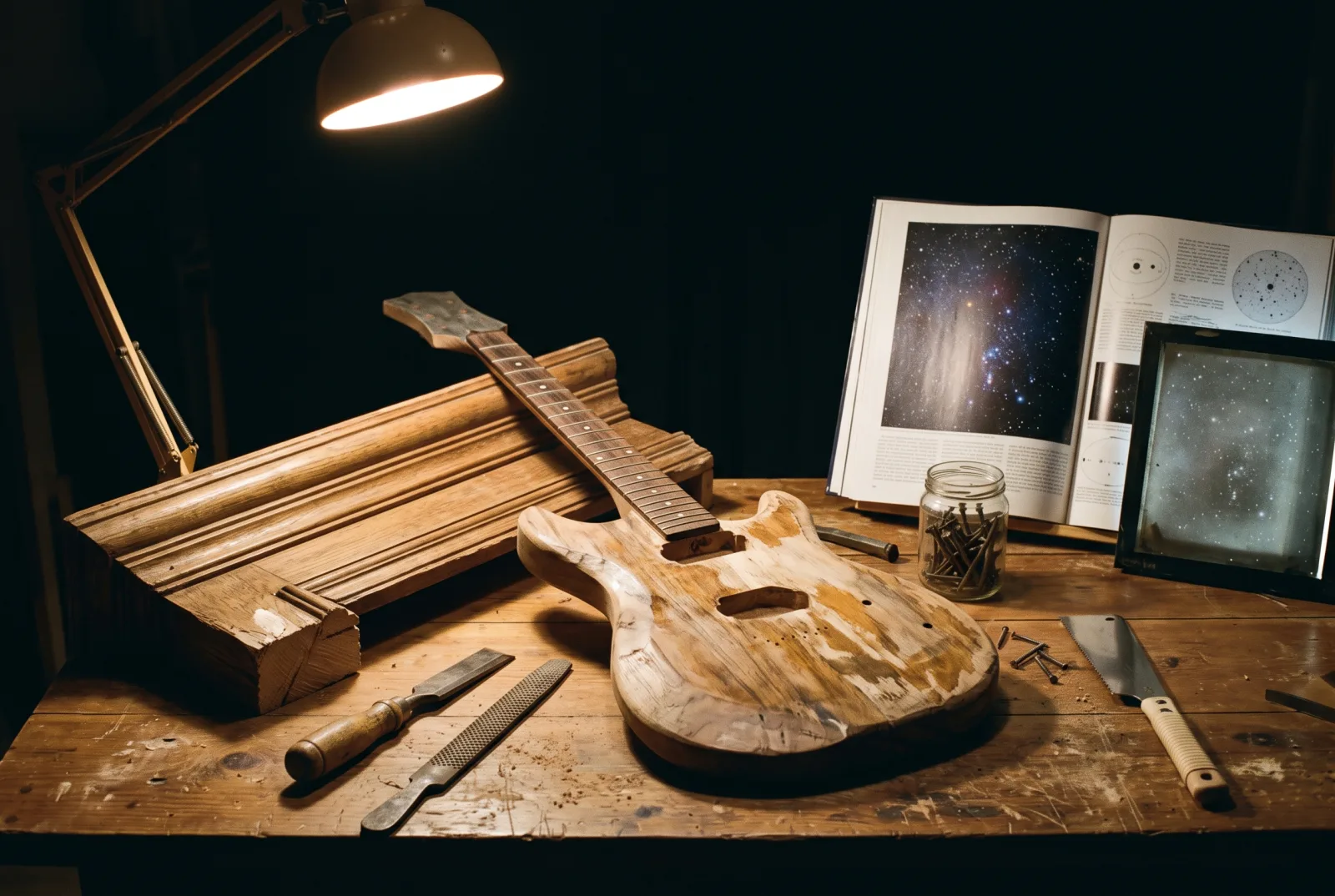
Ilustración: Rebobinados
We already covered Freddie Mercury in his own profile: the voice and the face of Queen, the greatest showman ever to walk onto a stage.
But Queen was far more than Freddie, and that is what makes the band odd among rock's greats.
In almost every group there is one genius and three sidemen. In Queen there were four songwriters, and one of them was also a real scientist.
He built the guitar with his dad
Brian May made by hand the instrument he played on almost everything Queen recorded.
He called it the Red Special, and he built it between August 1963 and October 1964, when he was sixteen, together with his father Harold, at home.
He carved the neck from the mantelpiece of a fireplace more than a hundred years old. The buttons were mother-of-pearl. The vibrato springs came from a motorcycle valve, and there are parts taken from knitting needles and from a bicycle luggage rack.
All those enormous solos, those layers of guitar that sound like an orchestra, came out of a homemade guitar built from whatever was lying around.
And the man who built it holds a doctorate in astrophysics
Brian May was working on his PhD at Imperial College London when the band took off, and he left it half finished.
He went back thirty-three years later. He submitted the thesis on 3 August 2007 — a study of radial velocities in the zodiacal dust cloud — defended it in a viva voce, and the revised version was approved in September. The degree was handed to him at the ceremony in the Royal Albert Hall, on 14 May 2008.
Since then he has worked with NASA on space missions, on New Horizons and on OSIRIS-REx.
The guitarist who built his own instrument with household tools turned out to be the same man who studies interplanetary dust. There is no better summary of the kind of mind that band had.
All four wrote
The usual thing in a group is that one or two write and the rest play. In Queen all four wrote, and all four signed anthems.
Mercury did "Bohemian Rhapsody" and "We Are the Champions". May wrote "We Will Rock You", that stomp and clap the whole world chants. Roger Taylor, the drummer, composed "Radio Ga Ga".
And John Deacon, the bassist, the quietest of the four, the one who barely spoke in interviews, wrote "Another One Bites the Dust", which went to number one in the United States and became one of the band's best-selling songs.
It is worth putting this precisely, because it tends to get exaggerated: not all of them reached number one on the British or American charts. "We Will Rock You" came out as a double A-side with "We Are the Champions", and that single stalled at number two in the United Kingdom and number four in the United States, where the side that appears on the charts is Mercury's. "Radio Ga Ga" was number one in eight countries, but only second in the United Kingdom.
It doesn't matter. The point stands whole: in Queen, the quietest member was capable of writing a worldwide hit. There were no passengers. All four were engines. In 2003 they entered the Songwriters Hall of Fame together.
No synthesisers
Queen had an obsession that is surprising today: in the credits of their first records they made clear, with an exclamation mark, that no synthesisers had been used.
It was a matter of craftsman's honour. At a time when the electronic keyboard was becoming fashionable, they took pride in the fact that those enormous sounds came from May's homemade guitar and from hours of work in the studio.
The rule lasted until 1980, when "The Game" broke it.
And all of that — the stacked harmonies, the walls of guitar, the songs built to be chanted — had a destination: the stadium. Queen understood like nobody else how to make a hundred thousand people sing together. Their Live Aid performance, in 1985, was voted the greatest live show in the history of rock.
What to remember
Queen is proof that a band can be a sum and not the shadow of one man.
Put on "Bohemian Rhapsody", "We Will Rock You", "Another One Bites the Dust" or "Somebody to Love", and you will hear something almost no group ever managed: four musicians each capable of writing an anthem, playing together with boundless ambition.
Behind the unrepeatable figure of Freddie Mercury there was a guitarist with a doctorate in astrophysics playing an instrument he put together with his father, a drummer who wrote hits and a shy bassist who wrote the most danceable song of them all.
Remember them that way: not as Freddie's group, but as the very strange band in which nobody was surplus.
Sources
Queen, British band formed in London in 1970 by Freddie Mercury (vocals, piano), Brian May (guitar) and Roger Taylor (drums), with John Deacon (bass) joining in 1971; May and Taylor came from the band Smile. Brian May built the "Red Special" guitar by hand together with his father, Harold May, between August 1963 and October 1964; the neck was carved from the mantelpiece of a fireplace roughly a hundred years old, and the instrument incorporates mother-of-pearl, springs from a motorcycle valve, knitting needles and parts from a bicycle luggage rack. May began a doctorate in astrophysics at Imperial College London in the early seventies and abandoned it for the band; he submitted his thesis, on radial velocities in the zodiacal dust cloud, on 3 August 2007, defended it in an oral examination (viva voce) and the revised version was approved in September 2007; the doctorate was conferred at the Royal Albert Hall ceremony on 14 May 2008 (the date of 24 August 2007 corresponds to the press announcement, not to the degree). He has collaborated with NASA on the New Horizons and OSIRIS-REx missions. All four members wrote hits: Mercury ("Bohemian Rhapsody", "We Are the Champions", "Killer Queen", "Somebody to Love"), May ("We Will Rock You", "Fat Bottomed Girls"), Taylor ("Radio Ga Ga") and Deacon ("Another One Bites the Dust", number one in the United States). It should be noted that "We Will Rock You"/"We Are the Champions" reached number two in the United Kingdom and number four in the United States, and "Radio Ga Ga" number two in Britain and sixteen in the United States, although it was number one in eight countries. All four entered the Songwriters Hall of Fame in 2003. Queen's first albums carried the note "No Synthesisers!" in the credits; the first synthesiser appears on "The Game" (1980). Their Live Aid performance (1985) was voted the greatest live show in the history of rock in a 2005 poll of musicians and industry professionals. Queen entered the Rock and Roll Hall of Fame in 2001. Freddie Mercury died in 1991 and has his own profile in this series. Externally authored text, edited and verified for Rebobinados. Interpretations of the meaning of their work are offered as the author's reading. No song lyrics are reproduced, for copyright reasons. Information drawn from Britannica, AllMusic, Wikipedia, Guitar World and other coverage.
Keep rewinding
90s
hard rock
Lenny Kravitz
He doesn't play that guitar
The riff of "Are You Gonna Go My Way" (9 March 1993) is not played by him: the guitar is Craig Ross's, the song is co-written with him and the Academy nominated them both for Best Rock Song in 1994. "Always on the Run" was written by Slash for Guns N' Roses. And one of his four straight male rock Grammys, the one of 23 February 2000, he won with "American Woman", by The Guess Who, from which he removed the guitar solo.
60s
hard rock
Steppenwolf
The motorcycle was a Ford Falcon
The century's biker anthem was not written by the band that sings it, and it was not about a motorcycle: Mars Bonfire wrote "Born to Be Wild" as a folk ballad about his battered Ford Falcon, and he had left the group in June 1967, before the name Steppenwolf existed. "The Pusher" is Hoyt Axton's, Easy Rider dropped it in as a temporary track, and the single stalled at no. 2 on the Hot 100 in 1968.
00s
hard rock
Thirty Seconds to Mars
The seven-year law
In August 2008, EMI sued them for thirty million dollars for breaching a 1999 contract they had signed before releasing a single record. They defended themselves with a Californian employment law that voids contracts of more than seven years, closed a settlement on 28 April 2009 and signed with the same label again. The Guinness record they ended up with is not a box-office one: it is three hundred and nine concerts on a single tour.
Rewind with us
Comments · 0
No one has commented yet. Open the conversation.