
Tony Bennett
The room slowly fading
By Rebobinados · Published on September 5, 2026
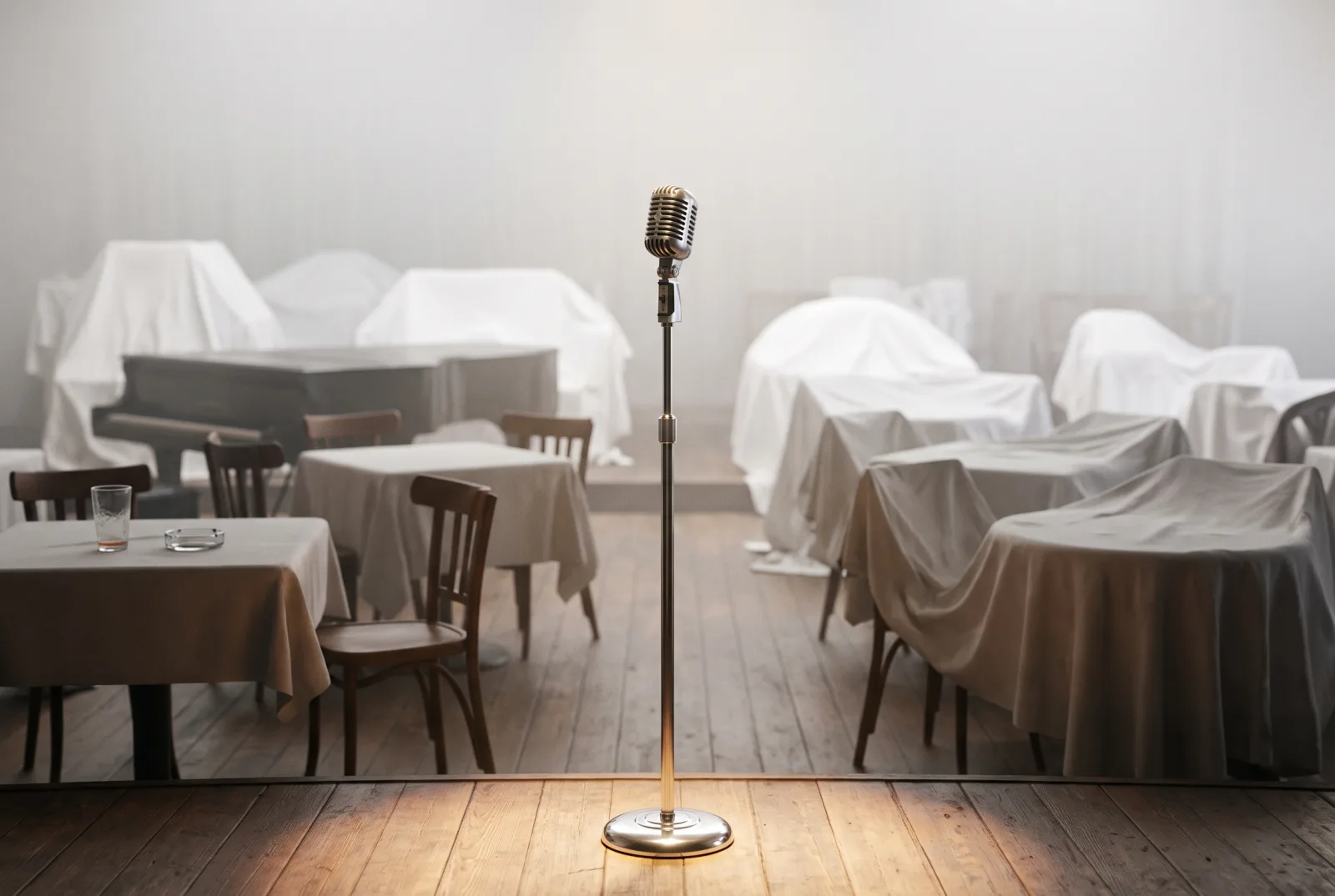
Ilustración: Rebobinados
In August 2021, at Radio City Music Hall, Tony Bennett was on stage when Lady Gaga walked out.
He had spent weeks of rehearsals without saying her name. He could not remember it.
He saw her appear and said: "Wow, Lady Gaga!".
Gaga later described what that instant meant: it was the first time in a long while that Tony had said her name.
What was left when there was almost nothing left
He had been diagnosed with Alzheimer's in 2016. It was made public in 2021.
Between those two dates he recorded a whole album.
"Love for Sale", with Lady Gaga, was put down between 2018 and early 2020, with the diagnosis hanging over him. It is a complete tribute to Cole Porter, and it is sung by a man who often no longer recognised the room he was in.
That is what makes his story unlike anyone else's. The memory of his life was going and the memory of the songs was not. The standards he had been singing for seventy years were still there, intact, when almost everything else had been erased.
Those Radio City concerts — on 3 and 5 August 2021, for his ninety-fifth birthday — were his last public appearances.
The stubbornness that cost him his career and gave it back
To understand why those songs were so deep down, you have to go back.
When rock and roll swept everything away in the fifties and sixties, many singers of his kind hurried to modernise, to record fashionable things so as not to be left out.
Bennett refused. He went on singing the great standards, the well-written songs of the previous decades, convinced that quality does not go out of fashion.
It cost him dearly. In the seventies his career collapsed.
And in the long run it proved him right. Fashions came and went; he was still there. In 1994 he stood before MTV's young audience without changing a single thing about what he did, and won them over by being exactly who he had always been. That record won the Grammy for album of the year.
Frank Sinatra, his friend, had said it in a Life interview in April 1965: for his money, Tony Bennett was the best singer in the business. Watching him moved him. He said Bennett was the one who got across what the composer had in mind, and probably a little more.
On that "last of the crooners" business
When he died, half the world said goodbye to him as the last of the great crooners.
It is a lovely formula and it is not literally true: Johnny Mathis, from the same school, outlived him. It is worth saying, because that is the sort of line that gets repeated until it turns into a fact.
What is true is more specific. He was the last of that generation to go on singing, working and on big stages, past the age of ninety. And the only one to make his final record with a pop star sixty years younger than him, and have it work.
What to remember
Tony Bennett is the proof that staying faithful to something good pays off in the end, even if it takes decades.
Put on "I Left My Heart in San Francisco", from '62, and then put on anything from "Love for Sale", recorded almost sixty years later. It is the same way of singing. He never changed it, not when it would have suited him, not when he could no longer remember where he was.
He died on 21 July 2023, at ninety-six.
Remember him like this: not as the elegant gentleman of the standards, but as the man whose whole life was being erased and who was left, right to the end, with the songs.
Sources
Anthony Dominick Benedetto, born in New York on 3 August 1926 and died on 21 July 2023, at ninety-six. "I Left My Heart in San Francisco" (1962) was his signature song. His career collapsed during the nineteen-seventies after he refused to adapt his repertoire to the fashions of the day; his MTV Unplugged appearance (1994) earned him the Grammy for album of the year in 1995. Frank Sinatra stated in an interview published in "Life" magazine on 23 April 1965 that Bennett was, in his words, "the best singer in the business" — the commonly repeated formula "the best singer in the world" is a later variation. He recorded two albums with Lady Gaga: "Cheek to Cheek" (19 September 2014), number one on the Billboard 200 and a Grammy for best traditional pop vocal album, and "Love for Sale" (30 September 2021), a full tribute to Cole Porter recorded between 2018 and early 2020, his last studio record, with two Grammys. His Alzheimer's diagnosis came in 2016 and was made public in February 2021 in a profile in AARP magazine. His last public appearances were the "One Last Time: An Evening with Tony Bennett and Lady Gaga" concerts at Radio City Music Hall on 3 and 5 August 2021, for his ninety-fifth birthday; the episode in which he said Lady Gaga's name on seeing her come out on stage was documented in a "60 Minutes" report broadcast in June 2022. The widely used formula "the last crooner" should be qualified: performers from the same school, such as Johnny Mathis, outlived him. Lady Gaga, Frank Sinatra and Nat King Cole have profiles of their own in this series. Externally authored text, edited and verified for Rebobinados. Interpretations of the meaning of his work are offered as the author's reading. No song lyrics are reproduced, for copyright reasons. Information drawn from Life magazine, CBS News, Wikipedia and other coverage.
Keep rewinding

10s
pop
Bruno Mars
Eleven names in the credits
"Uptown Funk" came out on 10 November 2014 with six writers and today it has eleven. In February 2015 The Gap Band's publisher filed a claim over "Oops Up Side Your Head" in YouTube's copyright system —there was never a lawsuit— and on 28 April five names were added, with 17 % of the publishing. It happened weeks after the "Blurred Lines" verdict, and the song had been fourteen weeks at number one.

00s
pop
André Rieu
It was not from the jazz suite
The waltz with which André Rieu reached half the world is not from Shostakovich's Suite for Jazz Orchestra No. 2: it is from the Suite for Variety Orchestra, which the composer did not assemble, and it was born in 1956 as music for a Soviet film about settlers in Kazakhstan. The error comes from a misprint in volume 10 of the complete works (Muzyka, Moscow, 1984), corrected only in 2001. And the title "The Second Waltz" was invented by his wife, because the real one did not sell.

90s
pop
Daniela Mercury
She took the neighbourhood out of the song
"O Canto da Cidade" was written by Tote Gira, a composer from Nordeste de Amaralina who recorded the demo on a borrowed cassette, marking the beat on the door of a refrigerator; Mercury's team almost threw the tape away. She shares the credit because she deleted the references to the Pelourinho so that the song would serve all of Brazil. The album, from 20 September 1992, sold more than 2 million copies and nationalised axé. But she did not invent it: the name was a journalist's insult in 1987.
Rewind with us
Comments · 0
No one has commented yet. Open the conversation.