
Michael Jackson
The man in the mirror
By Rebobinados · Published on September 9, 2026
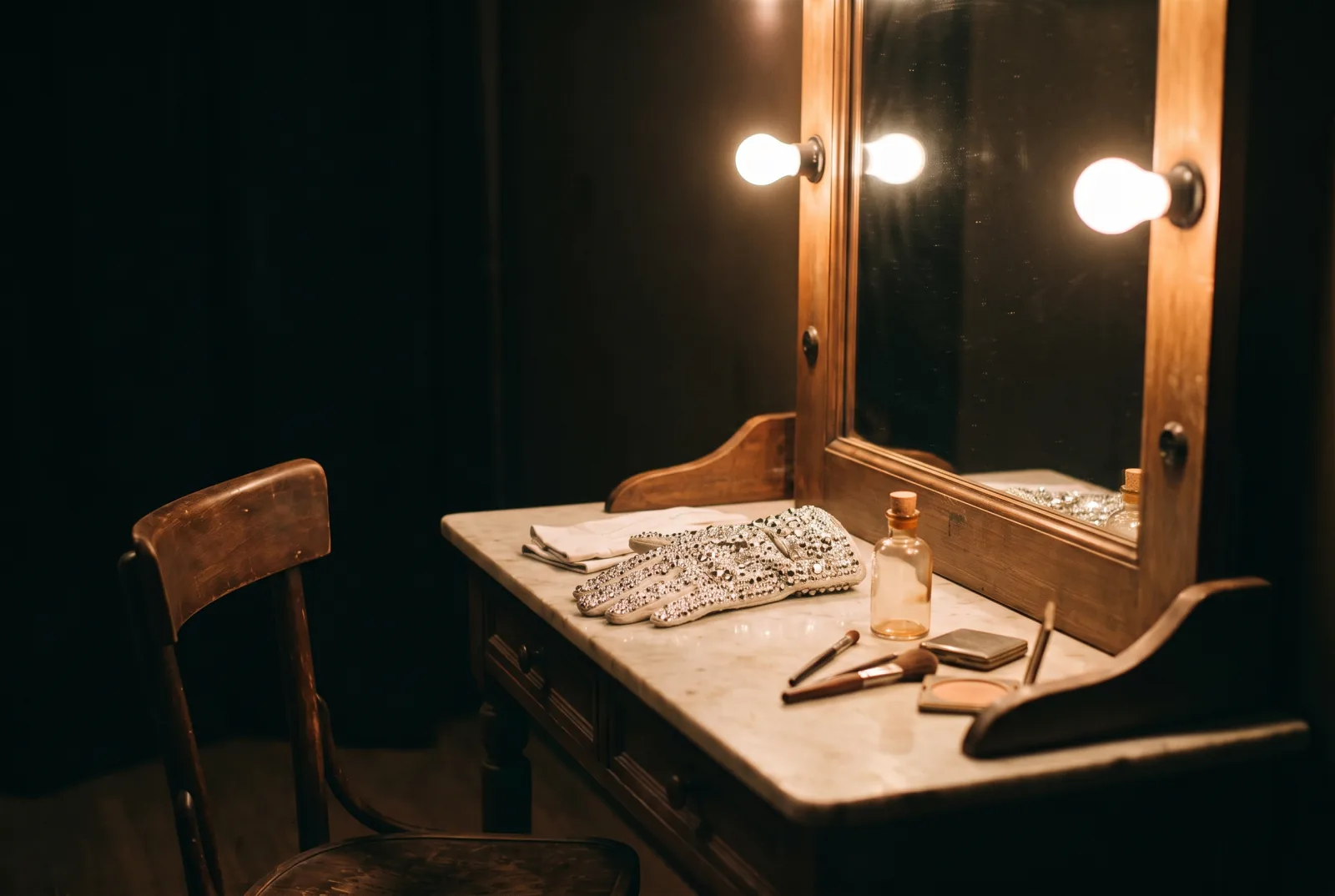
Ilustración: Rebobinados
Michael Jackson is probably the hardest figure in all of music to remember. Not for lack of facts, but because he is at the same time things that refuse to fit together.
He was one of the greatest artists who ever lived and a formative voice for an entire generation. And he is also a man carrying the gravest suspicions a human being can carry, suspicions that were never entirely cleared.
This text is not here to resolve that, because it cannot be resolved. It is here to hold both things at once, without closing them off in either direction.
Where the light and the shadow both begin
He was born in 1958 in Gary, Indiana, into a poor family, and was the child prodigy of the Jackson 5. Behind that band was his father, Joseph, who ran them with a brutal discipline. As an adult Michael said his father abused him physically and emotionally and that he was terrified of him. Several of his brothers have denied it.
What is not in dispute is that he was a professional at five or six. A child who worked while other children played, and who never had a childhood.
A good part of what followed — the Neverland ranch with its funfair, the obsession with childhood, the whole life — was a man trying to buy back the childhood that had been taken from him.
And there is the knot with no way out: that same wound is the place from which both the brightest and the darkest parts of his story spring. They do not separate cleanly.
Colossal
As an artist he was simply enormous. Off the Wall, then Thriller — the best-selling album in history — Bad, Dangerous. The moonwalk. Videos that permanently reinvented what a video could be. He broke MTV's racial barrier at a time when the channel barely programmed Black artists. They called him the King of Pop and it was not press exaggeration.
And there was a paradox in him that made him unique: a fragile speaking voice, high, almost childlike, shy. That same person, on a stage, became a force capable of moving entire stadiums to tears in any corner of the planet.
The most vulnerable voice in the world concealed the greatest power.
What the scandal buried
There is a part of him worth rescuing, because it is the part that makes him, for millions, more than a singer.
Michael Jackson did not just make you dance: he taught you. "Heal the World". "Earth Song", about caring for the planet and the animals. "Man in the Mirror", that change begins by looking at yourself. "Black or White", that skin colour does not matter. "They Don't Care About Us", for the trampled. "We Are the World", which he co-wrote with Lionel Richie, against hunger.
For a generation of children whose parents worked themselves to the bone and had neither the time nor the words to teach them those things, Michael Jackson was the one who said them. His message was not filler. It was, in its way, a form of cultural fatherhood.
And that idea does not rest on any rumour. It rests on the songs, which are there and say what they say.
The war with the mirror
His body was another tragedy, and it is worth telling carefully, because it also gets caricatured.
His skin gradually lightened, and the explanation is not simply that he wanted to stop being Black: his dermatologist diagnosed him with vitiligo, a real condition that destroys skin pigment in patches. The same man who was lightening because of an illness wrote "Black or White".
What is true, and painful, are the surgeries, the increasingly extreme transformation of his face, the evident torment of someone who could not bear his own reflection, wounded since childhood by a father who mocked his nose.
Michael Jackson was at war with the mirror, and that war is his own tragedy, quite distinct from the easy caricature.
And perhaps that is why it touches us more than we admit. We live in a culture that worships beauty and treats youth as a virtue, where being at odds with your own body has stopped being unusual and become almost the norm. For Michael, as a child, that pressure came from a father. For a teenager today it comes from a phone full of perfect faces and filters that "improve" their own: a far crueller mirror, one that fits in a pocket and never switches off.
What we saw as an extreme, isolated case turned out to be commonplace.
What cannot be sidestepped
And then there is the thing this text will not sweep under the carpet.
Michael Jackson carries the gravest accusations there are: having abused children. The facts, stated plainly.
In 1993 there was a first allegation, which he settled financially in 1994. In 2005 he faced a criminal trial over another, long and heavily covered, and was acquitted on all fourteen counts: the jury found the prosecution had not proved its case. And in 2019, after his death, the documentary Leaving Neverland gathered the accusations of two men, Wade Robson and James Safechuck, who as children had been close to him — and who at the time had defended him, Robson even testifying for the defence at the 2005 trial — and who now described years of abuse. Michael could no longer answer; his family and his estate reject the claims outright.
The honest truth is that we do not know, and probably never will with certainty. He was never criminally convicted, and he was never simply cleared either. The suspicion is extremely grave and it never dispersed.
And here is the most unbearable thing in his whole story: the very thing that made him adored — his closeness to children, his identification with childhood — is the exact ground where the blackest suspicion lives. Purity and shadow occupy the same place. Anyone who tells you they can cleanly separate them, in either direction, is selling you something.
A fatherhood that is verifiable
There is, however, one fatherhood of his that is not suspicion but fact, and it is only fair to state it.
His three children — Prince, Paris and Bigi — grew up into sensitive, decent adults who remember him with love as a present and affectionate father, and who have defended him publicly. That is their testimony, and it counts. He covered their faces in public to give them what he had been denied: privacy, the chance to be children.
Whatever the unreachable truth of everything else, for those three, by their own account, he was a good father.
All of it is true at once
He died on 25 June 2009, aged fifty, of acute propofol intoxication, the anaesthetic he took in order to sleep. His personal physician was convicted of involuntary manslaughter. A man who never learned how to rest.
What he leaves behind cannot be filed in a single box. A genius who changed music for good. A cultural father who taught a generation to care about the world. A broken man at war with his body and his childhood. And a figure over whom a shadow falls that will never lift.
Loving his music does not absolve him. Distrusting the man does not erase the songs. Rebobinados is not here to judge him — the courts did not convict him, and we are neither a court nor his defenders. We are here to remember him whole.
Put on "Man in the Mirror" or "Heal the World" and you will hear the best he gave. And you will carry, at the same time, the weight of everything that cannot be resolved about the man who sang it.
That weight is the honest price of remembering Michael Jackson. There is no way to set it down, and perhaps there should not be.
Sources
Michael Joseph Jackson (Gary, Indiana, 29 August 1958 – Los Angeles, 25 June 2009), singer, songwriter and dancer, known as the "King of Pop". He died at 50 of cardiac arrest caused by acute propofol intoxication; his personal physician, Conrad Murray, was convicted of involuntary manslaughter. As a child he was a star of the Jackson 5 under the harsh discipline of his father, Joseph Jackson, whom Michael described as physically and emotionally abusive, something several of his brothers have denied. Solo he released "Off the Wall" (1979), "Thriller" (1982, the best-selling album in history), "Bad" (1987), "Dangerous" (1991) and "HIStory" (1995); he revolutionised the music video and his presence was decisive in breaking the racial barrier in MTV's programming. His work includes songs with social and environmental messages: "Heal the World", "Earth Song", "Man in the Mirror", "Black or White", "They Don't Care About Us" and "We Are the World", which he co-wrote with Lionel Richie. The lightening of his skin is attributed principally to vitiligo, diagnosed by his dermatologist Arnold Klein in the 1980s; he also underwent various surgeries. On the child sexual abuse allegations: in 1993 there was a first complaint, resolved by a financial settlement in 1994; at the criminal trial People v. Jackson (2005) he was acquitted on all fourteen counts; in 2019 the documentary "Leaving Neverland" gathered the accusations of Wade Robson and James Safechuck, who had previously defended him — Robson testified as a defence witness in 2005 — and which his family and his estate reject. He was never criminally convicted over these matters. His three children, Prince, Paris and Prince Michael II ("Bigi"), have publicly remembered and defended him as a dedicated father. Externally authored text, edited and verified for Rebobinados. This profile does not pass judgment on guilt or innocence regarding the allegations, which remain without criminal conviction and are disputed. Interpretations of the meaning of his work and of image culture are offered as the author's reading. No song lyrics are reproduced, for copyright reasons. Information drawn from Wikipedia, The Washington Post, NPR, Rolling Stone and other press coverage.
Keep rewinding

10s
pop
Bruno Mars
Eleven names in the credits
"Uptown Funk" came out on 10 November 2014 with six writers and today it has eleven. In February 2015 The Gap Band's publisher filed a claim over "Oops Up Side Your Head" in YouTube's copyright system —there was never a lawsuit— and on 28 April five names were added, with 17 % of the publishing. It happened weeks after the "Blurred Lines" verdict, and the song had been fourteen weeks at number one.

00s
pop
André Rieu
It was not from the jazz suite
The waltz with which André Rieu reached half the world is not from Shostakovich's Suite for Jazz Orchestra No. 2: it is from the Suite for Variety Orchestra, which the composer did not assemble, and it was born in 1956 as music for a Soviet film about settlers in Kazakhstan. The error comes from a misprint in volume 10 of the complete works (Muzyka, Moscow, 1984), corrected only in 2001. And the title "The Second Waltz" was invented by his wife, because the real one did not sell.

90s
pop
Daniela Mercury
She took the neighbourhood out of the song
"O Canto da Cidade" was written by Tote Gira, a composer from Nordeste de Amaralina who recorded the demo on a borrowed cassette, marking the beat on the door of a refrigerator; Mercury's team almost threw the tape away. She shares the credit because she deleted the references to the Pelourinho so that the song would serve all of Brazil. The album, from 20 September 1992, sold more than 2 million copies and nationalised axé. But she did not invent it: the name was a journalist's insult in 1987.
Rewind with us
Comments · 0
No one has commented yet. Open the conversation.