
Michael Kiwanuka
The Name in Capitals
By Rebobinados · Published on August 25, 2026
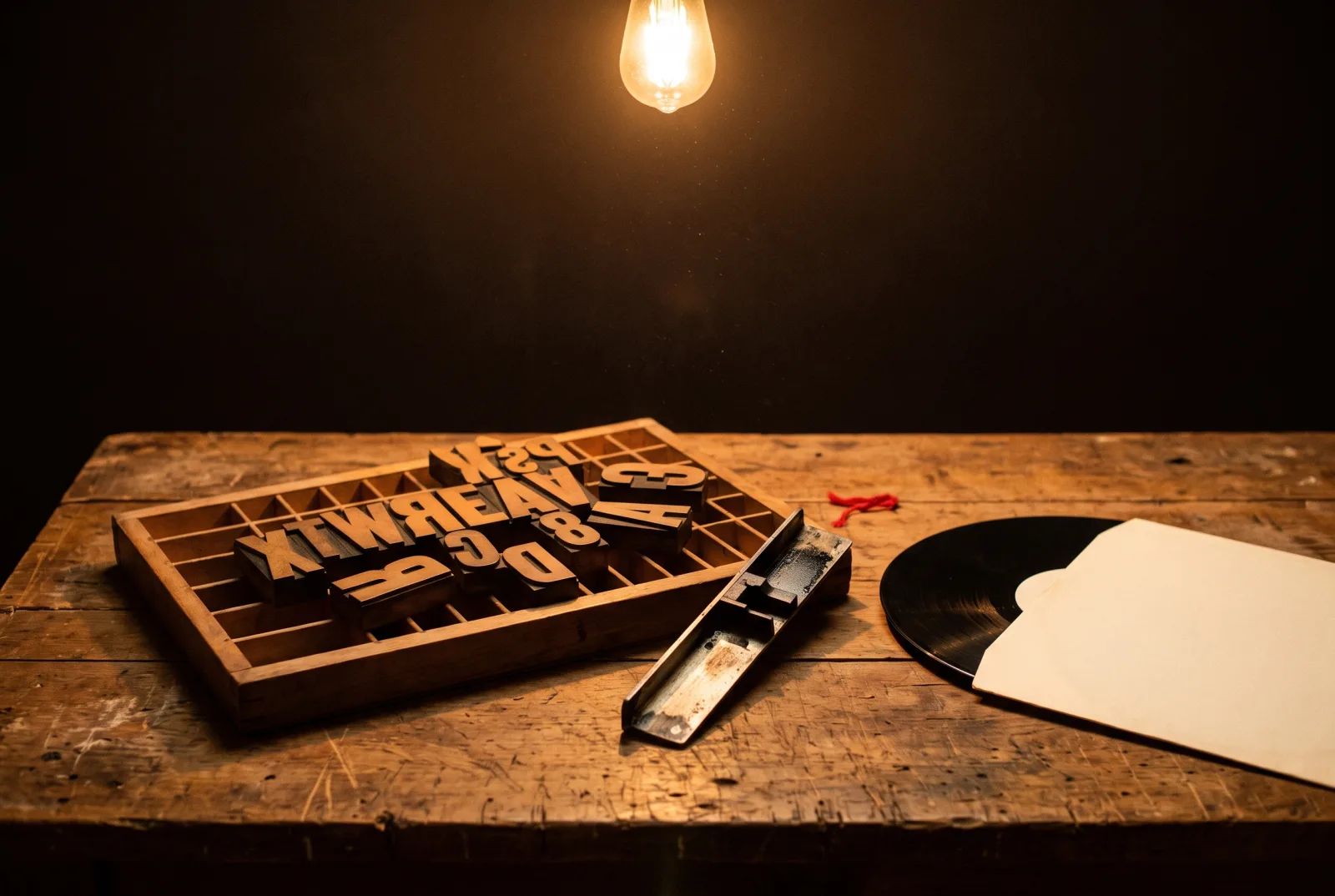
Ilustración: Rebobinados
There is a voice that sounds as if it came from 1972. Warm, worn in exactly the right places, the kind you associate with Bill Withers, with Curtis Mayfield, with Marvin Gaye: vinyl soul, strings and horns, from an age when music was made slowly. But that voice does not come from 1972. It comes from a young Londoner who started recording a little over a decade ago, and whom you probably don't know yet. His name is Michael Kiwanuka, and he is worth knowing — not only for the way he sings, but for what he did with his name.
Kiwanuka was born in north London, the son of Ugandan parents who had escaped Idi Amin's reign of terror in the seventies. A Black child with an African surname, raised in white neighbourhoods, who as a boy fell in love not with soul but with rock —Radiohead, Nirvana— and who ended up, by strange routes, making the most vintage, most soulful music imaginable. His first album put him on the map at once: nominations, critics' prizes, tours. He seemed to have everything he needed to take off.
"Change your surname"
And then came the part this piece wants to tell. At some point the industry people —the ones who know the market, the ones who decide what sells— told him his surname was a problem. Kiwanuka didn't sound commercial: it was difficult, foreign, it wouldn't stick. He should swap it for something easier, more chewable for the public. And it isn't that he told them to go to hell there and then. Quite the opposite: the doubt got in deep, so deep it lodged in his chest and stopped him working. He recorded an entire second album and threw it in the bin, never released it. He got as far as wondering whether it was worth carrying on making music at all. The mould —that pressure to file down whatever makes you different so you'll fit— almost swallowed him. It almost made him disappear before he'd begun.
The album that carries his name
But he came back. And he came back the only way worth coming back: doing exactly the opposite of what he had been asked. His third album, the one he recorded when he finally stopped asking permission, did not hide his surname. He titled it with it. The record is called, simply, "Kiwanuka", with his surname written in capitals, enormous, on the sleeve. The very name he had been told to erase, he made the title, in the biggest letters that would fit. And that record won the Mercury Prize, the most important award in British music. What he'd been told was his flaw turned out to be his signature.
There is the turn, and it's the kind that straightens your back. Kiwanuka was asked to make himself sellable by erasing what made him unique, and trying to obey nearly destroyed him. Only when he did the opposite —when he took that very surplus, his name, his root, his difference, and put it at the centre— did he find his best work and his place. He didn't succeed in spite of his name. He succeeded because of his name. The thing that didn't fit the mould was never the problem; the problem was the mould. One of the songs on that record is called, almost like a cosmic joke, "You Ain't the Problem". It cost him years and an album in the bin to understand that sentence. When he understood it, he wrote it in capitals.
What they ask you to erase
And that is why we bring him to Rebobinados, even though he sings in English and comes from far away, because his story is useful to anyone who reads it, at twenty or at sixty. All of us, at some point, are told that what makes us different is a problem. Soften the accent, hide the quirk, change the name, make yourself easier to swallow. And the temptation to obey is real, because it arrives disguised as advice, from people who "know". Kiwanuka came within a step of believing them, and those were his worst years. His story says, in a velvet voice, something quite hard: what they ask you to erase in order to fit is usually the best thing you have. Your name is not the obstacle. It is the signature. It's the same law we learned rewinding back to Víctor Jara: sing only what you are willing to live, and don't fake being someone else when it costs you. It is also, in exact reverse, what Annie Lennox did with a man's suit: she put something on so that people would listen; he refused to take off what was already his.
Where the strength came from
Where did he get the strength for that? From a place almost nobody mentions when they talk about him: faith. Kiwanuka grew up in a church in north London, and he says, without exaggerating, that his training in the choir and in the building shaped almost the whole of the way he writes. He doesn't talk so much about religion —he shies away from the word, with nuances— but about something deeper: the trust that there is something guiding you, larger than yourself. He has a lovely idea about this: he says music has only twelve notes and that, even so, out of those twelve has come all the music in history, infinite, impossible to hold in your hand, and that this, for him, is proof that music is something spiritual. And that faith was, by his own account, what gave him the strength not to bend: to write his most uncomfortable songs without fear, to stop needing other people's approval, not to change his name. When you have something pushing you harder than the wish to fit in, you stop asking permission.
That faith can be heard from the very beginning, in one of his earliest songs, "I'm Getting Ready". At its core it is a song about getting ready to believe: a man standing at the crossroads between doubt and faith, admitting that until then he had not known what believing meant and, even so, preparing himself to trust in something larger. And there, for anyone listening closely, an even deeper reading opens up: trusting precisely when nothing is left in your own hands, when you understand that you are not powerful enough to protect everyone you love, and that giving yourself over to something greater is not surrender out of weakness but finding the only strength left. Getting ready to believe is, read this way, getting ready to let go of control. Kiwanuka himself has put it in his own words: faith is what holds you up when your own strength no longer reaches.
A map between doubt and faith
The rest of his work is a map of that same tension, between doubt and faith, between love and hate. "Cold Little Heart", which opens his second album with almost ten minutes of strings before the voice comes in, does something almost nobody dares to do: the cold heart of the title is not that of a partner who left him, it is his own. Instead of accusing someone else, he accuses himself, and sings the shame he says he has carried all his life. In "Black Man in a White World" he says, without a single metaphor, what it is to be a Black man in a white world. In the song that gives that album its title, "Love & Hate", he stubbornly withstands the tug of war between the two forces that name it. And in "You Ain't the Problem", from the record that bears his surname, he closes the circle: he sings to whoever believes themselves to be the problem in order to tell them they are not, the very thing it took him years to understand about himself.
Go and listen to him. You will hear a man who sounded like another era and turned out to have something desperately urgent to say about ours. And you will hear, beneath the strings and the soul, the story of someone who almost let his name be erased, and who in the end wrote it bigger than ever.
The surname, enormous, in Parque Bicentenario
And perhaps you have already heard him, without knowing any of this. In March 2025, on a hot afternoon in Parque Bicentenario in Cerrillos, Michael Kiwanuka played in Chile for the first time, at Lollapalooza. While a few metres away the festival boiled with teenage pop, he filled his stage with that voice that seems fetched from 1972, with "Cold Little Heart", with "Love & Hate", with songs from his latest album. And at the back of the stage, behind him, there was a single word written large: his surname. KIWANUKA. The very name he had been told to change, projected enormous over a Chilean audience singing his songs back at him. If you were there, you saw the ending of this story without knowing that's what it was: a man standing in front of his own name, no longer asking anyone's permission.
That is the kind of memory worth rewinding: not the memory of someone who had it easy, but of someone who came close to giving in and becoming somebody else, and chose, in time, to go on being himself.
Sources
Michael Samuel Kiwanuka (Muswell Hill, London, 3 May 1987) is the son of Ugandan parents who fled Idi Amin's regime. A rock fan in his youth (Radiohead, Nirvana), he worked as a session guitarist before his solo career. His debut, "Home Again" (2012), was nominated for the Mercury Prize and won the BBC Sound of 2012. After the discouragement caused by industry executives —who, among other things, pressed him to change his surname for a more commercial one— he scrapped an already recorded second album and came to doubt whether to continue in music. He returned with "Love & Hate" (2016), number one in the United Kingdom, which includes "Black Man in a White World" and "Cold Little Heart" (theme of the series Big Little Lies). His third album, titled "Kiwanuka" (2019), with his surname in capitals on the sleeve as an assertion of identity, won the 2020 Mercury Prize and includes "You Ain't the Problem". In 2024 he released "Small Changes". His vintage soul and folk sound has been compared to Bill Withers, Curtis Mayfield, Terry Callier and Marvin Gaye. Kiwanuka was raised a Christian —at St James's church, Muswell Hill— and has said that this upbringing hugely influenced his songwriting; "I'm Getting Ready" (2012) is about preparing oneself to believe and to trust in something greater, and the artist himself has said his faith gave him the strength to write uncomfortable songs and not to depend on other people's acceptance (interviews in NME, Church Times and Songfacts). "Cold Little Heart" (2016) turns the reproach on himself, not on a partner; "Black Man in a White World" deals directly with the experience of being a Black man in a white world; "You Ain't the Problem" (2019) is about overcoming self-loathing. Michael Kiwanuka made his Chilean debut at Lollapalooza 2025, on 21 March 2025, at Parque Bicentenario in Cerrillos, with a set that included "Cold Little Heart", "Love & Hate", "Hero" and "You Ain't the Problem", along with songs from "Small Changes"; the press noted the graphic bearing his surname at the back of the stage. Readings of the songs are offered as the author's interpretation. No song lyrics are reproduced, for copyright reasons. Information drawn from AllMusic, Wikipedia, DIY Magazine, NME, BBC, MOJO, The Clinic, setlist.fm and press coverage.
Keep rewinding

00s
soul
Duffy
She told it first
Rockferry (2008) was the best-selling album of the year in the United Kingdom, with 1,685,000 copies, three BRITs in 2009 and the Grammy for Best Pop Vocal Album. In 2020 Duffy told it herself, before anybody else, that she was drugged, held captive and raped. And it is not an epilogue: a new song in 2024, a Disney+ documentary announced in 2025 and a signing with TaP Management in 2026.
80s
soul
Hall & Oates
The craft they called a guilty pleasure
Daryl Hall and John Oates put six songs at number one in the United States, and Billboard named them the most successful duo in Hot 100 history — a measure of chart performance, not of records sold. They met in Philadelphia in 1967 and ended up in a Nashville court in 2023, over the sale of the company that held their name and royalties.
90s
soul
Seal
The song that embarrassed him, and the scars he never hid
The song that won the Grammy for record of the year sat in a drawer for years because its author thought it was bad and was embarrassed to show it: it took a producer who believed in it more than he did. With the scars on his face he did the opposite: he never covered them.
Rewind with us
Comments · 0
No one has commented yet. Open the conversation.