
Nancy Sinatra
Boots on the shadow
By Rebobinados · Published on September 6, 2026
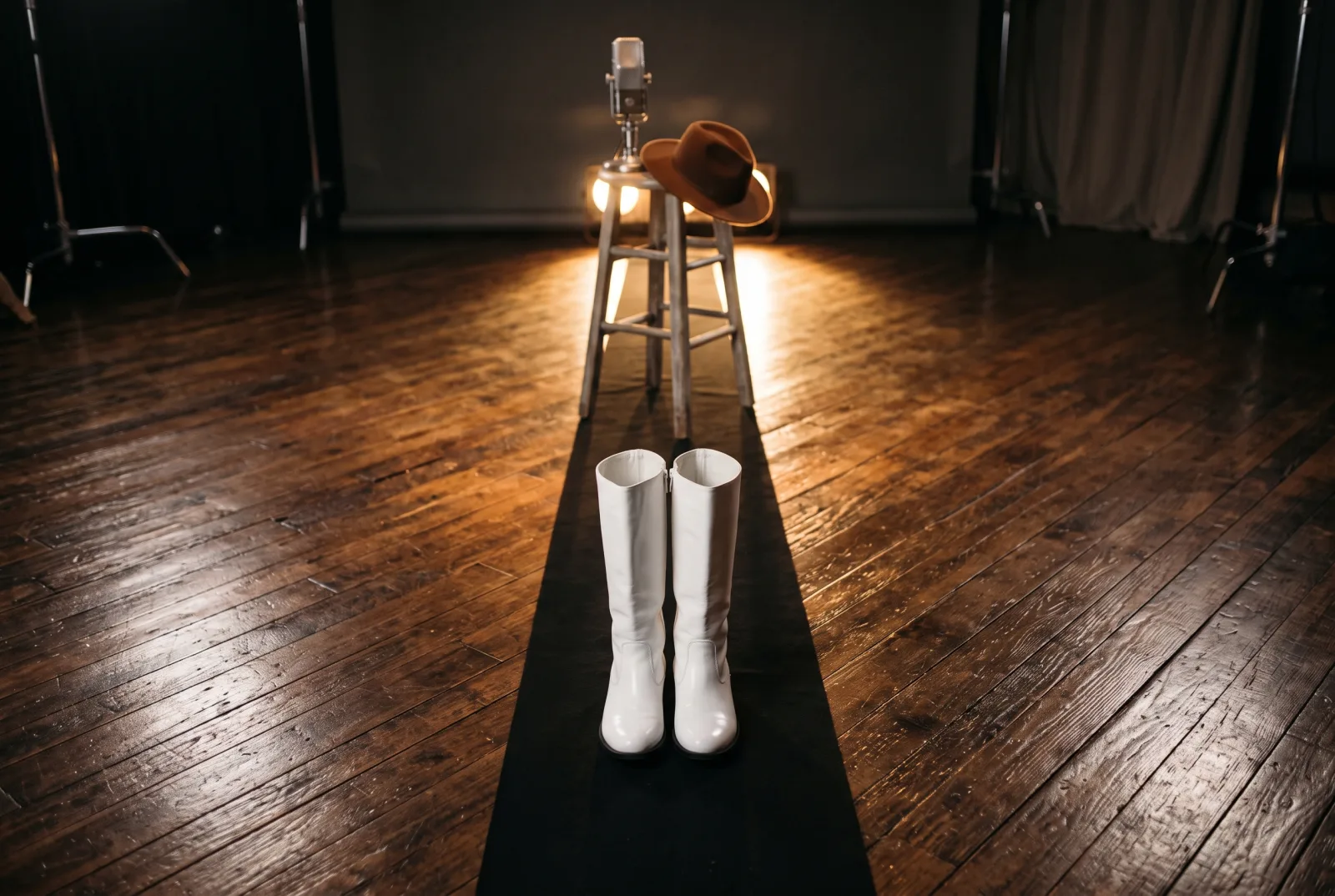
Ilustración: Rebobinados
Being the child of a legend is a sentence disguised as a privilege.
Everything you do gets measured against the giant. And it will always look like you got there on the surname.
Nancy Sinatra carried the heaviest surname in American popular music. She shook it off with a pair of boots.
The song her father would never have sung
She recorded "These Boots Are Made for Walkin'" on 19 November 1965, in Hollywood, with musicians from the Wrecking Crew. Lee Hazlewood wrote and produced it. It came out in December and went to number one in 1966.
And it was the exact opposite of everything Frank Sinatra stood for.
No elegance, no romance, no wounded gentleman. A brazen song, with a bass line that walks, and a warning: a woman tells a man who has been cheating on her to brace himself, because these boots are going to walk right over him.
She was not the woman who waits. She was the one who gives fair notice and leaves, stomping.
With the miniskirt, the tall boots and that voice halfway between innocent and dangerous, she became the image of a new kind of femininity, freer and more sure of itself, just as the world was starting to change for women.
And here is the decisive part: nobody could hand that hit to her father. Frank Sinatra would never have sung anything like it. It was her territory and nobody else's.
It was number one in the United States and the United Kingdom, and in a good dozen other countries. Worth being precise, because people tend to say "all over the world", and no: in West Germany it stopped at two, in Italy at three and in France at thirteen.
The only father-and-daughter number one
Once she had made herself independent, they did something lovely: they sang together.
They recorded "Somethin' Stupid" on 1 February 1967 — a song by C. Carson Parks, produced by Jimmy Bowen and Lee Hazlewood — and it went to number one.
And here is a detail the usual telling misses: in the United States it is the only number one in history sung by a father and a daughter. Not "one of the few". The only one.
Some people found a romantic duet between father and daughter odd. The affection and the ease with which they did it won out, and it stayed a classic.
A point of accuracy about "Bang Bang"
"Bang Bang (My Baby Shot Me Down)" is often cited as another of her jewels, and it is worth being exact: it is a cover.
Sonny Bono wrote it for Cher, who released it first, in February 1966, and took it into the American top three. Nancy's is an album track from "How Does That Grab You?", from that same year, and was never issued as a single.
Her reading of it is magnificent, and decades later Quentin Tarantino rescued it for the opening titles of "Kill Bill Vol. 1", in 2003, introducing it to a whole generation.
But in an article about making a name of your own, you have to say who each thing belongs to.
What to remember
Nancy Sinatra is the proof that you can carry a giant's surname and still make a name, if you find the thing that makes you different.
Put on "These Boots Are Made for Walkin'", "Sugar Town" or the theme she sang for "You Only Live Twice" and you will hear an artist whose personality resembles her father's in nothing at all.
She could have been, forever, "Frank Sinatra's daughter": a footnote in somebody else's biography. Instead she found a song about boots that walk over whoever underestimates you, planted her feet, gave notice, and walked to a place of her own.
She is still with us; she turned eighty-six in June 2026.
Remember her this way: not as the daughter of The Voice, but as the woman who worked out that the only way out of a shadow is to step on it.
Sources
Nancy Sandra Sinatra, born in Jersey City, New Jersey, on 8 June 1940, the eldest daughter of Frank Sinatra; she is still alive. It is worth noting that in September 2026 a hoax about her death circulated and was denied. "These Boots Are Made for Walkin'" was written and produced by Lee Hazlewood, arranged by Billy Strange, and recorded on 19 November 1965 at United Western Recorders (Hollywood) with musicians from the Wrecking Crew; it was released in December 1965 and reached number one on the Billboard Hot 100 and the UK Singles Chart in 1966, as well as topping the charts in Argentina, Australia, Canada, Denmark, Ireland, the Netherlands, New Zealand, Singapore and South Africa. Since it is often claimed to have been number one all over the world, it should be specified that it reached number two in West Germany, three in Italy and thirteen in France. "Somethin' Stupid", written by C. Carson Parks and recorded as a duet with her father on 1 February 1967 with production by Jimmy Bowen and Lee Hazlewood, reached number one in the United States, the United Kingdom, Australia, Austria, Canada, Ireland, Norway and South Africa, and is the only number one in the history of the Billboard Hot 100 performed by a father and a daughter. "Bang Bang (My Baby Shot Me Down)" was written by Sonny Bono for Cher, whose version was released in February 1966 and reached the American top three; Nancy Sinatra's version belongs to the album "How Does That Grab You?" (1966) and was not issued as a single, and it was used by Quentin Tarantino in the opening titles of "Kill Bill Vol. 1" (2003). She also performed the title theme of the film "You Only Live Twice" (1967). Frank Sinatra has a profile of his own in this series. Externally authored text, edited and verified for Rebobinados. Interpretations of the meaning of her work are offered as the author's reading. No song lyrics are reproduced, for copyright reasons. Information drawn from Wikipedia, Billboard, the Official Charts Company and other coverage.
Keep rewinding

10s
pop
Bruno Mars
Eleven names in the credits
"Uptown Funk" came out on 10 November 2014 with six writers and today it has eleven. In February 2015 The Gap Band's publisher filed a claim over "Oops Up Side Your Head" in YouTube's copyright system —there was never a lawsuit— and on 28 April five names were added, with 17 % of the publishing. It happened weeks after the "Blurred Lines" verdict, and the song had been fourteen weeks at number one.

00s
pop
André Rieu
It was not from the jazz suite
The waltz with which André Rieu reached half the world is not from Shostakovich's Suite for Jazz Orchestra No. 2: it is from the Suite for Variety Orchestra, which the composer did not assemble, and it was born in 1956 as music for a Soviet film about settlers in Kazakhstan. The error comes from a misprint in volume 10 of the complete works (Muzyka, Moscow, 1984), corrected only in 2001. And the title "The Second Waltz" was invented by his wife, because the real one did not sell.

90s
pop
Daniela Mercury
She took the neighbourhood out of the song
"O Canto da Cidade" was written by Tote Gira, a composer from Nordeste de Amaralina who recorded the demo on a borrowed cassette, marking the beat on the door of a refrigerator; Mercury's team almost threw the tape away. She shares the credit because she deleted the references to the Pelourinho so that the song would serve all of Brazil. The album, from 20 September 1992, sold more than 2 million copies and nationalised axé. But she did not invent it: the name was a journalist's insult in 1987.
Rewind with us
Comments · 0
No one has commented yet. Open the conversation.