
Phil Collins
The one at the back
By Rebobinados · Published on September 9, 2026
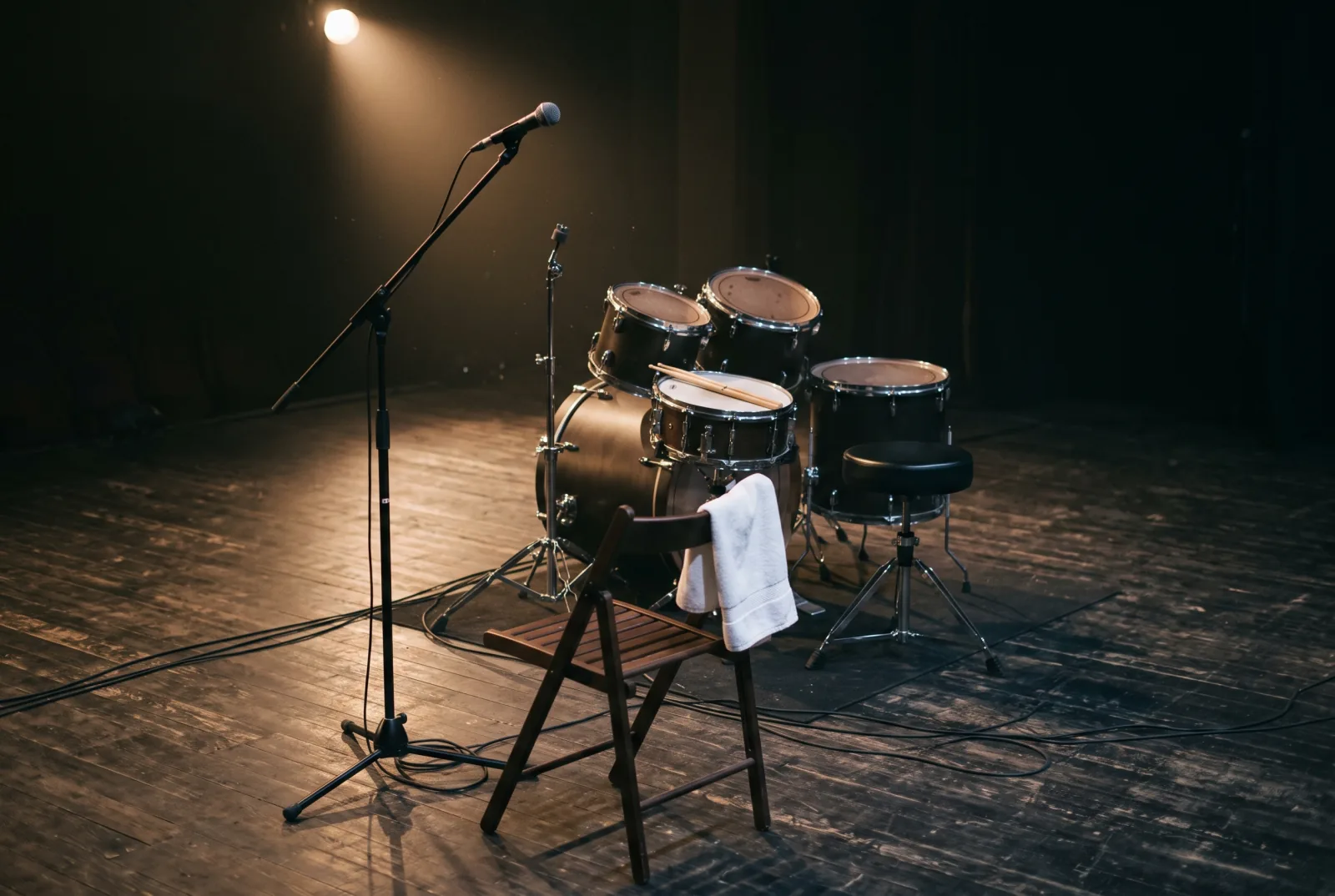
Ilustración: Rebobinados
When Peter Gabriel left Genesis in 1975, the band placed an anonymous advert in Melody Maker. They were looking, it said, for "a singer for a Genesis-type group". About four hundred replies came in. Several arrived with photographs: men in costume, wearing masks, posing as the man they wanted to replace.
None of them worked.
The drummer would sit in on the auditions, teaching the applicants the songs. One day in the studio a professional singer could not reach the notes on a track called "Squonk". Somebody had to put down a guide vocal so the shape of it was clear. The drummer volunteered, half reluctantly, and sang it.
That was the end of the search. The answer had been sitting at the back for five years.
The boy who turned up early
In 1970 Genesis needed a drummer and had advertised for that in Melody Maker too. A nineteen-year-old called Phil Collins turned up at Gabriel's parents' house in Chobham to try his luck. And he turned up early on purpose.
He waited outside for a while, listening to the other candidates struggle with the songs from Trespass. By the time it was his turn he knew them. Gabriel said afterwards that he could tell the moment Collins sat down: from the way he settled in front of the kit you could see he knew what he was doing.
It is a small detail and it says everything. Collins was not a lucky kid: he was a professional before he was old enough to be one. As a child he had acted — he played the Artful Dodger in the West End production of Oliver!, which he described as the best part a boy could get in all of London, until his voice broke mid-performance and he had to speak his lines for the rest of the show. He had been playing drums since he was five. And he was, without exaggeration, one of the most gifted drummers of his generation: he walked through the impossible time signatures of progressive rock as if strolling, and in his spare time played jazz fusion, which is the hardest music there is.
Certain European critics later allowed themselves to look down on him for how big he got. In Latin America that doubt never existed. Here Collins was always what he was: an enormous musician who also happened to sell records.
The accident that sounded like a decade
With him out front, Genesis pulled off what almost no band manages: it turned a catastrophe into its best years. From intricate art rock it moved to a perfect radio pop, all the way to number one with "Invisible Touch". They were really two bands with the same name, and we tell the other one in its own profile.
But his own story was only starting. In 1981, coming out of his first divorce, he released Face Value, and with it "In the Air Tonight": the most recognisable drum fill in pop, the one that arrives at three and a half minutes and that everyone identifies from the first note.
And that huge, cavernous sound — gated reverb — was an accident. It came out of an odd studio setup, an ambient microphone compressed and cut off dead, and once discovered it swallowed the whole decade. Every eighties drum sound you remember is chasing what Phil Collins found without looking for it.
Through the eighties he had more US Top 40 singles than any other artist. He won seven Grammys and an Oscar. And he was, on top of that, the kind of showman they no longer make.
Concorde day
Which brings us to the anecdote everyone tells and almost nobody finishes. At Live Aid in 1985 Collins played in London, boarded a Concorde, crossed the Atlantic and played in Philadelphia the same day. Nothing is more eighties than that.
What usually gets left out is how it ended. On the far side he sat down at the drums for the Led Zeppelin reunion, and it was a mess. The band later disowned the performance and asked that it not be released. Jimmy Page said Collins had not learned the parts. Collins replied that the band were not playing well and that he had felt uncomfortable. Both had a point and nobody came away happy.
It is worth writing down unrepaired, because Collins's career is full of moments that collective memory turned into a postcard and that were, live, considerably more human.
What his body charged him
Then came the bill. Three divorces — one of them announced, legend says, by fax, something he has been denying for decades without anyone believing him. Depression. A long fight with alcohol he described head-on in his memoirs, without playing the victim and without asking for mercy.
And the cruellest blow of all. Decades of drumming damaged his nerves and his spine. Operations, an injury that left him with a dropped foot, hands that stopped answering. The best drummer of his generation could no longer play the drums.
On his last tours he came out to sing sitting in a chair, without the strength to hold the sticks. And behind him, at the kit, sat his son Nic, playing the parts his father no longer could. Even the setlist was built to avoid the songs that leaned too heavily on the way he used to play.
Stop on that image, because it says everything: the man who gave a whole era its pulse, watching his own son carry that pulse for him.
Forty-six years to the day
The last show was on 26 March 2022, at the O2 in London. Genesis said goodbye there, with Collins seated at the front and Nic at the back.
That date was not a coincidence. It was the exact anniversary — forty-six years — of his first concert as the singer of Genesis, in London, Ontario, in 1976. The drummer who was pushed to the front closed the circle on the same calendar day he had opened it.
And backstage, that night, was Peter Gabriel.
Phil Collins is alive, retired, and was — without many people quite registering it — one of the most complete musicians of his time: a virtuoso hidden inside a pop star. If you only know "In the Air Tonight" from a meme or a film, put it on again, and this time do not listen to the singer. Listen to the one at the back.
That is the real Phil Collins. The one at the back, the one who did not want to sing, who ended up in front of everybody and earned it by playing.
Sources
Philip David Charles Collins (London, 30 January 1951), drummer, singer, songwriter and actor. As a child he acted and played the Artful Dodger in the West End production of "Oliver!"; he had played drums since he was five. He joined Genesis in August 1970 after auditioning at Peter Gabriel's parents' house in Chobham, Surrey, where he arrived early and listened to the other candidates before his turn. After Gabriel left in 1975, Genesis placed an anonymous advert in "Melody Maker" asking for "a singer for a Genesis-type group" and received around 400 replies, some with photographs of applicants in costume and masks; none worked out. During the "A Trick of the Tail" sessions (Trident Studios, October 1975) Collins recorded a guide vocal for "Squonk" and the band decided he should be the vocalist. On tour, Bill Bruford and later Chester Thompson played drums so that he could sing. Under his leadership Genesis turned towards pop and reached number one with "Invisible Touch" (1986). Solo, he released "Face Value" (1981), with "In the Air Tonight", whose drum sound uses gated reverb, a studio discovery emblematic of the eighties. He won seven Grammy Awards and an Oscar for "You'll Be in My Heart" (1999). At Live Aid (1985) he played in London and Philadelphia on the same day, travelling by Concorde, and took part in the Led Zeppelin reunion, a performance poorly received and later disowned by the band itself: Jimmy Page maintained that Collins had not learned the parts and Collins answered that the group were not playing well. He has spoken publicly about his divorces, his depression and his alcoholism. Nerve and spinal damage from years of playing prevented him from continuing to drum; on "The Last Domino?" tour he sang seated and his son Nic Collins took the drum stool, with a setlist that avoided the songs most dependent on his playing. The final concert was on 26 March 2022 at the O2 Arena in London, on the 46th anniversary of his first concert as the singer of Genesis (London, Ontario, 1976); Peter Gabriel attended backstage. Externally authored text, edited and verified for Rebobinados. Interpretations of the meaning of his work are offered as the author's reading. No song lyrics are reproduced, for copyright reasons. Information drawn from Wikipedia, Britannica and press coverage.
Keep rewinding

10s
pop
Bruno Mars
Eleven names in the credits
"Uptown Funk" came out on 10 November 2014 with six writers and today it has eleven. In February 2015 The Gap Band's publisher filed a claim over "Oops Up Side Your Head" in YouTube's copyright system —there was never a lawsuit— and on 28 April five names were added, with 17 % of the publishing. It happened weeks after the "Blurred Lines" verdict, and the song had been fourteen weeks at number one.

00s
pop
André Rieu
It was not from the jazz suite
The waltz with which André Rieu reached half the world is not from Shostakovich's Suite for Jazz Orchestra No. 2: it is from the Suite for Variety Orchestra, which the composer did not assemble, and it was born in 1956 as music for a Soviet film about settlers in Kazakhstan. The error comes from a misprint in volume 10 of the complete works (Muzyka, Moscow, 1984), corrected only in 2001. And the title "The Second Waltz" was invented by his wife, because the real one did not sell.

90s
pop
Daniela Mercury
She took the neighbourhood out of the song
"O Canto da Cidade" was written by Tote Gira, a composer from Nordeste de Amaralina who recorded the demo on a borrowed cassette, marking the beat on the door of a refrigerator; Mercury's team almost threw the tape away. She shares the credit because she deleted the references to the Pelourinho so that the song would serve all of Brazil. The album, from 20 September 1992, sold more than 2 million copies and nationalised axé. But she did not invent it: the name was a journalist's insult in 1987.
Rewind with us
Comments · 0
No one has commented yet. Open the conversation.