
Poison
The laundromat ballad
By Rebobinados · Published on September 4, 2026
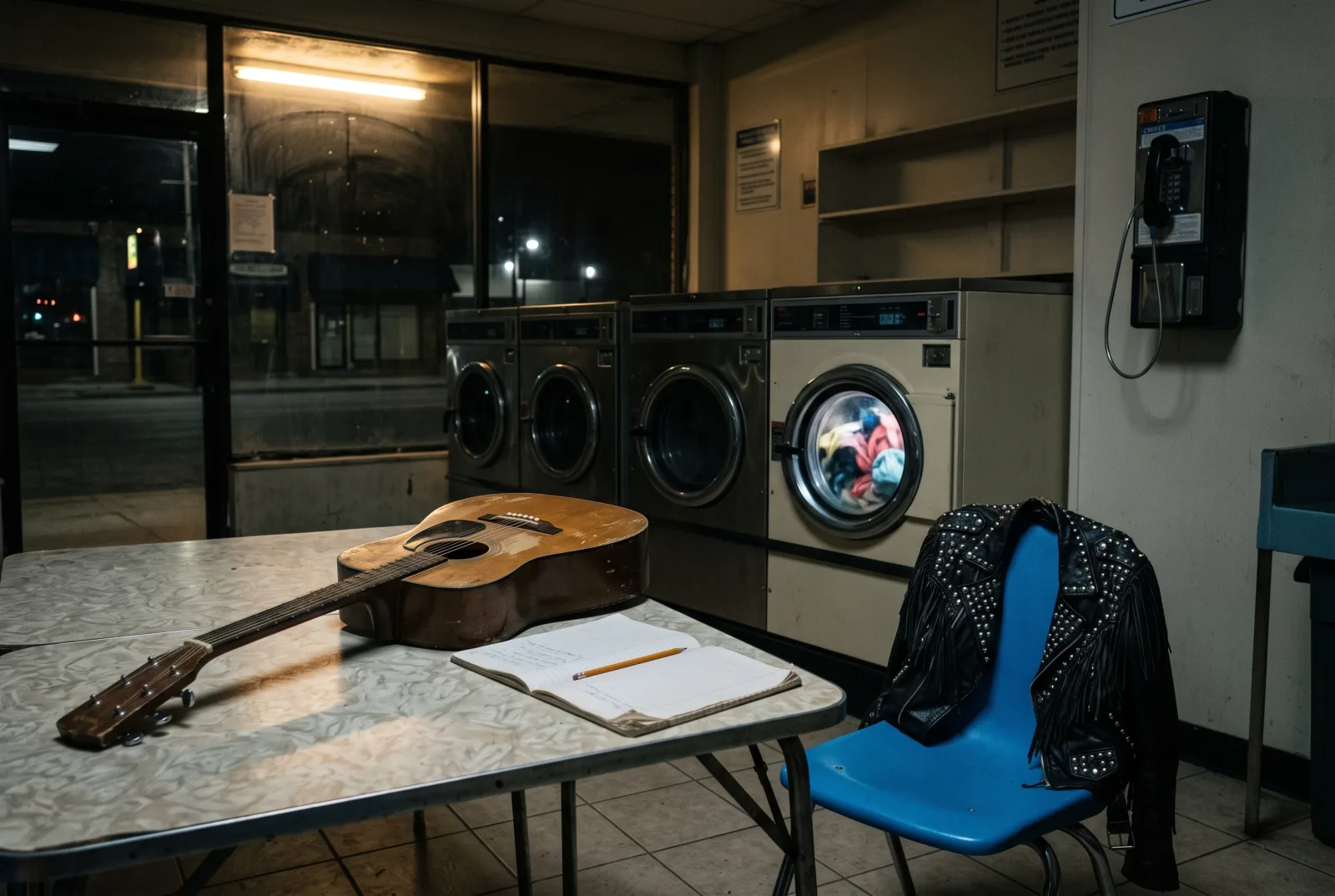
Ilustración: Rebobinados
Poison were one of the most exuberant bands in glam metal, that eighties rock of teased hair, make-up and an attitude of endless partying.
Coming out of the Sunset Strip scene in Los Angeles, where dozens of bands competed on sheer excess, they won that war with a simple formula: catchy songs about having a good time, a flashy look, and pure celebration.
And in the middle of all that excess they left behind a ballad born of real pain.
The party made band
Poison understood the spirit of their era better than almost anyone.
In the mid-eighties the Sunset Strip was a jungle of glam metal bands fighting for attention, in the same years when Bon Jovi was taking that aesthetic to stadiums from the other end of the country. Poison, led by the charismatic Bret Michaels, were not the most virtuosic nor the deepest, and never claimed to be.
They were the most fun.
Their songs — "Nothin' but a Good Time", "Talk Dirty to Me", "Unskinny Bop" — were anthems to partying and to carefree youth, made for jumping and shouting. They sold more than sixty million records and DVDs.
Their message fitted into the title of one of their hits: nothing but a good time.
They had been born in Mechanicsburg, Pennsylvania, in 1983, when they were still called Paris, with Michaels, Rikki Rockett, Bobby Dall and Matt Smith. C.C. DeVille, the guitarist who would give them their sound, joined in 1985, by then in Los Angeles, replacing Smith: they chose him at the auditions ahead of Slash, who would end up in Guns N' Roses.
The laundromat ballad
But the song that made Poison eternal is not a party one. It is the opposite.
"Every Rose Has Its Thorn" is a sad, acoustic ballad about a broken heart, and it has a real story behind it.
It is credited to all four of them — Bret Michaels, C.C. DeVille, Bobby Dall and Rikki Rockett — just like the rest of their hits. The one who tells where the words came from is Michaels.
He has told it like this: he was on tour, in a laundromat in Dallas, waiting for his clothes to dry. He called the girlfriend he had left at home from a payphone, and heard a man's voice on the other end.
The song came out of that.
It is worth attributing it to his account, because Michaels has told it many times with variations about where exactly he wrote the song. What stays the same in every version is the core: the laundromat, the phone, the voice that should not have been there.
The pain of that break-up, the loneliness of being far away, the sense that the price of life on the road was losing love, came out of a genuine moment of suffering.
The betrayal, though, has more than one version: Tracy Lewis, the woman in that story, has publicly said the opposite, that the one cheating was Michaels.
And that truth shows. In the middle of a repertoire of pure partying, this song connected with millions of people, reached number one on the Hot 100 on 24 December 1988 and stayed there three weeks. It was their only number one, and it is one of the best-loved ballads of the eighties.
The kings of shallow fun left their deepest mark when, for once, they sang their pain.
The end of an era
Poison's story is also the story of the end of an entire world.
In the early nineties, when grunge broke through with its rawness and its rejection of excess, glam metal collapsed. Suddenly the teased hair and the party songs looked ridiculous, everything the new generation despised.
The collapse was not instant — it took from '91 to '93 — but it was brutal, and many of those bands disappeared.
Poison almost broke apart from the inside at the same time. At the 1991 MTV Video Music Awards, C.C. DeVille walked on stage intoxicated and started playing the wrong song — "Talk Dirty to Me" instead of "Unskinny Bop" — out of tune, and at one point with his guitar unplugged.
The fist fight with Michaels came afterwards, backstage, and they fired him: he was replaced by Richie Kotzen and then Blues Saraceno, and DeVille did not return until 1996.
They survived, more modestly, as a band that filled shows with people who wanted to relive that party.
Not even that any more. The fortieth anniversary tour, planned for 2026, fell through: Rockett said that DeVille, Dall and he were willing, and that Michaels was asking for a disproportionate share. Poison do not tour.
Bret Michaels, besides, had a second life on television and came through serious health problems: he has been a type 1 diabetic since he was six, in April 2010 he suffered an emergency appendicitis and, ten days later, a subarachnoid haemorrhage; shortly afterwards a hole in his heart was found that had caused him an ischaemic event. He recovered from all of it.
What to remember
Poison are proof that making music for having a good time is a legitimate art, and that sometimes the most superficial band hides a profoundly truthful song.
Put on "Nothin' but a Good Time", "Talk Dirty to Me" or "Unskinny Bop", and you will hear the eighties party in its pure state: energy, fun, guilt-free hedonism, the kind of songs that force you to smile.
And if you put on "Every Rose Has Its Thorn", you will hear something else: the broken heart of a real man, written in a laundromat in Dallas, which turned out to be the most lasting thing they ever made.
They were the kings of an era that later became a laughing stock, they survived their own fall, and they left behind a handful of anthems of pure joy and a ballad that still makes people sigh.
They did not claim to be deep or eternal. They wanted people to have a good time, and they pulled it off.
In a world that sometimes takes everything too seriously, it is no small merit to be, without embarrassment, the party band.
Sources
Poison, American glam metal band formed in Mechanicsburg, Pennsylvania, in 1983 — previously called Paris, between 1980 and 1983 — by the singer Bret Michaels, the drummer Rikki Rockett, the bassist Bobby Dall and the guitarist Matt Smith; the group moved to Los Angeles and established itself on the Sunset Strip scene. C.C. DeVille joined in 1985 replacing Smith, chosen at auditions ahead of Slash. They were one of the most successful glam metal bands of the late eighties, with more than sixty million records and DVDs sold and party hits such as "Talk Dirty to Me" (number 9 on the Hot 100), "Nothin' but a Good Time" (6) and "Unskinny Bop" (3). Their ballad "Every Rose Has Its Thorn" reached number one on the Billboard Hot 100 on 24 December 1988 and stayed there three weeks, their only number one; according to Bret Michaels's account on VH1's "Behind the Music", the song is credited to all four members —Bret Michaels, C.C. DeVille, Bobby Dall and Rikki Rockett—, and the lyric came to Michaels while on tour, in a laundromat in Dallas, after calling his girlfriend from a payphone and hearing a man's voice in the background, although he has told the episode with variations about where he finally composed the song. The arrival of grunge caused the decline of glam metal between 1991 and 1993. After a fight with Michaels at the 1991 MTV Video Music Awards, C.C. DeVille was fired from the band and replaced by Richie Kotzen (1991-1993) and Blues Saraceno (1993-1996), returning in 1996. Bret Michaels later developed a television career and came through serious health problems: he has had type 1 diabetes since the age of six, suffered an emergency appendicitis on 11 April 2010 and a subarachnoid haemorrhage on 21 April of the same year, and in May 2010 a patent foramen ovale was found that had caused him a transient ischaemic attack. All the members are still alive. Bon Jovi and Guns N' Roses have their own profiles in this series. Externally authored text, edited and verified for Rebobinados. Interpretations of the meaning of their work are offered as the author's reading. No song lyrics are reproduced, for copyright reasons. Information drawn from Wikipedia, AllMusic, Rolling Stone, Good Morning America and other coverage.
Keep rewinding
90s
hard rock
Lenny Kravitz
He doesn't play that guitar
The riff of "Are You Gonna Go My Way" (9 March 1993) is not played by him: the guitar is Craig Ross's, the song is co-written with him and the Academy nominated them both for Best Rock Song in 1994. "Always on the Run" was written by Slash for Guns N' Roses. And one of his four straight male rock Grammys, the one of 23 February 2000, he won with "American Woman", by The Guess Who, from which he removed the guitar solo.

60s
hard rock
Steppenwolf
The motorcycle was a Ford Falcon
The century's biker anthem was not written by the band that sings it, and it was not about a motorcycle: Mars Bonfire wrote "Born to Be Wild" as a folk ballad about his battered Ford Falcon, and he had left the group in June 1967, before the name Steppenwolf existed. "The Pusher" is Hoyt Axton's, Easy Rider dropped it in as a temporary track, and the single stalled at no. 2 on the Hot 100 in 1968.
00s
hard rock
Thirty Seconds to Mars
The seven-year law
In August 2008, EMI sued them for thirty million dollars for breaching a 1999 contract they had signed before releasing a single record. They defended themselves with a Californian employment law that voids contracts of more than seven years, closed a settlement on 28 April 2009 and signed with the same label again. The Guinness record they ended up with is not a box-office one: it is three hundred and nine concerts on a single tour.
Rewind with us
Comments · 0
No one has commented yet. Open the conversation.