
Rage Against the Machine
Intelligent rage
By Rebobinados · Published on September 18, 2026
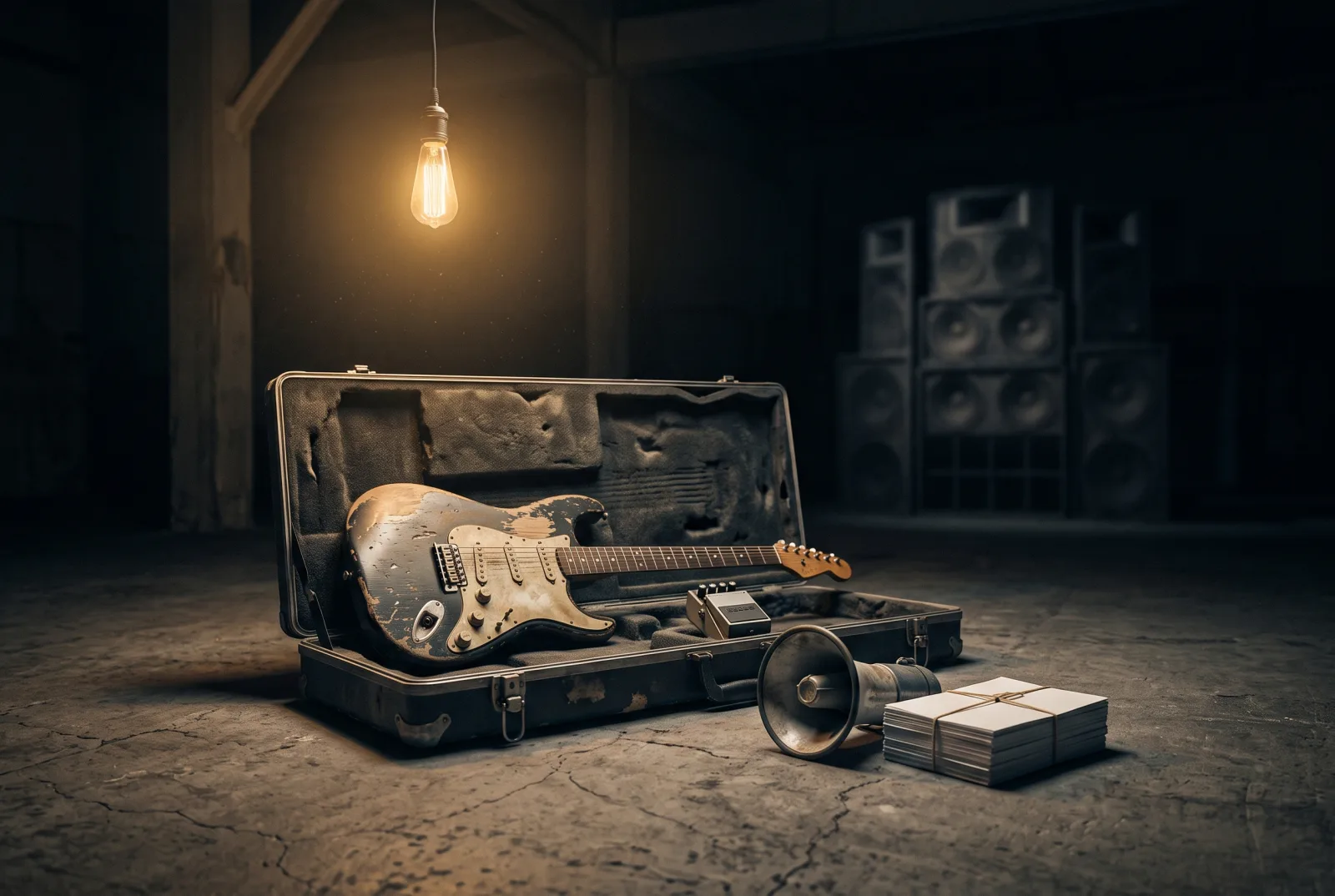
Ilustración: Rebobinados
Rage Against the Machine pulled off something almost nobody manages: they turned political fury into a mass phenomenon, without diluting it by a single drop.
They were rap, metal, punk and funk crashing into capitalism, police brutality and power, at stadium volume.
And millions of teenagers who had never read a political pamphlet felt, for the first time, rage as energy, and started asking questions.
Four stories that converge
The band formed in Los Angeles in 1991, and each of its four members brought his own.
Zack de la Rocha, the voice, was born in Long Beach and raised in Irvine, a white, conservative county where he suffered racism for his Mexican background. He is the son of Robert "Beto" de la Rocha, a painter from Los Four, the first Chicano collective to exhibit in an American museum. That wound and that inheritance are in every word he screams.
Tom Morello, the guitarist, is the son of a Kenyan militant of the Mau Mau uprising and of an American teacher and activist, and on top of that he is a Harvard social studies graduate: an intellectual with a guitar.
With Tim Commerford on bass and Brad Wilk on drums, they built a machine.
The guitar that sounded like a turntable
And we have to talk about Morello's guitar, because it was a revolution in itself.
With a switch, a pedal and sheer nerve, he made his guitar sound like a scratched record, like sirens, like industrial machinery, like nothing anyone had heard before.
He was not imitating hip-hop: he was translating hip-hop into the language of an electric guitar. That sound, added to de la Rocha's furious rapping, defined an entire genre.
Real militancy
Their first album, in 1992, was a cannon blast: "Killing in the Name" — whose chorus of absolute refusal against racism and police brutality became an anthem — "Bombtrack", "Bullet in the Head".
Then came "Evil Empire" and "The Battle of Los Angeles", with "Bulls on Parade" and "Guerrilla Radio". They have sold more than sixteen million records worldwide.
But theirs was not only music: it was militancy.
They supported the Zapatistas of Chiapas, political prisoners such as Leonard Peltier and Mumia Abu-Jamal, the movements for immigrants' rights and against globalisation.
On 26 January 2000 they shot the video for "Sleep Now in the Fire" with Michael Moore on the steps of Federal Hall, opposite the New York Stock Exchange, without a permit. Security ended up closing the doors of the building and Moore was held for close to an hour. Over the years the story grew until it had them shutting down the whole Stock Exchange: that is disputed, and what is documented is that they closed the doors.
And in 2009, a campaign by two British fans on Facebook pushed "Killing in the Name" to the UK Christmas number one, with half a million copies in a week, to snatch it from the winner of a talent show. Seventeen years after its release.
The contradiction, head on
And here is what followed them always, and what has to be looked at without ducking it: they were a ferociously anti-capitalist band signed to a multinational, selling millions and getting rich on it.
Many accused them of hypocrisy. How do you scream against the system from the biggest label in the system?
The band's answer was deliberate and consistent: they chose to use the enemy's giant megaphone to push radical ideas into millions of kids who were never in their lives going to read a book about politics. They preferred to smuggle the message inside the mainstream rather than preach only to the already convinced.
Using the master's tools against the master.
Whether that is a stroke of genius or an impossible contradiction is a genuine debate, and everyone will have their own view. What cannot be denied is that it was a considered decision, not an oversight.
Wake up
And there is one place where that message found its perfect frame: the cinema.
In 1999, "Wake Up" — one of their fiercest songs, whose lyrics speak of how power silenced leaders like Martin Luther King — closes "The Matrix". It plays over the final scene, when Neo hangs up the phone, puts on his dark glasses and takes off to show humanity the truth that had been hidden from it.
The fit is perfect, almost miraculous: "wake up" is, in two words, the summary of everything Rage Against the Machine ever came to say, and it is exactly the order the film shouts at the viewer as the credits roll.
Millions of people all over the world heard Rage for the first time right there, in the cinema, without knowing that the song which had shaken them was a whole band telling them to open their eyes.
It fitted so well that the credits of the saga's second film carried another of their tracks, "Calm Like a Bomb".
The end and what came after
The band broke up in October 2000, over internal tensions about how decisions were taken. Ironic, in a group that preached horizontality.
De la Rocha left, and the other three formed Audioslave alongside Chris Cornell.
Over the years there were reunions and tours, and in 2023, after five nominations, they entered the Rock and Roll Hall of Fame. Only Morello went to the ceremony.
What to remember
Rage Against the Machine is the proof that rage can be intelligent, and that a rock band can be a genuine political force.
Four guys who turned rap-metal into a weapon and the charts into a platform.
The contradiction of screaming against the machine from inside the machine was real, and they owned it, betting that the message mattered more than the purity.
If you put on "Killing in the Name", "Bulls on Parade" or "Guerrilla Radio", you will hear fury with a cause made enormous and danceable: a band that got millions of kids to raise a fist and, more important still, to ask why.
Whether or not you share their politics, few bands believed so much in what they were saying, or made rebellion sound so good.
Sources
Rage Against the Machine, an American rock band formed in Los Angeles in 1991, made up of Zack de la Rocha (vocals), Tom Morello (guitar), Tim Commerford (bass) and Brad Wilk (drums); they fused metal, rap, punk and funk with anti-authoritarian and anti-capitalist lyrics. De la Rocha was born in Long Beach on 12 January 1970 and raised in Irvine; he is the son of the Chicano painter Robert "Beto" de la Rocha, of the Los Four collective. Morello, a social studies graduate from Harvard, is known for a guitar style that emulates turntables and effects by means of the pickup selector and the whammy pedal. Their self-titled debut album (1992) included "Killing in the Name"; it was followed by "Evil Empire" (1996, with "Bulls on Parade") and "The Battle of Los Angeles" (1999, with "Guerrilla Radio"). They have sold more than 16 million records worldwide, according to figures from 2010. On 26 January 2000, the shooting of the video for "Sleep Now in the Fire", directed by Michael Moore, on the steps of Federal Hall led security to close the doors of the New York Stock Exchange and Moore to be held for close to an hour; whether trading itself was halted is disputed among the sources. In December 2009, a campaign driven on Facebook by Jon and Tracy Morter took "Killing in the Name" to the British Christmas number one with some 502,000 copies in a week, ahead of Joe McElderry, winner of "The X Factor". Their song "Wake Up" plays over the final scene and the credits of "The Matrix" (1999), and "Calm Like a Bomb" appears in the closing credits of "The Matrix Reloaded" (2003). They were committed activists (the Zapatistas of Chiapas, Leonard Peltier, Mumia Abu-Jamal, immigrants' rights, the anti-globalisation movement). The band — criticised for the apparent contradiction between their anti-capitalist stance and their contract with a multinational, a tension they owned as a deliberate strategy — announced their split on 18 October 2000; Morello, Commerford and Wilk formed Audioslave with Chris Cornell. There were later reunions and they entered the Rock and Roll Hall of Fame in 2023, after five nominations, at a ceremony attended only by Morello. This text presents their political stance even-handedly, without endorsing it. Externally authored text, edited and verified for Rebobinados. Interpretations of the meaning of their work are offered as the author's reading. No song lyrics are reproduced, for copyright reasons. Information drawn from Wikipedia, Official Charts, Rolling Stone, Consequence and other press coverage.
Keep rewinding
10s
metal
Bring Me the Horizon
Twenty years to get back to the scream
Bring Me the Horizon started in 2006 with a deathcore record and their turn did not happen in 2013: the leap to metalcore was in September 2008 and the synthesisers and clean vocals arrived in October 2010. Jordan Fish, eleven years in the band, was the one who put in the electronics. On 10 July 2026 they re-recorded that first record for its twentieth anniversary, with Oli Sykes back on the guttural scream.
00s
metal
Staind
The sleeve that nearly cost them everything
In October 1997, Fred Durst tried to pull Staind off the bill at the Webster Theatre in Hartford over the sleeve of their home-made record; then he listened to them and signed them. In 2001, Break the Cycle debuted at number one on the Billboard 200 and "It's Been Awhile" spent sixteen weeks at number one on the Modern Rock. Jon Wysocki, founding drummer, died on 18 May 2024.
90s
metal
Marilyn Manson
The lawsuit he withdrew while paying
The triad of Antichrist Superstar, Mechanical Animals and Holy Wood, and a file that is still open: two out-of-court settlements, one sworn retraction, the prosecutor's office that ruled out charges in January 2025 on statute-of-limitations grounds, the defamation suit he withdrew while paying 327,000 dollars and a jury trial set for November 2027.
Rewind with us
Comments · 0
No one has commented yet. Open the conversation.