
Tom Morello
Six strings and a cause
By Rebobinados · Published on September 18, 2026
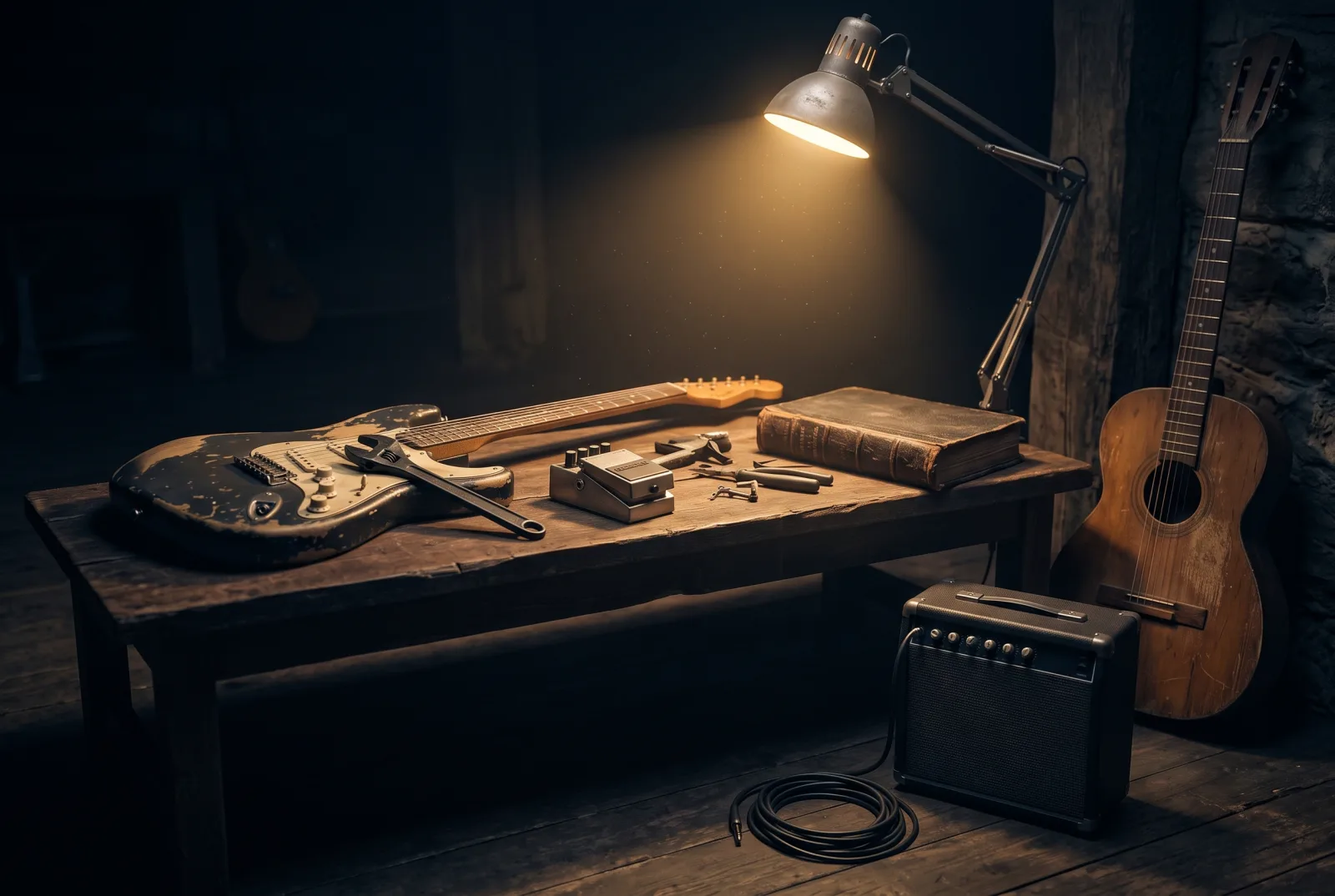
Ilustración: Rebobinados
Tom Morello is one of those artists whose life seems made up.
He is one of the most original guitarists in the history of rock, a man who does things with an electric guitar that had never occurred to anyone.
But he is also the son of an African guerrilla fighter and an American activist, a Harvard graduate, and one of the most politically committed musicians there is. And for us he has something special: he loves Chile, he has come several times, and he carries Víctor Jara wherever he goes.
A guitar that sounds like a machine
Let us start with what really matters: how he plays.
Morello reinvented what an electric guitar can do. He was not content to strum and pick; he turned the instrument into a box of impossible sounds.
With a simple switch that turns the pickups on and off, he makes the guitar sound like a DJ scratching a record. With a pedal and sheer nerve, he pulls siren shrieks out of it, industrial noises, machine howls. He has rubbed the strings with a spanner, used the cable as an instrument, made music out of pure feedback.
And the astonishing part is that he does it with minimal gear: almost all of it comes from his hands and his ingenuity.
On "Bulls on Parade", the solo is not a normal guitar solo: it is a turntable scratch played on six strings.
Nobody sounded like that before him, and many copied him afterwards. Rolling Stone places him among the greatest guitarists of all time, and not for speed — though he can play extremely fast too — but for pure imagination.
Morello does not play the guitar: he reinvents it every time.
A family out of a novel
And now the story, because it is one of the most incredible in rock.
He was born in Harlem in 1964, the son of two worlds that could not have been more different.
His father, Ngethe Njoroge, was Kenyan, took part in the Mau Mau uprising against the British empire, and later became a diplomat: he was part of Kenya's delegation to the United Nations in the mid-sixties and was his country's high commissioner in the United Kingdom during the seventies. He is related to Jomo Kenyatta, the independence leader and first president of Kenya, whom Morello calls his great-uncle.
His mother, Mary, was a white teacher from a town in Illinois, of Italian and Irish stock, and an activist to the core: she campaigned for civil rights and in 1987 founded Parents for Rock and Rap, a group against censorship in music. The two met at a pro-democracy protest in Nairobi.
But the fairy tale did not last: the father denied paternity and went back to Kenya when Tom was a year and a half old.
So Morello was raised by his mother, alone, in Libertyville, a white, conservative suburb of Illinois where she taught history at the high school and where he was one of the very few non-white children. He suffered racism from an early age: once a noose was found hanging in the garage of his house.
From there, from that mixture of insurgent blood and a childhood spent fighting not to feel like a stranger in his own town, comes all his music. His rage against injustice is not a pose: he drank it in at home and lived it in his skin.
Harvard, and the choice
Here comes the twist almost nobody would expect from a furious metal musician: Tom Morello studied at Harvard and graduated in 1986 in social studies, with honours.
He could have been a lawyer, an academic, a politician. In fact he worked for two years as scheduling secretary to the Democratic senator Alan Cranston.
But he understood something, and it is a lesson for anyone: that he could perhaps change more things with a guitar than from behind a desk.
He left institutional politics, moved to Los Angeles, and in the early nineties formed Rage Against the Machine with Zack de la Rocha, one of the most important and most political bands in history.
The Harvard intellectual chose the stage, and he was right: he spoke to millions of people no politician was ever going to reach.
Beyond Rage
When Rage split in 2000, Morello did not stop; on the contrary, he multiplied.
Alongside his bandmates and the singer Chris Cornell he formed Audioslave, a more melodic and less political group, which sold millions of records and left classics such as "Like a Stone".
At the same time he invented an alter ego completely at odds with his electric guitar god image: The Nightwatchman, with whom he went out alone, with an acoustic guitar, to sing folk protest songs, like a troubadour heir to Woody Guthrie and Bob Dylan.
Then he put together Prophets of Rage, a supergroup with members of Public Enemy and Cypress Hill. And he even got on stage as guitarist for Bruce Springsteen, one of his heroes.
For him, making music and fighting for his ideas are the same thing.
The activism
Because activism, in Morello, is not an accessory: it is the centre.
He has been on the front line of almost every cause of recent decades, from the free Tibet movement to Occupy Wall Street, from workers' rights to the protests against the Iraq war. He has played on picket lines, on marches, at strikes.
He genuinely believes that ordinary people should not wait for a leader to fix their lives, but organise to fix them together.
You may or may not share his politics — he is openly left-wing — but nobody can accuse him of being a drawing-room artist: he puts his body and his guitar where his mouth is.
Chile, and Víctor Jara
And here is the part that touches us closely.
Morello has a real bond with Chile. He came with Rage Against the Machine on 11 October 2010, to the Estadio Bicentenario de La Florida, in front of some twenty-seven thousand people: it was the only time that band played in the country. He returned with Prophets of Rage to the Movistar Arena in May 2017, and came back as a solo artist to the Teatro Caupolicán in June 2023.
At that 2010 show, in the encore, the band played "Canción del minero", by Víctor Jara, and dedicated it to the thirty-three miners who at that moment were still trapped underground: the rescue would begin two days later. Zack de la Rocha sang it, with Morello on guitar. They never played it again.
In 2017 he walked out onto the Movistar Arena stage with a patch on his guitar reading "Justicia Víctor Jara". And that same day he wrote that Jara is "one of my all time heroes" and "the Bob Dylan of Latin America".
What has to be told properly
But there is something that needs saying carefully, precisely because Morello has helped to spread it and because here it is our history.
When he tells of Jara's martyrdom, Morello has repeated the most widespread version: that the soldiers destroyed his hands and dared him to play the guitar.
The taunt is backed by the testimonies of survivors of the Estadio Chile, and the sentence for the crime held it proven that Jara was seen with his hands bloodied and deformed, his fingers evidently broken. That did happen.
What did not happen is the other thing, the part usually added: that they cut them off with an axe. That version was born in a press article in 1974 and spread around the world for fifty years, but neither of the two autopsies — not the one in 1973 nor the one in 2009, which counted forty-four bullet wounds — records any amputation. Morello himself has also told a variant involving a hammer, and has placed the events in the wrong stadium.
Joan Jara, who identified the body, always rejected that version with a phrase that says it all: the reality is horrific enough.
This is not a minor detail or a pedantic correction. That one of the greatest guitarists in the world should carry Víctor Jara's story and tell it in every corner of the planet is enormous, and for that very reason it is worth telling it exactly.
What to remember
Tom Morello is the proof that you can be an absolute virtuoso and, at the same time, a man with a cause; that the guitar can be an instrument and a tool at once.
Born of an African insurgent and an American activist, raised fighting racism, educated at Harvard and determined to change the world from a stage, he made his guitar sound like nobody else and always put it at the service of something bigger than himself.
If you put on "Bulls on Parade", "Killing in the Name", "Like a Stone" or one of his acoustic songs as The Nightwatchman, you will hear a musician who turned six strings into a new language, and that new language into a shout for those who have no voice.
When he comes back to Chile, go and see him. You will be standing in front of one of the greats, one who loves us back.
Sources
Thomas Baptist "Tom" Morello (Harlem, New York, 30 May 1964), American guitarist, singer, songwriter and activist, known above all for Rage Against the Machine and Audioslave (with Chris Cornell), for the supergroup Prophets of Rage and for his acoustic solo project The Nightwatchman; he has also played with Bruce Springsteen. He is the son of Ngethe Njoroge, a Kenyan who took part in the Mau Mau uprising against British rule, was part of Kenya's delegation to the UN between 1964 and 1966 and was Kenya's high commissioner in the United Kingdom between 1970 and 1979 — it is best to avoid the much repeated claim that he was the first Kenyan ambassador to the UN: that post was first held by Burudi Nabwera in 1963 — and of Mary Morello, an American teacher and activist who in 1987 founded the anti-censorship group Parents for Rock and Rap. His kinship with Jomo Kenyatta, first president of Kenya, Morello himself describes as "great-uncle"; Kenyan sources place it as a Kikuyu classificatory kinship rather than a direct link. The father denied paternity and returned to Kenya when Morello was around 16 months old; he was raised by his mother in Libertyville, Illinois, where she was a history teacher and where he faced episodes of racism. He graduated from Harvard in 1986 (Committee on Degrees in Social Studies, with honours) and worked as scheduling secretary to Senator Alan Cranston between 1987 and 1988 before devoting himself to music. He is celebrated for his innovative technique — use of the pickup selector to emulate a DJ, the whammy pedal, feedback and unconventional objects — and features among the greatest guitarists according to Rolling Stone. On Chile: he played with Rage Against the Machine on 11 October 2010 at the Estadio Bicentenario de La Florida, that band's only appearance in the country, in front of some 27,000 people; with Prophets of Rage at the Movistar Arena on 3 May 2017; and as a solo artist at the Teatro Caupolicán on 6 June 2023, a show billed under his own name and not as a Nightwatchman tour, although it included songs from that project. In the encore of the 2010 concert, the band performed "Canción del minero", by Víctor Jara — sung by Zack de la Rocha — dedicated to the 33 miners still trapped in the San José mine; the rescue began on the night of 12–13 October. On 3 May 2017, Morello posted that Jara was "one of my all time heroes" and "the Bob Dylan of Latin America", and wore a patch with the legend "Justicia Víctor Jara". On the murder of Víctor Jara: the testimonies of survivors of the Estadio Chile relate that the soldiers beat his hands and dared him to play, and the ruling of the Santiago Court of Appeal (Rol 4.160-2018, 23 November 2021), upheld by the Supreme Court on 28 August 2023, held it proven that he was seen "with his hands bloodied and deformed, his fingers evidently broken or fractured". The version that his hands were amputated with an axe has been traced back to an article published in January 1974 in the Argentine newspaper La Opinión and is rejected by historical research — the biographer Mario Amorós documents it as a myth — and by the autopsies of 1973 and 2009, the latter with 44 bullet wounds and no record of amputation; Joan Jara refuted it, pointing out that "the reality is horrific enough". Morello has spread a variant of that version, involving a hammer and set in the wrong stadium. Externally authored text, edited and verified for Rebobinados. Interpretations of the meaning of his work are offered as the author's reading. No song lyrics are reproduced, for copyright reasons. Information drawn from Wikipedia, Harvard Magazine, setlist.fm, Cooperativa, Emol, El Desconcierto, the Judiciary of Chile, Público and other press coverage.
Keep rewinding
10s
metal
Bring Me the Horizon
Twenty years to get back to the scream
Bring Me the Horizon started in 2006 with a deathcore record and their turn did not happen in 2013: the leap to metalcore was in September 2008 and the synthesisers and clean vocals arrived in October 2010. Jordan Fish, eleven years in the band, was the one who put in the electronics. On 10 July 2026 they re-recorded that first record for its twentieth anniversary, with Oli Sykes back on the guttural scream.
00s
metal
Staind
The sleeve that nearly cost them everything
In October 1997, Fred Durst tried to pull Staind off the bill at the Webster Theatre in Hartford over the sleeve of their home-made record; then he listened to them and signed them. In 2001, Break the Cycle debuted at number one on the Billboard 200 and "It's Been Awhile" spent sixteen weeks at number one on the Modern Rock. Jon Wysocki, founding drummer, died on 18 May 2024.
90s
metal
Marilyn Manson
The lawsuit he withdrew while paying
The triad of Antichrist Superstar, Mechanical Animals and Holy Wood, and a file that is still open: two out-of-court settlements, one sworn retraction, the prosecutor's office that ruled out charges in January 2025 on statute-of-limitations grounds, the defamation suit he withdrew while paying 327,000 dollars and a jury trial set for November 2027.
Rewind with us
Comments · 0
No one has commented yet. Open the conversation.